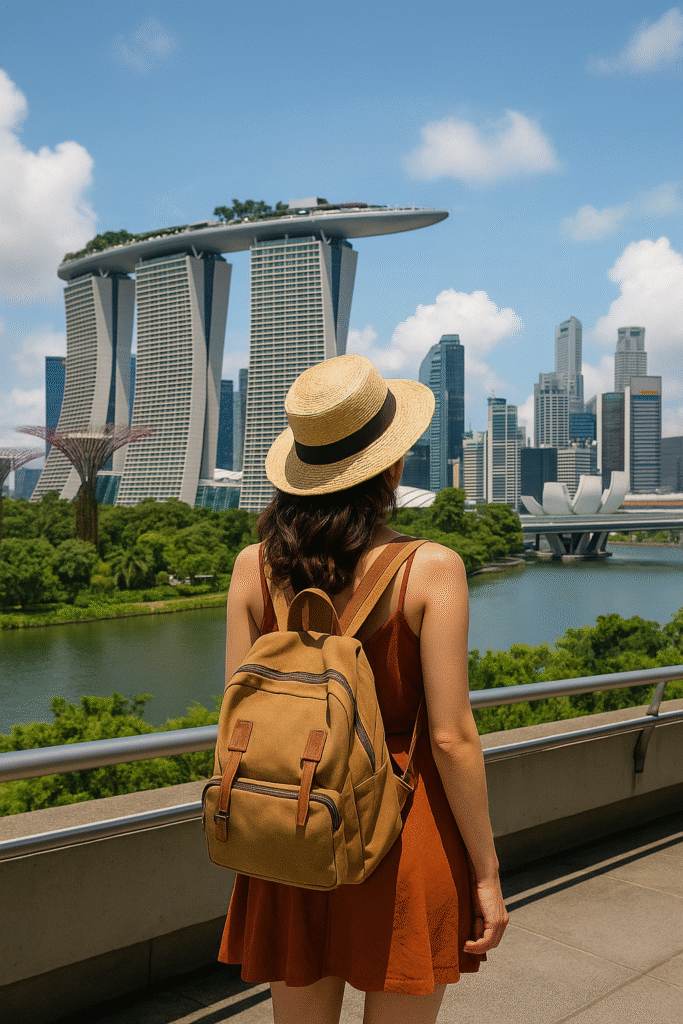

There is magic in solo female travel in Singapore, especially if you have ever dreamed of exploring Southeast Asia but felt a little nervous about taking the first step alone. It is both a soft landing and a springboard, a place that lets you test your independence without fear.
I will never forget standing in Changi Airport at 2 AM on my first night in Asia, clutching my backpack and wondering if I had made a huge mistake. Within hours, those nerves melted away. Singapore wrapped me in the warmest, safest embrace I could have imagined. Walking alone through pristine streets at 3 AM felt more comfortable than strolling through some neighborhoods back home.
That is exactly why I created this Singapore travel guide. To show other solo female travelers that this feeling is also possible for them.
Why Singapore Should Be Your First Solo Destination in Asia
Think of Singapore as your gateway to Asia, where safety, culture, order, and adventure blend in surprising ways. Have a look at these.
1. Unmatched Safety and Cleanliness
Singapore consistently ranks as one of the safest countries in the world. Stringent laws and a visible security presence contribute to a very low crime rate, which makes it reassuring for first-time solo female travelers to explore even at night.
Yes, it is famous for meticulous cleanliness and strict public order laws, including anti littering rules, but the result is a comfortable, pleasant environment where you feel looked after without feeling watched.
2. Seamless Navigation and Communication
The Mass Rapid Transit (MRT) subway system and bus networks are world class. They are clean, affordable, punctual, and connect virtually every key attraction you will want to see.
While on language, English is widely spoken and is one of the four official languages, alongside Malay, Mandarin, and Tamil. It is also the most commonly used language in business and administration, so you will not be stuck trying to translate every interaction.
You will occasionally encounter “Singlish”, a unique form of English mixing Malay, Chinese, and Tamil influences. Do not worry. Singaporeans easily switch to standard English when speaking with foreigners.
Also, the central areas and key attractions are often within walking distance of each other. So you can wander at your own pace without much planning.
3. Strategic Location and Cultural Mix
Often called the “Gateway to Southeast Asia”, Singapore’s Changi Airport, a major attraction in itself, is a crucial regional hub. Its location makes it a perfect first stop before venturing into Malaysia, Thailand, or Vietnam.
Singapore is also a vibrant melting pot of Chinese, Malay, Indian, and Western influences. The city gives you energy to explore distinct, colorful neighborhoods like Chinatown, Little India, and Kampong Glam, and you get to experience a diverse range of cultures and cuisines in a very compact, manageable area.
4. Solo Dining Is Standard
Hawker Centres like Maxwell Food Centre and Lau Pa Sat offer top tier, affordable food, including Michelin recognized dishes, in a relaxed, casual setting. Eating alone is completely normal and safe.
All you need to do is stick to local etiquette, including the “choping the table” system, which I explain later in this guide.
5. Abundant Solo Activities
You can fill your days wandering through stunning places like Gardens by the Bay and the Botanic Gardens, then switch to world class museums and art installations without ever feeling out of place or unsafe.
Why Singapore Works for Solo Female Travelers
If you are trying to figure out what to do in Singapore alone and what to eat as a solo traveler, this city gently rewrites your idea of solo travel. It does not have to feel lonely. It can be calm, bold, and deeply personal.
Singapore eases you into Asia gently. If you have never left Western countries before, jumping straight into the bustling chaos of Bangkok or the language barriers of rural Japan might feel overwhelming. Singapore bridges that gap beautifully.
It also builds your confidence for bigger adventures. My time in Singapore taught me that I could navigate foreign public transport, eat street food without getting sick, and handle being alone in unfamiliar places.
Hostels overflow with solo travelers eager to swap stories. Group tours and walking experiences create instant communities when you want company. At the same time, nobody questions why you are exploring alone, and nobody stares at solo female diners. The city respects your independence.
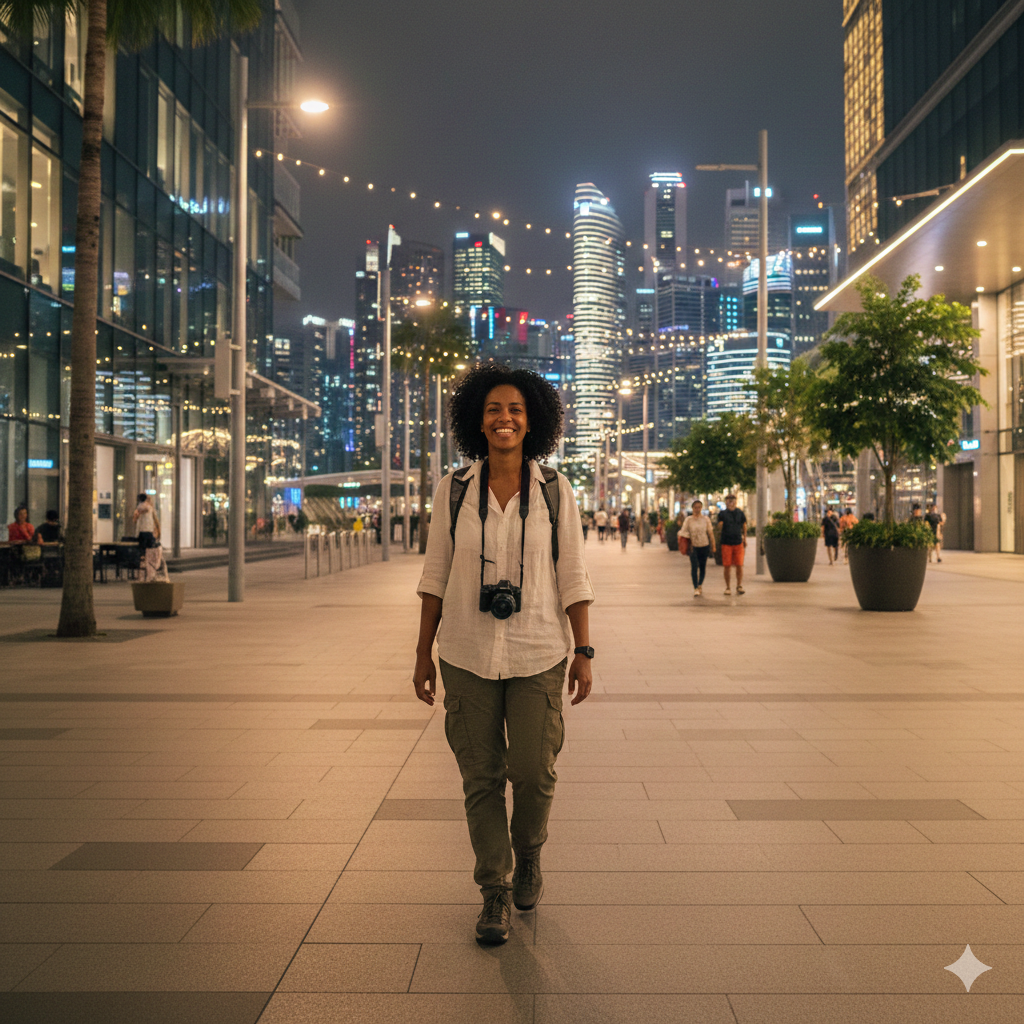
A clean, secure, well-lit street at night
Safety and Security
Walking at Night: You can move around the city after dark and still feel at ease. Streets are well-lit, sidewalks are clean, and public spaces feel secure even after midnight.
Public Transport Safety: The MRT and bus systems are heavily monitored by CCTV, impeccably clean, and often staffed. The last trains run until around midnight on weekdays and later on weekends, and stations feel safe and orderly.
Taxis and Ride Sharing: Use the Grab app or licensed taxis. Taxi meters are mandatory, which eliminates haggling and potential scams.
Petty Theft: This is extremely rare, but crowded tourist areas like Bugis Street Market can still attract opportunistic pickpockets. Wear your bag across your body with zippers facing inward, and you will be fine.
Essential Singapore Laws You Must Know
- No vaping or e cigarettes: Import, sale, and use of all vaping products are banned, and penalties are severe, including potential jail time.
- Littering means serious fines: Do not drop anything on the ground. Fines start at S$300, and repeat offenders face Corrective Work Orders.
- Chewing gum is banned: Importation and sale of chewing gum are prohibited, except for specific therapeutic gums.
- No eating or drinking on public transport: Fines are actively enforced, even for water, candy, and snacks.
- Zero tolerance for drugs: Singapore maintains an absolute zero tolerance drug policy with mandatory severe penalties.
- Jaywalking can be fined: Use pedestrian crossings and obey signals, especially in busy areas.
Emergency Contacts
Save these before you land.
- Police (Emergency): 999
- Ambulance or Fire: 995
- Police Hotline (Non Urgent): 1800 255 0000
- Anti Violence and Harassment Helpline: 1800 777 0000
Women Specific Safety Considerations
- Harassment is rare: Street harassment, catcalling, and unwanted attention are significantly less common in Singapore than in many Western cities. I did not experience any harassment during my stay.
- Dress code flexibility: Thanks to the multicultural mix, dress standards vary, and most styles coexist comfortably. Dress modestly when visiting temples or mosques, with shoulders and knees covered, and wear whatever makes you comfortable elsewhere.
- Late night safety: Many solo female travelers report feeling comfortable exploring late into the night. Busy nightlife areas like Clarke Quay remain lively and safe well past 2 AM.
Planning and Logistics
Before you book – is Singapore right for you?
Singapore is incredible, but it is not everyone’s dream destination, and that is perfectly okay. Travel is personal. What feels exciting for one person might feel sterile or pricey for another.
You might want to consider elsewhere if you are craving:
- Budget backpacking
Singapore is more expensive than Thailand or Vietnam. You can do it on a budget, but it is not a “10 dollars a day” destination. - Wild nightlife and party chaos
There are bars and clubs, but the energy is more polished than wild. If you want nonstop party vibes, you might be happier in Bangkok or Bali. - Untouched nature and rugged adventure
The city is beautiful and green, yet still a city. You will not find remote mountain treks or off-the-radar jungle expeditions here. - Total cultural immersion far from Western influence
Singapore is multicultural and global, which is amazing, but it is not a place to completely disconnect or experience a dramatic cultural shift. - The messy, chaotic version of Asia some travelers chase
If you want scooters weaving around you, constant haggling, and raw unpredictability, Singapore may feel a little too orderly.
Consider Singapore as your destination if:
- You are planning your first solo trip and want a destination that will not throw you into the deep end
- You are a seasoned traveler seeking a clean, efficient retreat between more challenging destinations
- You love food adventures and want to explore one of Asia’s most diverse culinary scenes
- You are building confidence for bigger Asian adventures
- You want efficiency, safety, and comfort without sacrificing culture
The Perfect Time to Visit Singapore
The sweet spot is March to May or September to November. These shoulder seasons offer relatively comfortable conditions. Temperatures hover between 26 and 30 °C (79 to 86 °F), rainfall is manageable, and tourist crowds thin out after major school holidays.
Skip June and December if you can. School holidays push prices up, sometimes by 30 percent or more, and popular attractions are packed with families.
What’s the weather reality check? Singapore is hot and humid year-round, with no true cool season. Temperatures rarely drop below 24 °C (75 °F) even at night, and humidity often reaches 80 to 90 percent. You will sweat constantly. That is normal.
How long should you stay? Most solo travelers find four to six days ideal. That gives you enough time to hit major attractions, explore several neighborhoods, enjoy leisurely hawker meals, and squeeze in a day trip without feeling rushed.
Visa, Entry, and Arrival
Singapore keeps things simple for visitors. Citizens from many countries, including most of Europe, North America, and large parts of Asia, get up to 90 days of visa free entry. Your passport must be valid for at least six months beyond your arrival date.
Well, every foreign visitor must fill out the electronic SG Arrival Card (SGAC) within three days before arriving. It is online, free, and takes about five minutes. Do not skip it.
Here’s what you need to show at the Immigration Office
- Passport valid for at least 6 months
- Proof of onward or return travel
- Evidence of sufficient funds
- Accommodation confirmation
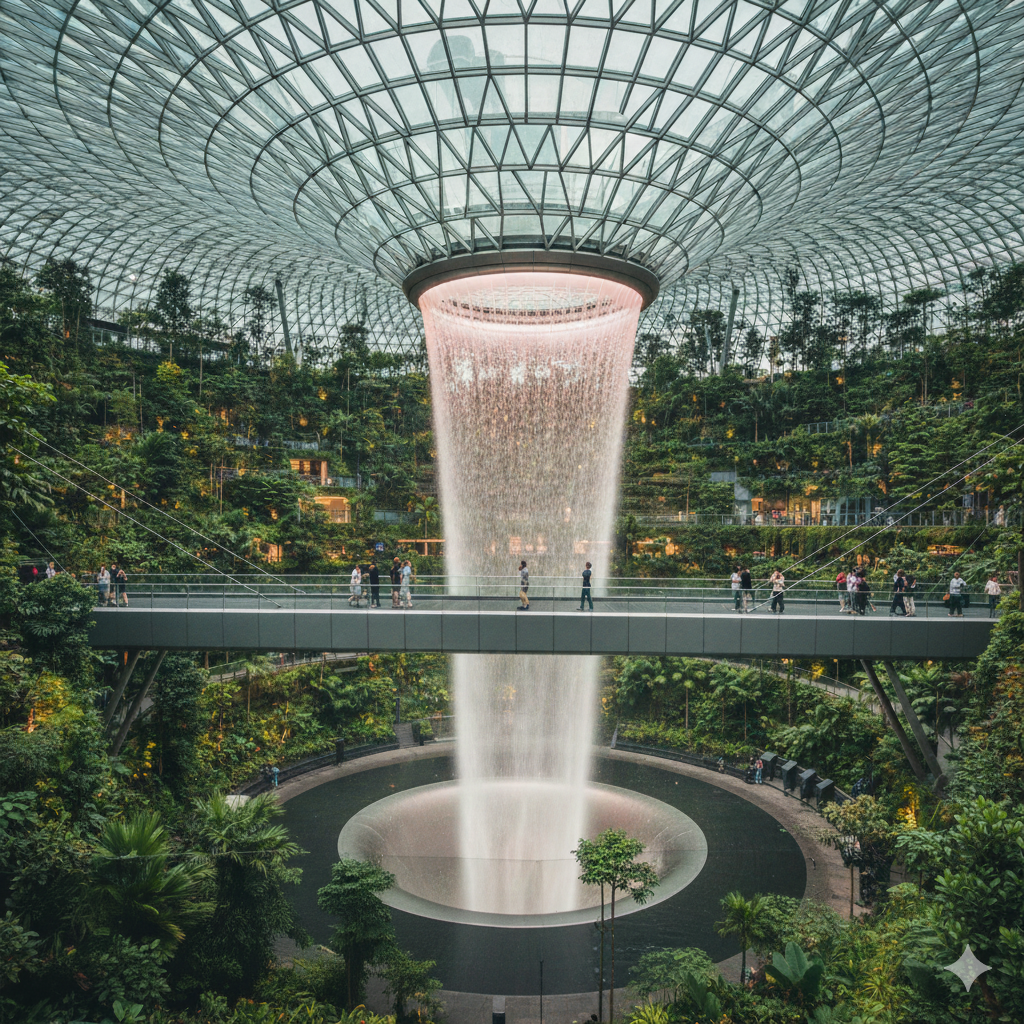
Indoor waterfall and lush forest inside Jewel Changi Airport in Singapore
From Changi Airport to the City Center
Landing at Changi Airport feels less like arriving at an airport and more like walking into a futuristic garden mall hybrid. Before you rush out, it helps to know what is there.
Here are airport highlights you will actually care about:
- Jewel Changi is built around the tallest indoor waterfall on Earth. You will probably stand there wondering why other airports are not trying this hard.
- Multiple 24 hour cinemas show recent films, and the movie theaters are free, which is ideal for long layovers.
- Baggage storage counters in Terminal 2 and 3 let you drop your bags and explore freely.
- If you have a layover of 5.5 hours or more, Changi’s Free city tours will take you sightseeing.
How To Get to Your Accommodation
MRT (Mass Rapid Transit) is clean, cheap, and straightforward. It gets you into the city in about 40 to 60 minutes for under S$3. Also, it’s perfect during day-time when you are alert and unhurried.
A Taxi or Grab is fast, direct, and comfortable. Taxis and Grab rides into the city take 20 to 30 minutes, with airport surcharges added. If you arrive late, feel exhausted, or just want air conditioning and a soft seat, this is worth every dollar.
Now, between the humidity, travel fatigue, and the shock of a new environment, the door-to-door ease of a taxi or Grab is sometimes the best gift you can give yourself.
How To Get Connected in Singapore
Buy a tourist SIM card at Changi Airport vending machines or from a 7 Eleven. Tourist packages often include generous data, sometimes 100 GB or more, which is plenty for navigation, translation, and staying in touch.
If your phone supports eSIM, services like Airalo offer Singapore data packages you can purchase before you leave home.
Here are the essential apps for every solo female traveler
- MyTransport.SG – real time transit information
- Grab – ride hailing and food delivery
- Google Maps – download offline maps
- SG Secure – official emergency app
- Google Translate – offline language packs
- WhatsApp – messaging with locals and businesses
On power and charging, Singapore uses Type G plugs (UK-style three-pin). Bring a universal adapter or pick one up at a 7 Eleven.
Money Matters: Understanding Costs
Singapore uses the Singapore Dollar (S$). ATMs usually offer the best rates and are widely available. Also, airport exchange counters work in a pinch, but the rates are not as favorable.
It’s good to note that credit cards are accepted almost everywhere, but it is still useful to carry some cash for hawker centers and smaller stalls.
Can I travel to Singapore on a budget? Yes. Though it’s more expensive than many Southeast Asian countries, it’s often cheaper than major Western cities if you are strategic.
Where Singapore costs more:
- Alcohol, which is heavily taxed
- Accommodation
- Western food and international chains
- Attractions and entertainment
Where Singapore surprises with affordability:
- Hawker center food
- Public transportation
- Many free attractions
- Healthcare and pharmacy items
What money-saving strategies should you know?
- Eat at hawker centers
- Use public transport
- Visit free attractions such as temples, parks, and the exterior of Gardens by the Bay
- Book attractions online for discounts
- Avoid obvious tourist trap restaurants
Accommodation Strategy: Choosing Your Neighborhood
I have stayed in a few different areas around Singapore, but I kept coming back to Chinatown. It has a warm, lived in energy that makes solo travelers feel grounded.
Let’s look at the main options.
- Chinatown – A perfect blend of culture, affordability, and accessibility. You get temples, markets, hawker food, and cozy capsule hotels within a few blocks. I loved ending my nights here with dessert or slow walks under lanterns.
- Marina Bay – The postcard skyline. It is polished, scenic, and close to major attractions, but also expensive and slightly curated.
- Little India – Colorful, lively, and full of amazing food. One of the best areas for budget stays, but it can feel intense and crowded, especially on weekends.
- Kampong Glam (Arab Street) – Indie cafés, street art, and Middle Eastern flavors. Stylish and very Instagram friendly, although accommodation options are more limited.
- Bugis – Central, well connected, and generally cheaper than Marina Bay. It is a practical, safe middle ground that still puts you near lots of action.
- Joo Chiat or Katong – Beautiful heritage neighborhoods full of Peranakan shophouses, quiet streets, and incredible local food, but farther from the big tourist attractions.
Here are the accommodation types for solo female travelers
- Capsule hotels – Modern, secure, and surprisingly comfortable. Lockable pods give you hotel style privacy at hostel prices.
- Hostels – Female only dorms are common. Great for meeting other travelers, joining free activities, and saving money.
- Boutique hotels – Cozy rooms, safe buildings, and personalized service, at a higher price.
My recommendation for a first-time solo traveler is a capsule hotel or highly rated hostel with female-only dorms in Chinatown or Bugis. Both neighborhoods offer:
- Safe, walkable streets
- A wide mix of local food
- Easy MRT access
- A friendly vibe that makes solo travel feel effortless
Things To Do in Singapore (What To Actually Do, See, and Eat)
Singapore rewards wanderers. The city is compact, walkable, and so safe that getting “lost” becomes an adventure rather than a risk. The worst that happens is you stumble upon an amazing hawker stall nobody told you about, discover a hidden temple, or end up chatting with locals at a neighborhood coffee shop.
The Perfect 4 Day Singapore Itinerary (Budget-Friendly Guide for First-Time Travelers)
Four days in Singapore is that sweet spot where you get to see the highlights, taste different neighborhoods, and still have slow moments that make the trip feel human rather than rushed. Here is how I would do it if we were planning this trip together.
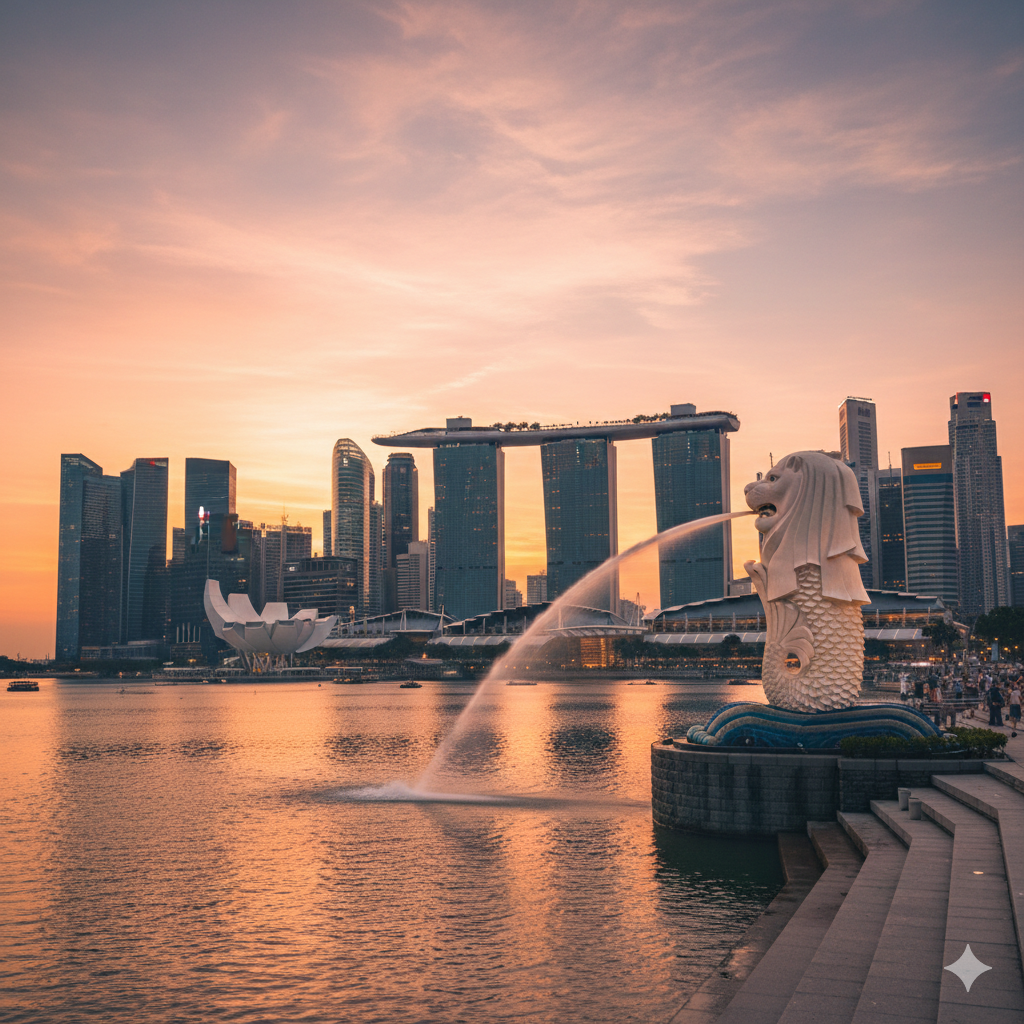
Marina Bay Sands and Singapore skyline viewed from Merlion Park at sunset
Day 1: Marina Bay and Gardens (The Instagram Essentials)
Touch down, freshen up, and ease straight into your 4-day Singapore itinerary by heading to Merlion Park, that iconic “I am really here” moment every traveler needs. From there, wander along Marina Bay, letting the skyline rise around you like a scene from a futuristic film. The lotus-shaped ArtScience Museum sits right at the edge, an instant stop for every first-timer following a Singapore travel guide.
By midday, Lau Pa Sat pulls you in with smoky satay, one of the best introductions to hawker centers in Singapore. Affordable, lively, and delicious, it sets the tone for exploring Singapore on a budget.
When you are ready, drift over to Gardens by the Bay. The outdoor gardens are free, which is perfect if you are searching for free things to do in Singapore, while the Cloud Forest, with its misty waterfall and spiraling walkways, remains one of the coolest indoor spaces on the planet.
As the sun dips, stay for the Supertree Grove light show before wandering back toward Marina Bay for the Spectra water show. Wrap up your night at Maxwell Food Centre with Hainanese chicken rice, an essential for any Singapore food guide, then stroll through Chinatown’s lantern glow.
Day 2: Cultural Immersion in Chinatown, Little India, and Kampong Glam
Start your morning like a local with kaya toast and kopi, simple staples that belong in every first-timer guide to Singapore. Chinatown is where your deeper cultural dive begins. Visit the Buddha Tooth Relic Temple, walk to heritage shophouse lanes, and step into Sri Mariamman Temple. It’s a stop that appears on many best places to visit in Singapore lists.
When hunger returns, head upstairs at Chinatown Complex Food Centre for char kway teow, a smoky classic beloved across the city.
Little India adds another burst of color to your Singapore travel itinerary. Visit Sri Veeramakaliamman Temple and explore the 24-hour maze of Mustafa Centre. While here, grab that bright, photo-ready moment at the House of Tan Teng Niah, a favorite for solo travelers.
A masala dosa at Tekka Centre hits exactly the way you want it to on a warm Singapore afternoon.
As golden hour arrives, Kampong Glam becomes one of the most atmospheric places in the city. The Sultan Mosque glows softly while Haji Lane buzzes with indie energy. Dinner at a Middle Eastern spot completes a perfect day of Singapore cultural experiences.
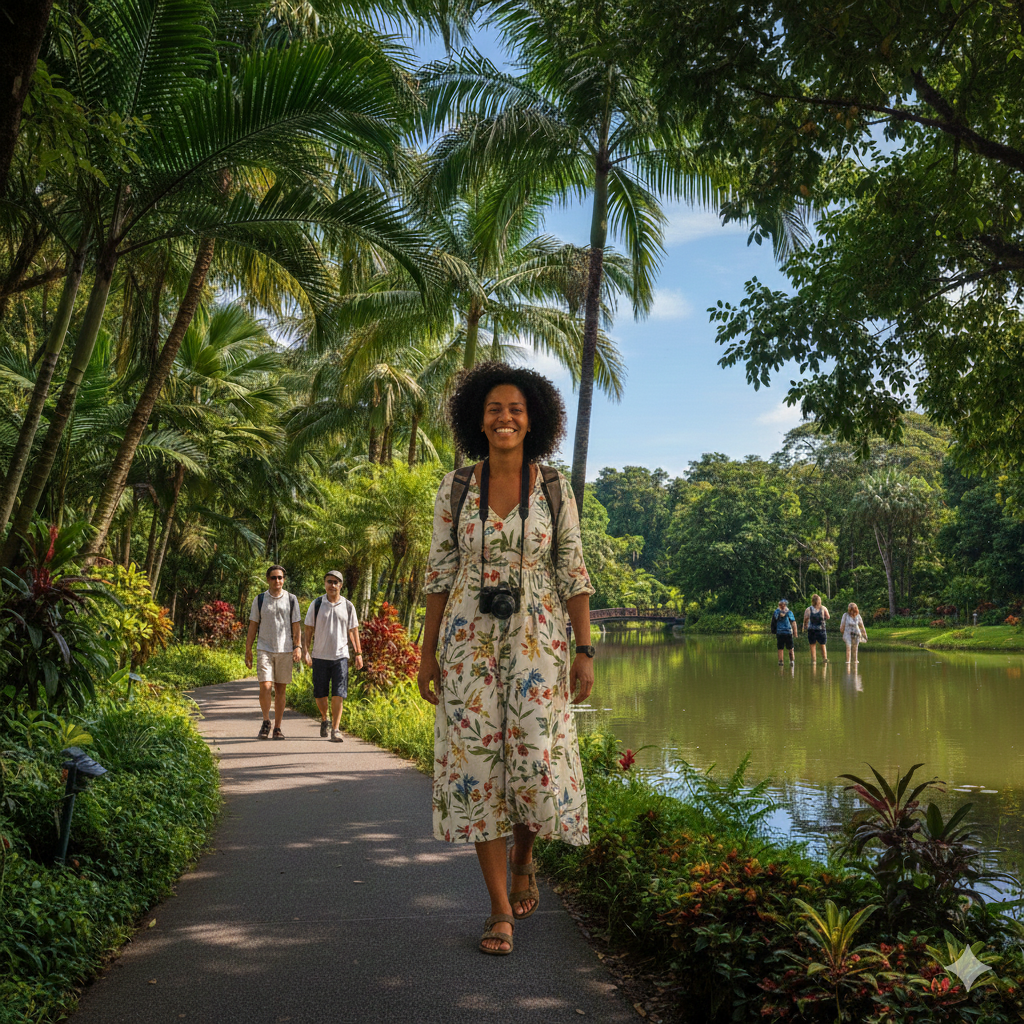
Lush pathway with palms and lake at Singapore Botanic Gardens
Day 3: Nature and Local Life Through Tiong Bahru and Botanic Gardens
Tiong Bahru is where modern cafés and old school charm blend effortlessly. Breakfast at Tiong Bahru Market is a must, and wandering streets lined with Art Deco architecture belongs in any Singapore itinerary for first-time visitors.
Next up is the Singapore Botanic Gardens, a UNESCO World Heritage Site that always ranks high among the best things to do in Singapore. If you want more, the National Orchid Garden, a small paid section, is worth the detour, especially for travelers hunting for budget Singapore travel that still feels special.
Your afternoon is a choose your adventure moment.
- Nature lovers can tackle MacRitchie Reservoir and its TreeTop Walk, one of the best free activities in Singapore.
- Photography lovers can head to Joo Chiat or Katong for pastel Peranakan shophouses, a must-do on many Singapore travel guides.
- Or you can rest, because every good itinerary leaves space to breathe.
End your night at Clarke Quay, where riverside views, neon reflections, and endless dinner options keep things lively without blowing your budget plan.
Day 4: Beach Escape and Final Favorites
Today is about slowing down. Take the MRT and Sentosa Express to Sentosa Island, a highlight in any Singapore itinerary. Palawan Beach gives you that soft, relaxed beach morning: swim, nap, read, or simply exist. It is one of the easiest ways to enjoy Singapore on a budget without sacrificing beauty.
Lunch stays simple, either a packed meal or the Sentosa food court.
For your last afternoon, you can choose between:
- a scenic Singapore cable car ride
- the lush trails of the Southern Ridges, perfect for travelers searching for free things to do in Singapore
- or more beach time
Spend your final evening revisiting your favorite neighborhood and your favorite hawker stall. It is the perfect way to close a Singapore solo-travel. Slowly, warmly, and on your own terms.
Alternative Day 4: Pulau Ubin for Adventure Lovers
If you want something wilder, skip Sentosa and take a day trip to Pulau Ubin, a favorite among travelers searching Google for a Pulau Ubin day trip. Rent a bike, wander quiet forest trails, and explore the wetlands at Chek Jawa. It feels like a completely different country, yet it fits seamlessly into a budget-friendly Singapore itinerary.
Iconic Attractions – The Must Sees
Gardens by the Bay
Cloud Forest
Step inside the Cloud Forest and it feels like you’ve walked into a sci fi rainforest. A 35 meter indoor waterfall crashes down a lush, mist covered mountain, walkways spiral around the “cliff”, and the cool air hits you like a blessing after Singapore’s heat. This is easily one of the most memorable things to do in Singapore.
Flower Dome
Next door, the Flower Dome holds the title of the world’s largest glass greenhouse. Inside, you’ll find Mediterranean plants, seasonal displays, and themed exhibits that change throughout the year. It is less dramatic than the Cloud Forest, but still a lovely break from the humidity.
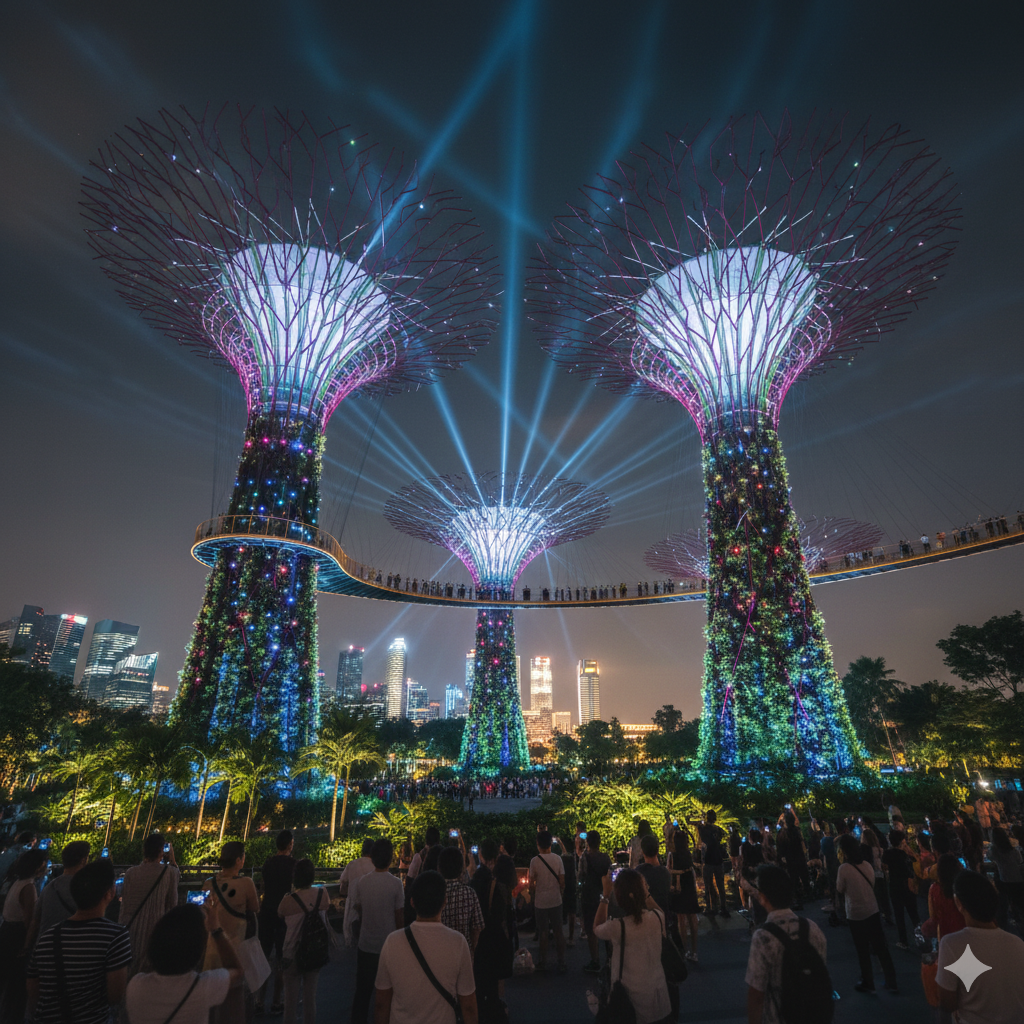
Supertree Grove lit up during Garden Rhapsody night show
Supertree Grove Light Show
Every evening, the Supertrees come alive during Garden Rhapsody, a free, 15 minute light and music show at 7:45 PM and 8:45 PM. Arrive about 20 minutes early if you want a prime spot lying on your back under the Supertrees, looking straight up into the lights.
Solo traveler tip
Visit the domes around 9 AM to dodge most of the crowds and soak up more air conditioning. Plan two to three hours for both Cloud Forest and Flower Dome. Bring a light jacket if you get cold easily.
Budget hack
Book tickets online in advance for discounts. If budget forces you to choose just one, Cloud Forest offers more “wow factor” for first time visitors following a 4-day Singapore itinerary.
Marina Bay Sands
SkyPark Observation Deck
If you are not staying at Marina Bay Sands, you can still pay to visit the SkyPark observation deck. The views stretch across the city, and sunset here is peak “I’m really in Singapore” energy.
Rooftop Bar Alternative
Instead of a straight ticket, many travelers opt for a drink at rooftop spots like CÉ LA VI or LeVeL33. Yes, drinks are pricey, but you get similar views, actual seating, and a cocktail in hand.
Infinity Pool Reality Check
The famous infinity pool is only for hotel guests. The good news? The view of Marina Bay Sands from Gardens by the Bay or Merlion Park is often more striking than the view from the hotel.
Spectra Light Show
Down at the Event Plaza, Spectra – a free water, light, and music show – plays nightly at 8 PM and 9 PM (and at 10 PM on weekends). It is a great way to end a Marina Bay Singapore evening without spending anything.
Merlion Park
The Merlion, Singapore’s half lion half fish mascot, is kitschy and smaller than you might expect, but the location is excellent. From here, you get textbook views of Marina Bay Sands, the ArtScience Museum, and the glittering waterfront skyline.
Solo tip
Arrive before 8 AM for a quiet, soft light moment, or after 9 PM when the crowds thin out. You only need about 15 to 20 minutes here unless you are really working that tripod.
Singapore Botanic Gardens – UNESCO Serenity
The Singapore Botanic Gardens spread over 82 hectares of lawns, lakes, palm lined paths, and shaded corners. Entry is free, and the whole place feels like the city took a deep breath and turned into a park.
The National Orchid Garden inside charges a small fee but is absolutely worth it if you love flowers or photography.
Why solo travelers love it
- Easy early morning walk before the heat peaks
- Plenty of quiet corners for reading or journaling
- Perfect place to reset if city energy feels intense
Wear comfortable shoes, bring water and sunscreen, and plan two to three hours. The gardens sit right next to the Botanic Gardens MRT station, so getting there is simple.
National Gallery Singapore
Housed in two beautifully restored colonial era buildings, the National Gallery is one of the largest museums of modern art in Southeast Asia. Its collection focuses on Singaporean and regional art, which gives you a strong cultural context for what you are seeing on the streets.
Solo advantages
- Free or low cost guided tours help you understand the stories behind the art
- Wandering alone means you can linger at pieces that grab you and skip what does not
- Rooftop bars and restaurants offer incredible city views if you want to combine culture with a drink
Check the website or onsite boards for which galleries are free and which exhibitions are paid.
Asian Civilisations Museum – Cultural Context
The Asian Civilisations Museum traces the histories and cultures of Asia, with standout collections on Peranakan heritage, Chinese trade ceramics, and Southeast Asian maritime trade.
When you walk back into Chinatown, Kampong Glam, or Little India after a visit here, you notice details – motifs, colors, architecture – that would have slipped past you otherwise. It turns neighborhoods into living museums instead of just pretty backdrops.
Neighborhood Deep Dives
These are the places where your Singapore travel itinerary stops being a checklist and starts feeling personal.
Chinatown – Layers of History and Flavor
Chinatown mixes temples, old shophouses, modern cafés, and markets into one walkable grid.
- Buddha Tooth Relic Temple: Free to enter if you dress modestly. Go early (around 7–8 AM) to hear monks chanting their morning prayers.
- Chinatown Street Market: Pagoda Street and nearby lanes fill with souvenir stalls. Touristy but fun for browsing and people watching.
- Chinatown Complex: A huge hawker center upstairs and a wet market downstairs. This is everyday life, not a show.
- Ann Siang Hill: Climb up into a pocket of chic bars and restaurants. It feels like a little city within the city.
Solo wandering tip
Let yourself drift away from the main streets. That is where you find quiet temples, old school coffee shops, and residents going about their day – the sort of details that never make “best places to visit in Singapore” lists, but stay with you.
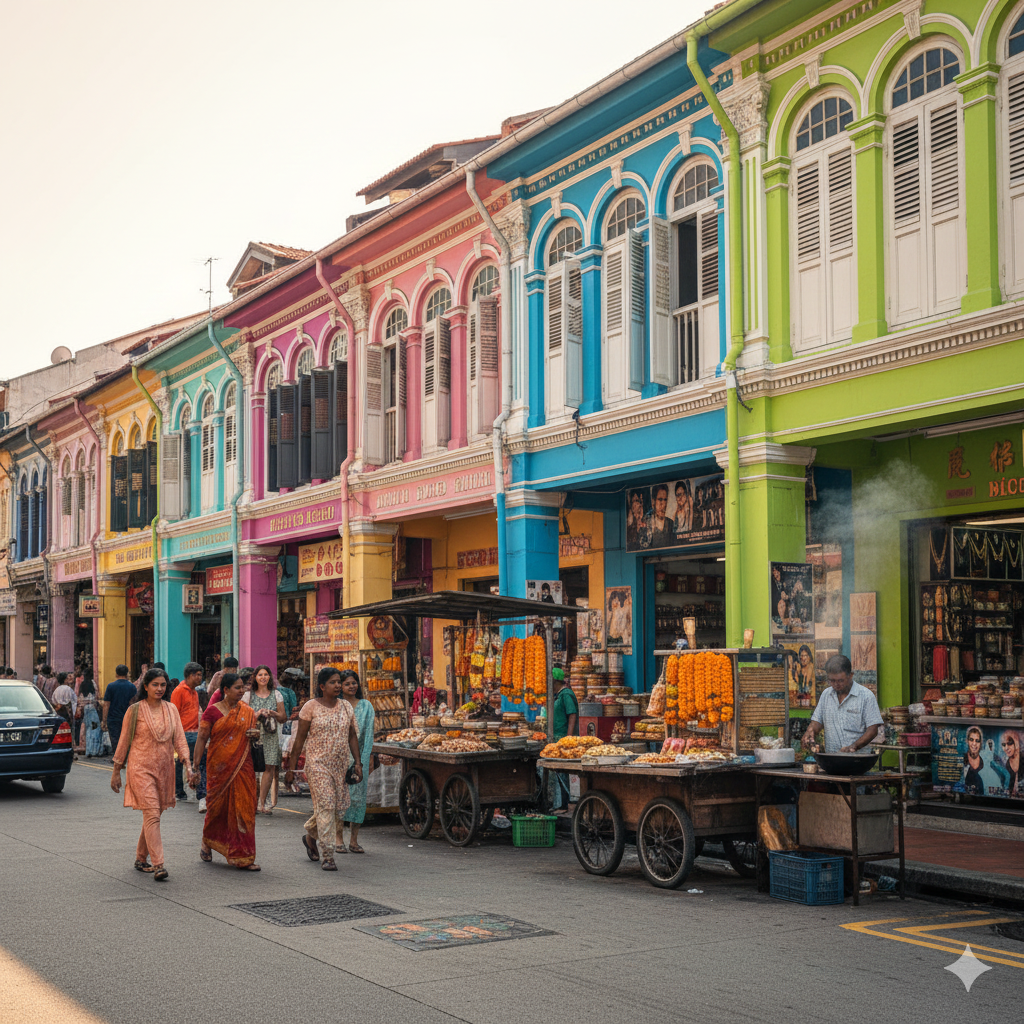
Colorful shophouses and vibrant street activity in Little India, Singapore
Little India – Sensory Explosion
Little India is one of the places that challenges the stereotype that Singapore is “too sterile”.
Incense, spices, temple bells, bright fabrics, and Bollywood music all swirl together here. It can feel intense, but in an energizing way.
- Tekka Centre: Affordable and incredible Indian food on the ground floor, plus a wet market upstairs. Weekends are wild and fun; weekdays are calmer.
- Sri Veeramakaliamman Temple: An ornate Hindu temple with a richly decorated gopuram (tower). Dress modestly, remove your shoes, and soak in the devotional atmosphere.
- Mustafa Centre: A 24 hour, everything under one roof shopping maze. Slightly chaotic, totally fascinating.
Solo safety note
Little India is safe, but weekend evenings can feel crowded and overwhelming. If you are sensitive to sensory overload, visit on a weekday morning first, then decide if you want the weekend version.
Kampong Glam – Arab Quarter Charm
Kampong Glam is compact, colorful, and very easy to explore alone.
- Sultan Mosque: Golden domes, green accents, and a sense of calm right in the middle of the city. Free to enter for respectful visitors with modest clothing.
- Haji Lane: A narrow alley of street art, indie boutiques, and cafés. Yes, it is Instagram famous. Yes, it is still fun.
- Arab Street and Bussorah Street: Textile shops, rug sellers, Middle Eastern restaurants, and shisha bars.
You can easily spend hours here just wandering, snacking, and popping into shops. It is one of the most solo friendly neighborhoods in Singapore, especially for café hopping and people watching.
Tiong Bahru – Quiet Local Cool
Tiong Bahru feels like a neighbor’s secret.
Art Deco buildings curve around leafy streets, aunties chat at the wet market, and indie bookstores and cafés tuck into old shophouses.
- Tiong Bahru Market: Excellent breakfast and lunch options on the upper floor.
- BooksActually: A beloved independent bookstore with a focus on local and regional writers.
- Cafés: The area is full of spots where you can linger with a book or your journal and nobody will rush you out.
It is one of the best places to get a sense of how people actually live in Singapore, beyond the big attractions.
Joo Chiat and Katong – Peranakan Heritage
If you have ever seen pastel shophouses from Singapore on Instagram, there is a good chance they were taken here.
- Koon Seng Road: A row of pastel Peranakan shophouses that look like a storybook street.
- Katong Laksa: Try laksa at 328 Katong Laksa – creamy, spicy comfort in a bowl.
- The Intan: A private Peranakan museum you can visit by appointment for a deeper look at this unique culture.
If you are staying more than a few days or want to go beyond the usual city center loop, this is a great neighborhood to add to your Singapore itinerary for first-time visitors.
Clarke Quay – Riverside Energy
Clarke Quay is Singapore’s nightlife district, sitting right along the Singapore River.
By day, it is quiet and good for riverside walks. After dark, the area lights up – literally – with colorful buildings, bars, clubs, and restaurants.
For solo female travelers, it is one of the safest places to experience nightlife. It is busy, well patrolled, and full of people late into the night. You can easily enjoy the atmosphere without drinking, or find a bar with live music and settle in.
Hidden Gems and Off the Beaten Path
These spots add texture to your Singapore travel guide, especially if you are staying five or more days or want to escape polished city surfaces for a bit.
Haw Par Villa
This is an outdoor theme park dedicated to Chinese mythology and folklore. Think life sized dioramas, vivid statues, and scenes that range from beautiful to downright bizarre.
The most famous part is the Ten Courts of Hell, which graphically depict traditional ideas of punishment for various sins.
It is free, hot, and often nearly empty – which only adds to the atmosphere. Bring water, sunscreen, and about an hour of curiosity.
2. The Southern Ridges is a 10 kilometer trail system that links Mount Faber Park, Telok Blangah Hill Park, and HortPark via elevated walkways and forest trails.
The star is Henderson Waves, Singapore’s highest pedestrian bridge, which curves like a wooden wave 36 meters above the ground and lights up beautifully at night.
For solo travelers, this is a safe, scenic way to see a greener side of Singapore. Trails are well marked, popular with locals, and lit in the evenings. Wear proper walking shoes, bring water, and budget three to four hours if you want to do a substantial portion of the route.
Pulau Ubin
Pulau Ubin feels like time travel. Just off the northeastern coast, this small island shows you what much of Singapore looked like decades ago: kampung houses, jungle, gravel paths, and quiet.
Getting there is straightforward: take a bus to Changi Point Ferry Terminal, then hop on a bumboat that leaves when 12 passengers are on board.
Once you arrive, rent a bicycle and explore. Visit Chek Jawa wetlands for mangroves and coastal boardwalks, roll past abandoned quarries, and enjoy how quiet everything feels compared to the city.
It is safe but basic: bring water, sunscreen, and cash. Going solo sometimes means waiting a bit longer for boats to fill, but that is part of the slow pace.
Fort Canning
This is a small, tree-covered hill in the city center with walking paths, spice gardens, colonial relics, and old military structures.
Highlights include the Battle Box (a former British underground command center), Fort Gate, and shaded lawns that are perfect for a midday pause.
Solo travelers like it because it is central, peaceful, and easy to slot into a day of sightseeing. Aim for morning or late afternoon if you want to avoid the heat.
MacRitchie Reservoir Park
MacRitchie Reservoir is one of the best places in Singapore to feel genuinely surrounded by nature.
The famous TreeTop Walk is a free 250 meter suspension bridge above the forest canopy. Trails range from easy 4 kilometer loops to more challenging 11 kilometer hikes.
It is popular with local hikers and runners, and safe to explore solo if you start early, bring plenty of water, and respect the heat. Monkeys appear frequently – do not feed them, and do not wave food or plastic bags around in front of them.
The Hawker Center Experience
If I had to explain Singapore in one experience, I would take you to a hawker center at dinner time. This is the heartbeat of Singapore on a budget: affordable food, casual atmosphere, and a cross section of everyday life.
Why solo travelers love hawker centers
- Nobody cares that you are eating alone – half the diners are
- Meals can cost less than a fancy coffee back home
- You can try multiple dishes by ordering from different stalls
- This is where locals really eat
- Ordering is easy – most stalls have photos and numbers
So, what’s the choping system?
“Chope” means to reserve your seat by placing a small item (usually a tissue packet, but sometimes an umbrella or water bottle) on the table. You do this before you queue for food.
It looks strange at first, but Singaporeans take this seriously. Do not move someone else’s tissue packet.
How to navigate your first hawker center
- Walk around and scout the options. Look for stalls with steady queues.
- Chope your seat with a tissue packet or small item.
- Join the line at your chosen stall, point if needed, and order.
- Collect your food or wait if they deliver to the table.
- Order drinks at a separate drink stall.
- Return your tray and dishes to the tray return station when you are done.
Top Hawker Centers for Solo Travelers
- Maxwell Food Centre (Chinatown) – Famous for Tian Tian Hainanese Chicken Rice, tourist friendly but still very local.
- Chinatown Complex Food Centre – More local, less polished, great for char kway teow and exploring.
- Tekka Centre (Little India) – Amazing Indian food on the ground floor, plus tons of local energy.
- Lau Pa Sat – A historic Victorian style market in the financial district, with satay stalls taking over the street at night.
- Old Airport Road Food Centre – Beloved by locals; farther out, but worth it for serious food lovers.
- Tiong Bahru Market – Great breakfast and lunch in a neighborhood you already want to explore.
What To Eat in Singapore
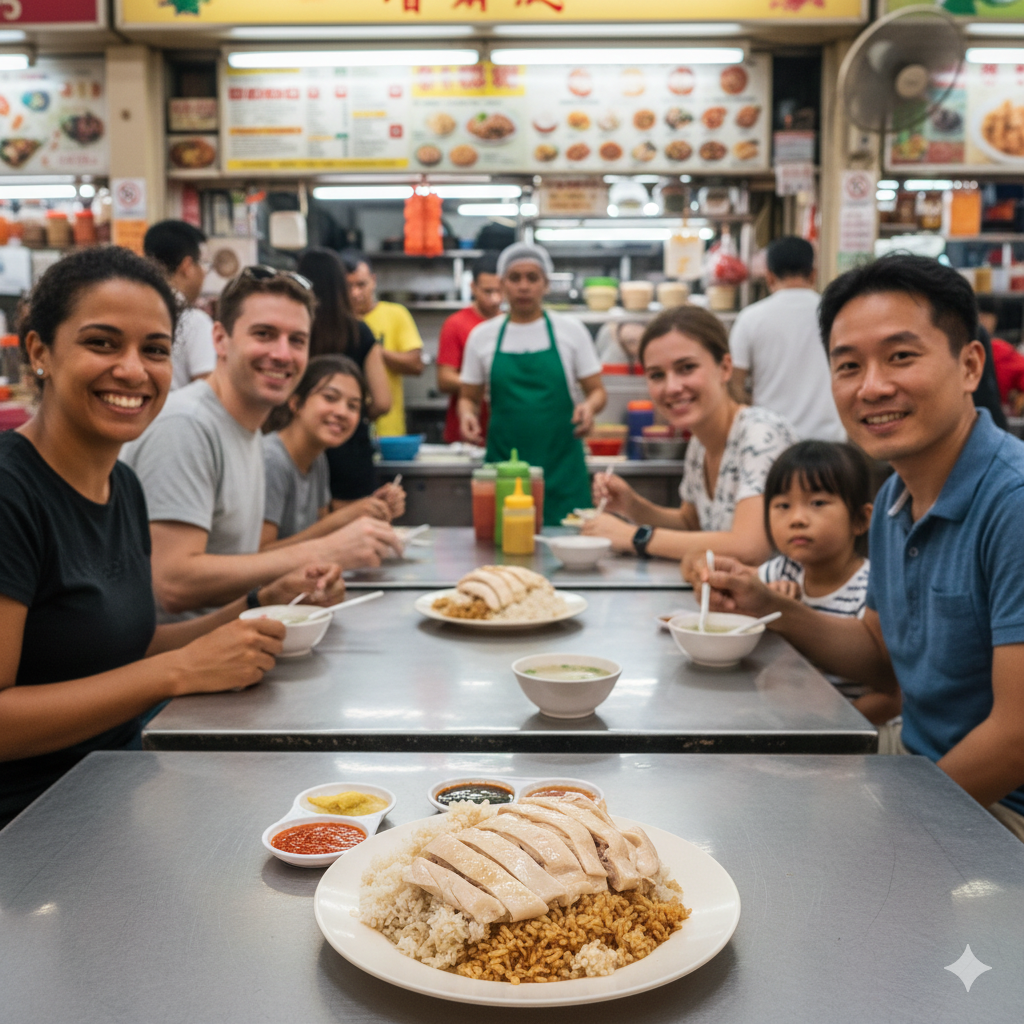
Plate of Hainanese chicken rice with chili sauce in a Singapore hawker centre
This is where your Singapore food guide really earns its name.
Hainanese Chicken Rice – The National Dish
Poached chicken, fragrant rice cooked in chicken stock, cucumber, chili sauce, and a ginger garlic mix. It looks simple, but when done right, it is comfort food perfection.
Where to try: Tian Tian at Maxwell, Boon Tong Kee, or any chicken rice stall with a consistent queue.
Laksa – Spicy Coconut Noodle Soup
Thick rice noodles in a rich coconut curry broth, with shrimp, fish cake, tofu puffs, and herbs. It’s spicy, creamy, and deeply satisfying.
Where to try: 328 Katong Laksa or Sungei Road Laksa.
Solo tip: Dress you do not mind splashing on. Laksa is gloriously messy.
Chili Crab – Singaporean Icon
Chili crab is messy, indulgent, and a must try if your budget allows. Mud crab is cooked in a sweet, spicy, eggy tomato based sauce that begs for bread.
Where to go: Jumbo Seafood or seafood places at East Coast.
Always order mantou (fried buns) to mop up the sauce – it is non negotiable.
Char Kway Teow
Flat rice noodles stir fried over high heat with egg, Chinese sausage, fish cake, and bean sprouts. The magic comes from wok hei, the smoky flavor that only appears with serious fire and skill.
Where to find: Hill Street Fried Kway Teow or any stall with a line and an older uncle wielding the wok.
Satay – Grilled Meat Skewers
Marinated meat grilled over charcoal and served with a rich peanut sauce, cucumber, and rice cakes.
Where to try: Lau Pa Sat’s satay street or East Coast Lagoon Food Village.
Order a mix of chicken, beef, and lamb in sets of 5 or 10 sticks and share with… yourself.
Nasi Lemak – Breakfast Favorite
Coconut rice served with fried chicken or fish, fried egg, anchovies, peanuts, cucumber, and sambal chili.
Where to go: Changi Village Nasi Lemak or Malay stalls at hawker centers around the city.
Kaya Toast with Soft Boiled Eggs – Breakfast Ritual
Thin toast with kaya (a coconut egg jam) and butter, served with soft boiled eggs, dark soy sauce, white pepper, and a cup of kopi.
Where to try: Ya Kun Kaya Toast or any traditional coffee shop.
Drinks and Desserts – Cooling Down in the Heat
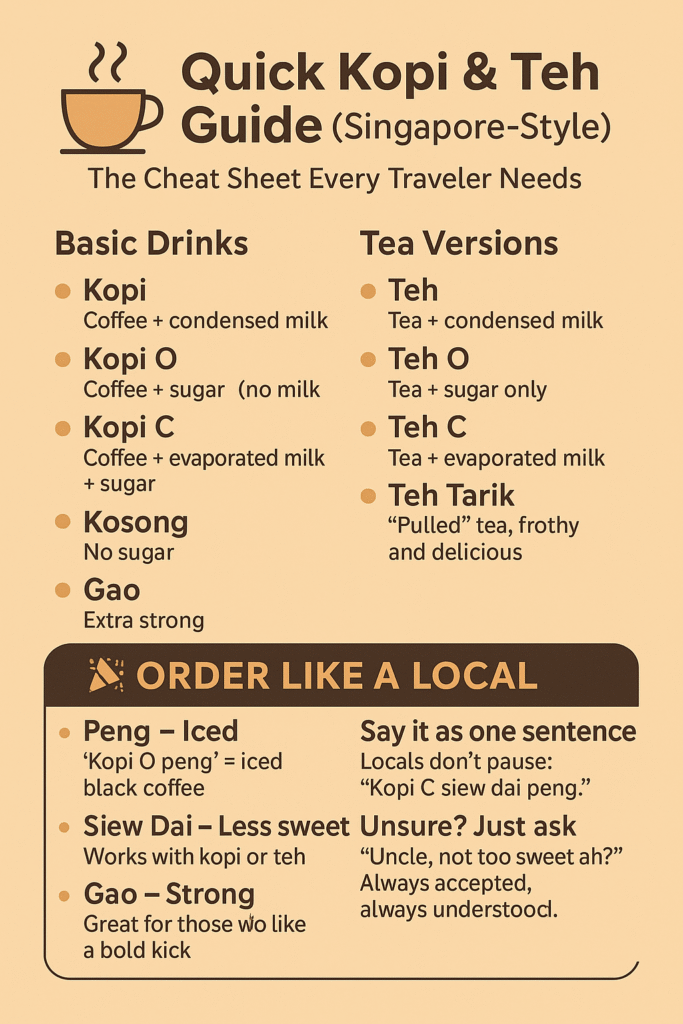
Kopi and Teh – Local Coffee and Tea
Singapore’s coffee and tea culture comes with its own ordering language. Learning how to order kopi like a local is a rite of passage and belongs in every first-timer guide to Singapore.
Order a kopi at a neighborhood coffee shop, sit at a plastic table, and just watch the morning unfold – uncles chatting, kids in uniforms, office workers grabbing a quick breakfast.
Ice Kacang – Shaved Ice Mountain
Ice kacang is a towering mound of shaved ice drenched in colorful syrups and topped with things like sweet corn, red beans, grass jelly, and condensed milk.
It looks chaotic and tastes like pure childhood nostalgia. Try it at hawker dessert stalls when the heat feels relentless.
Sugarcane Juice – Natural Energy
Fresh sugarcane stalks are crushed in front of you to make this light, sweet drink. Sometimes it comes with a squeeze of lime for extra freshness.
You will find sugarcane juice stalls at many hawker centers and markets. It is the perfect mid-day pick-me-up.
Chendol – Coconut and Palm Sugar Bliss
Chendol is made from pandan flavored jelly noodles, coconut milk, shaved ice, and gula melaka (palm sugar syrup), sometimes with red beans.
It is cold, creamy, and just sweet enough – exactly what you want after walking in 90 percent humidity.
Bandung – Rose Milk
Bandung is a bright pink drink made from rose syrup and milk or condensed milk. It is sweet, floral, and extremely photogenic.
You will see it at Malay and Indian stalls, especially at hawker centers.
Shopping, Spas, and Nightlife
Orchard Road – Shopping Mecca
Orchard Road is mall after mall after mall, stretched over roughly two kilometers. It is less about buying and more about having an air conditioned playground to duck into when the sun gets aggressive.
- ION Orchard, Paragon, Takashimaya – Big, shiny malls with global brands.
- Lucky Plaza – More budget friendly, with smaller shops and services.
Window shopping is free, and many malls connect via underground or overhead walkways, so you can wander for ages without stepping back into the sun.
Bugis Street Market – Budget Shopping
Bugis Street Market is where you go for cheap clothes, accessories, souvenirs, and phone cases.
It is covered, crowded, and full of energy. Haggling is expected, so do not be shy about offering 30 to 40 percent less than the first price.
It is safe, but this is one of the few places where you might actually need to keep an eye on your bag.
Bookstores for Solo Souls
Bookstores are underrated solo travel sanctuaries. Singapore has some lovely ones:
- BooksActually (Tiong Bahru) – Focus on local authors and small presses.
- Littered with Books – A cozy used bookstore, complete with resident cats.
- Kinokuniya – A huge Japanese bookstore chain with a massive English language section.
These are ideal for slow browsing, hidden air conditioning, and giving your brain a break from constant stimulation.
Spa and Wellness
Spas are naturally solo friendly – nobody expects you to show up with a friend.
- Budget: Foot reflexology and basic massage at neighborhood parlors can be surprisingly affordable.
- Mid Range: Traditional Chinese medicine spas with body massages, cupping, and herbal treatments.
- Splurge: Luxury hotel spas that cost a lot but deliver a full pampering experience.
A 60 or 90 minute treatment after a day of walking in the heat feels like restarting your body.
Nightlife for Solo Women
Singapore’s nightlife is one of the safest in the region for solo female travelers.
Clarke Quay is the main nightlife hub, with rooftop bars, riverside pubs, dance clubs, and quieter cocktail spots all clustered in one area.
Rooftop bars like LeVeL33, CÉ LA VI, 1 Altitude, and Lantern Bar give you city views with your drink. Yes, drinks are expensive – think of it as paying for the panorama.
Live music venues and late night hawker centers offer social energy without pressure to drink.
Use Grab to get home late at night, stay in well lit, busy areas, and trust your instincts.
Day Trips and Nearby Escapes
You have already seen Sentosa Island and Pulau Ubin in your 4 day Singapore itinerary and hidden gems section, but if you have extra time or want to extend your Singapore travel guide beyond the city core, these options help.
Sentosa Island – Resort Escape
Sentosa is Singapore’s playground: beaches, attractions, and resort hotels just across the water from the mainland.
- Palawan Beach – Quiet, family friendly, good for lounging.
- Siloso Beach – More beach bars, activities, and buzz.
- Tanjong Beach – Slightly more upscale and relaxed.
Get there via MRT to HarbourFront, then the Sentosa Express monorail, cable car, or walk along the boardwalk.
The beaches are free, and if you bring your own snacks and skip the big ticket attractions, Sentosa works nicely with a budget-friendly Singapore itinerary.
Pulau Ubin – Time Travel Island
Already covered above, but worth repeating: Pulau Ubin is the best full day nature escape if you want to see “old Singapore”.
Plan a full day so you are not rushing. The slow pace is part of the point.
Johor Bahru, Malaysia – Across the Border
Johor Bahru (JB) sits just across the causeway in Malaysia. In theory, it is 30 minutes away; in practice, border queues on weekends can make it longer.
People go for cheaper shopping, different food, and an extra passport stamp.
Bring your passport, expect two immigration checks (leaving Singapore and entering Malaysia), and build in time for possible lines. JB is safe in tourist and mall areas, but you will need to be more alert than in Singapore.
Bintan or Batam, Indonesia – Island Getaways
Ferries from Singapore reach Bintan and Batam in under an hour, where you will find beach resorts, golf courses, and a slower pace.
These islands make sense if you have a few extra days and like the idea of combining a city break with a resort stay. They work best for couples or groups splitting costs. For solo travelers, it can feel a bit isolating and pricey compared to staying in Singapore itself.
Meeting People and Building Community
Solo travel does not mean being alone all the time. Singapore makes it easy to switch between solitude and company.
Hostel Common Areas
Hostel lounges, kitchens, and rooftops are natural friendship factories.
- Cook and share food
- Join hostel pub crawls or walking tours
- Sit in common areas with a book and a friendly vibe
You will meet other solo travelers without trying too hard.
Free Walking Tours
Free (tip based) walking tours run in different neighborhoods and are usually packed with solo travelers, digital nomads, and backpackers.
You get some history, local stories, and people to potentially grab food with afterwards.
Food Tours and Cooking Classes
Food tours and cooking classes are one of the easiest ways to connect with strangers. You are literally sharing a table and learning together.
If you feel shy about hostels or bars, this can be a gentler, structured way to be social.
Apps and Groups
- Facebook groups like “Solo Female Travelers – Singapore” or backpacker communities
- Meetup.com for interest based gatherings
- Bumble BFF for platonic friend finding
- Couchsurfing Hangouts to meet people for activities
You do not have to use any of these, but they are helpful if you hit a lonely day.
Natural Conversation Moments
Some of the best chats happen casually:
- Sharing a table at a hawker center
- Asking a local for food recommendations
- Waiting in line at attractions
- Sitting next to someone on a walking tour
Singaporeans are generally friendly, especially when you show genuine curiosity and respect.
When To Embrace Solitude
Solo travel is not a failure if you spend whole days with only your own company. Some of your most powerful memories might come from:
- Long, slow meals at hawker centers
- Wandering a neighborhood with no agenda
- Sitting in the Botanic Gardens watching families and couples go by
- Browsing a bookstore or museum at your own pace
You get to choose when to be social and when to go quiet.
Instagram and Photography Tips
Best Photo Locations
- Gardens by the Bay Supertrees – Shoot from below or from the OCBC Skyway.
- Marina Bay Sands – The view of MBS from across the water is unbeatable at sunrise or sunset.
- Haji Lane – Go in the morning if you want clean shots, or afternoon if you like people and energy.
- Peranakan Shophouses – Koon Seng Road and Blair Road are postcard perfect.
- Chinatown – Lanterns, signs, and layered streetscapes everywhere you turn.
- Sultan Mosque – Stand on Bussorah Street for a straight on view of the golden domes.
Solo Selfie Strategies
- Travel with a small tripod and use your phone’s timer.
- Ask other travelers or friendly locals – most are happy to help.
- Use a selfie stick if you like wider framing.
- Turn on grid lines and use the rule of thirds for better composition.
- Remember that not every shot needs your face – photos of your perspective tell the story too.
Best Times for Photography
- Golden hour (around 7 AM and 7 PM) for warm, flattering light.
- Blue hour just after sunset for glowing skies and city lights.
- Early mornings for fewer crowds at popular spots.
- Overcast days for soft light that flatters faces and architecture.
- Night photography for neon signs, lit up bridges, and skyline reflections.
Respect and Ethics
- Always check rules in temples and mosques, especially about photographing interiors or worshippers.
- Be respectful when photographing locals – a smile or nod goes a long way.
- In hawker centers, food photos are fine; just avoid blocking queues or shoving cameras in people’s faces.
What Nobody Tells You About Singapore
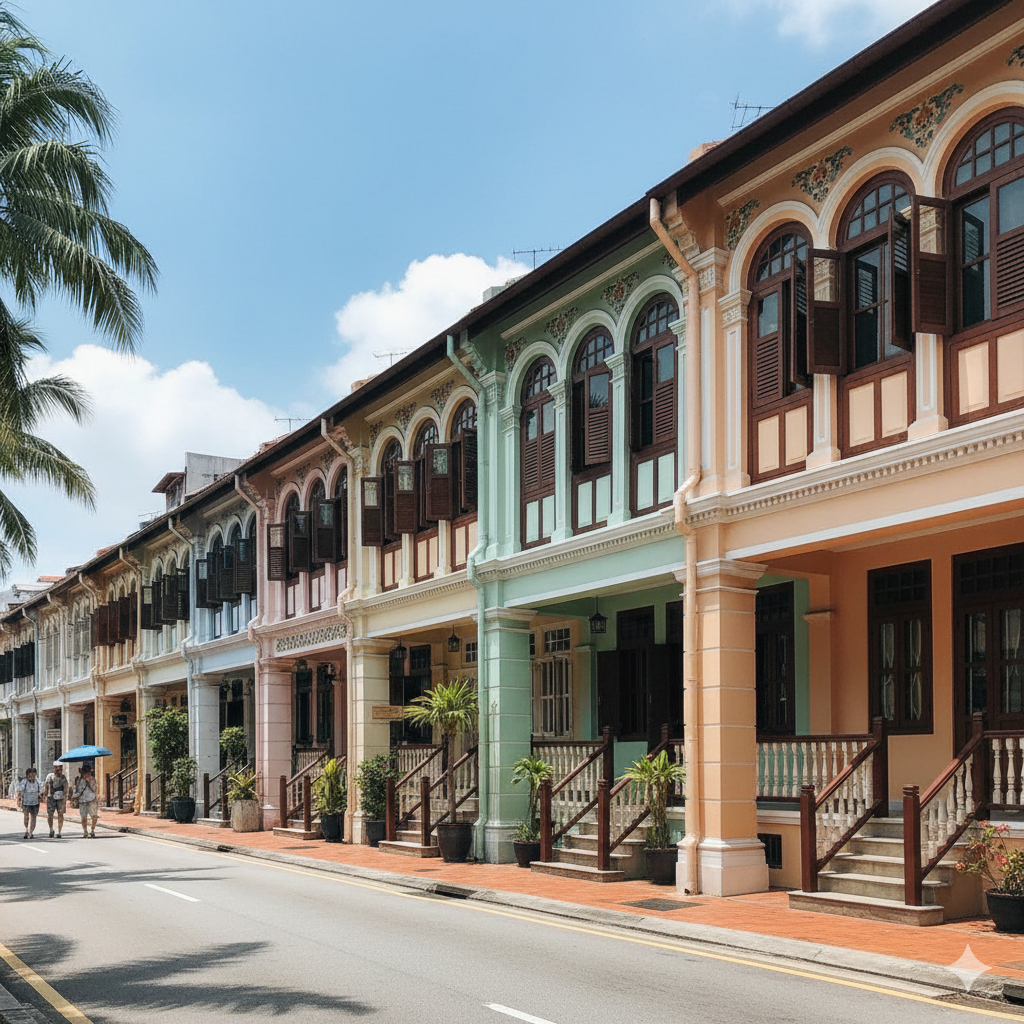
Pastel-colored Peranakan shophouses on Koon Seng Road in Singapore
1. Singapore Can Feel Sterile
All that order and cleanliness can make the city feel a bit too polished if you are craving chaos. That does not make it “less authentic”, just a different kind of authentic.
If you want grit and mess, add Bangkok or Hanoi to your wider Asia trip.
2. The Heat Is Unrelenting
You will sweat. Your clothes will cling. Your hair will do what it wants. Even at night, it does not cool down much.
Embrace it. Shower twice a day if you want, dress in breathable fabrics, use indoor spaces strategically, and drink enough water.
3. It Is Not Actually That Expensive If You Are Strategic
Accommodation is where you will feel the pinch compared to other Southeast Asian countries. But daily living does not have to be extreme:
- Hawker centers can be cheaper than fast food back home
- Public transport is incredibly affordable
- Many of the best things to do in Singapore are free
Your budget Singapore travel experience depends more on choices than on fixed costs.
4. Sometimes Solo Feels Lonely
Even in a safe, friendly city, you might have evenings when you wish someone was sitting across the table. That is normal.
Book a walking tour, say yes when someone at the hostel asks if you want to grab dinner, or FaceTime a friend. And remember that you chose this. The independence and growth are worth the occasional lonely night.
5. You Will Not See Everything
There is too much to fit into one trip. You will miss museums, restaurants, neighborhoods, or viewpoints someone tells you about later.
That does not mean you “did Singapore wrong”. It just means you have reasons to come back
6. Decision Fatigue Is Real
When you are solo, every decision is yours: when to wake up, where to go, what to eat, when to leave. It can get tiring.
Loosen your schedule. Repeat meals at places you loved. Take one day where your only mission is “Botanic Gardens, coffee, and an early night”.
What To Pack for Singapore
Singapore sits almost on the equator, so think heat, humidity, and sudden showers.
Essential clothing
- Lightweight, breathable fabrics like cotton, linen, and moisture wicking blends
- At least one outfit with shoulders and knees covered for temples and mosques
- Mix and match basics: 3–4 tops, 2–3 bottoms, 1–2 dresses
- One slightly dressier outfit for rooftop bars or nice dinners
Footwear
- Comfortable walking shoes (your most important item)
- Flip flops or slides for hostels and beaches
- One nicer pair of sandals or flats for evenings
Break shoes in before you arrive. Blisters in this climate are misery.
Rain Gear
- Compact umbrella
- Quick drying clothing
- A small waterproof pouch for your phone and documents
The air conditioning paradox
Outdoor life is hot and sticky, but indoor spaces are often freezing. Bring a light cardigan, scarf, or thin layer to throw on when you step into malls or the MRT.
What not to pack
- Heavy jeans
- A full toiletry arsenal (you can buy almost everything locally)
- Bulky towels (hostels provide them)
- Winter clothing
- Twice as many outfits as you actually need
Essentials list
- High SPF sunscreen (SPF 50+), hat, sunglasses
- Reusable water bottle
- Small day bag (crossbody or backpack)
- Power bank
- Universal adapter for Type G plugs
- Basic first aid and personal medications
- Copies (or digital backups) of important documents
How to deal with intense UV radiation
- Wear SPF 50+ on your face, neck, and exposed skin
- Reapply every two hours, especially if you sweat a lot
- Use a hat and sunglasses
- Choose breathable long sleeves for long outdoor days
- Seek shade frequently and hydrate
Cultural Etiquette and Local Customs
Everyday Etiquette
- Queuing is serious – always join the line and do not cut
- Keep your voice moderate on public transport and in enclosed spaces
- Say “thank you” and smile at service staff
- Remove shoes where you see racks at the entrance
Temples and mosques
- Dress modestly – shoulders and knees covered
- Remove shoes when required
- Ask before taking photos, especially of people
- Move quietly and avoid blocking worshippers
Many mosques provide scarves or robes for visitors if needed.
Public transport etiquette
- Stand on one side of escalators, let others pass
- Let passengers exit trains before boarding
- Offer priority seats to those who need them
- Do not eat or drink on the MRT or buses
- Keep bags out of aisles and away from doors
Hawker center manners
- Chope seats with tissues or small items
- Share tables during peak times
- Return trays to tray return stations
- Be patient with busy stall owners
Smoking and Tipping
Smoking is heavily restricted. Only smoke in clearly marked areas.
Tipping is generally not expected. Service charges are often included in restaurant bills, and hawker centers do not use tips.
Common Mistakes and How To Avoid Them
- Underestimating the heat – Schedule outdoor activities for morning or late afternoon; take indoor breaks mid day.
- Overpacking your itinerary – Leave buffer time; you do not need to see everything.
- Skipping hawker centers – They are essential to understanding Singapore.
- Not getting a local SIM – Data makes everything easier.
- Wearing brand new shoes – Your feet will revolt.
- Carrying only large bills – Break them at supermarkets or malls; hawker stalls prefer small notes.
- Ignoring EZ Link or travel cards – Tap and go on the MRT saves money and time.
- Overdressing – Singapore is casual; neat, cool clothes go almost anywhere.
- Not checking temple hours – Avoid disappointment by checking in advance.
- Sticking only to tourist districts – Build at least one residential neighborhood (like Tiong Bahru or Katong) into your Singapore itinerary for first-time visitors.
Final Preparations Checklist
Two Weeks Before Departure
☐ Make sure your passport is valid for the next 6 months
☐ Submit your SG Arrival Card (any time within 3 days before arrival)
☐ Double-check visa requirements
☐ Buy a comprehensive travel insurance policy you actually understand
☐ Book your accommodation (at least the first few nights)
☐ Let your bank know you’re traveling
☐ Check vaccination recommendations
☐ Reserve any paid attractions that need an advance booking
☐ Download offline maps for Singapore
☐ Look up MRT routes from Changi Airport to your neighborhood
One Week Before
☐ Finalize your packing list
☐ Break in any new shoes (your feet will thank you)
☐ Charge cameras, power banks, and everything else
☐ Make photocopies or digital backups of important documents
☐ Share your itinerary with someone you trust
☐ Download helpful apps (Maps, Grab, Google Translate, etc.)
☐ Set up two-factor authentication for safety
☐ Pick up any last items (adapter, travel-sized toiletries, power ba
Day Before Departure
☐ Re-check your passport and essential documents
☐ Confirm your flight time and terminal
☐ Pack liquids in a clear bag
☐ Fully charge your phone and power bank
☐ Review your first-day plan so you land feeling confident
☐ Set an alarm (or two)
☐ Pack snacks for the flight
☐ Wear something comfortable for the journey
Upon Arrival at Changi
☐ Buy a tourist SIM or activate your eSIM
☐ Withdraw some local currency from an ATM
☐ Grab an EZ-Link card for easy MRT travel
☐ Confirm your accommodation address and how you’re getting there
☐ Text someone: “Arrived safely!”
☐ Take a deep breath. You made it. Let the adventure begin.
Frequently Asked Questions
How much money do I need per day?
This depends on your choices. Budget travelers staying in hostels, eating at hawker centers, using public transport, and visiting free attractions keep costs very reasonable. Mid-range travelers adding private accommodation, restaurant meals, and paid attractions increase costs but remain manageable. Singapore rewards strategic spending.
Will I be lonely traveling solo?
Sometimes, and that’s normal. Solo travel includes both wonderful independence and occasional loneliness. Singapore makes meeting people easy through hostels, group tours, and naturally social environments like hawker centers. The question is whether periods of loneliness are worth the overall experience. For most people, including me, the answer is absolutely yes.
What if I get sick?
Singapore has world-class medical facilities and English-speaking doctors. Pharmacies are everywhere (Guardian, Watsons). For serious concerns, polyclinics offer affordable walk-in care while private hospitals provide excellent service at a higher cost. Travel insurance should cover significant medical needs.
Can I drink tap water?
Yes. Singapore’s tap water is completely safe and meets WHO standards. Bring a reusable water bottle and refill freely.
How do I handle menstruation while traveling?
Pharmacies and convenience stores sell all necessary products widely and affordably. Public restrooms are generally clean. Hostels have private bathrooms. Pack enough supplies for your first few days, then purchase more locally.
Is Singapore boring?
This depends on what you consider exciting. Singapore won’t provide wild backpacking chaos or intense cultural immersion requiring major adaptation. It offers excellent food, diverse neighborhoods, interesting history, beautiful gardens, and safe exploration. If those excite you, Singapore delivers. If you crave unpredictability and rough edges, you might find it too polished.
Is Singapore LGBTQ+-friendly?
Section 377A technically criminalizes homosexual acts but is rarely enforced, and the government has stated it won’t prosecute. Social attitudes are gradually liberalizing, especially among younger generations. Public displays of affection between same-sex couples might draw attention or disapproval, particularly from older generations.
Your Journey Begins Now
Singapore is the perfect place to practice that courage. You are not blazing a path into the unknown; you are following a route thousands of women have already walked, each one returning a little more confident and a little more self assured.
You will not come back from Singapore as a completely different person. But you will return more you than when you left – more aware of what you can handle, more trusting of your own judgment, and more willing to take the next leap, whether that is Thailand, Japan, Vietnam, or somewhere you have not even dreamed of yet.
Each small win in Singapore is a stepping stone to bigger adventures.
And that is the real magic of solo female travel in Singapore.