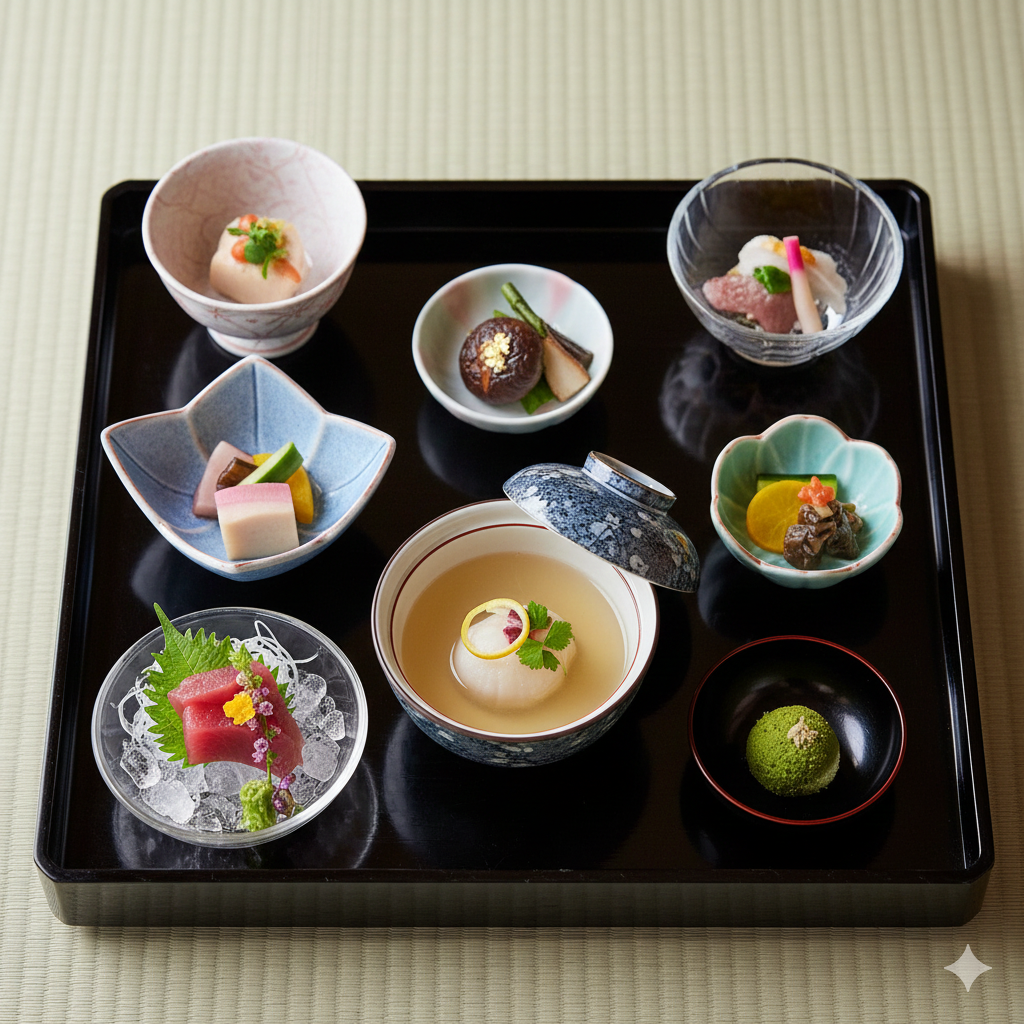

I went to Japan with one quiet, persistent fear tucked between the guidebooks and the excitement. Was I going to be a nuisance here?
I wasn’t worried about getting lost or using the wrong train line. I was worried about me. My clumsiness, my volume, and my inability to blend in. Japan has a reputation for harmony, order ,and precision. I imagined myself as the foreign body disturbing a perfectly calm pond.
Food seemed like the safest doorway in. But food is never just food in Japan. It’s where every insecurity I carried showed up first.
Tokyo: The First Crack in the Fear
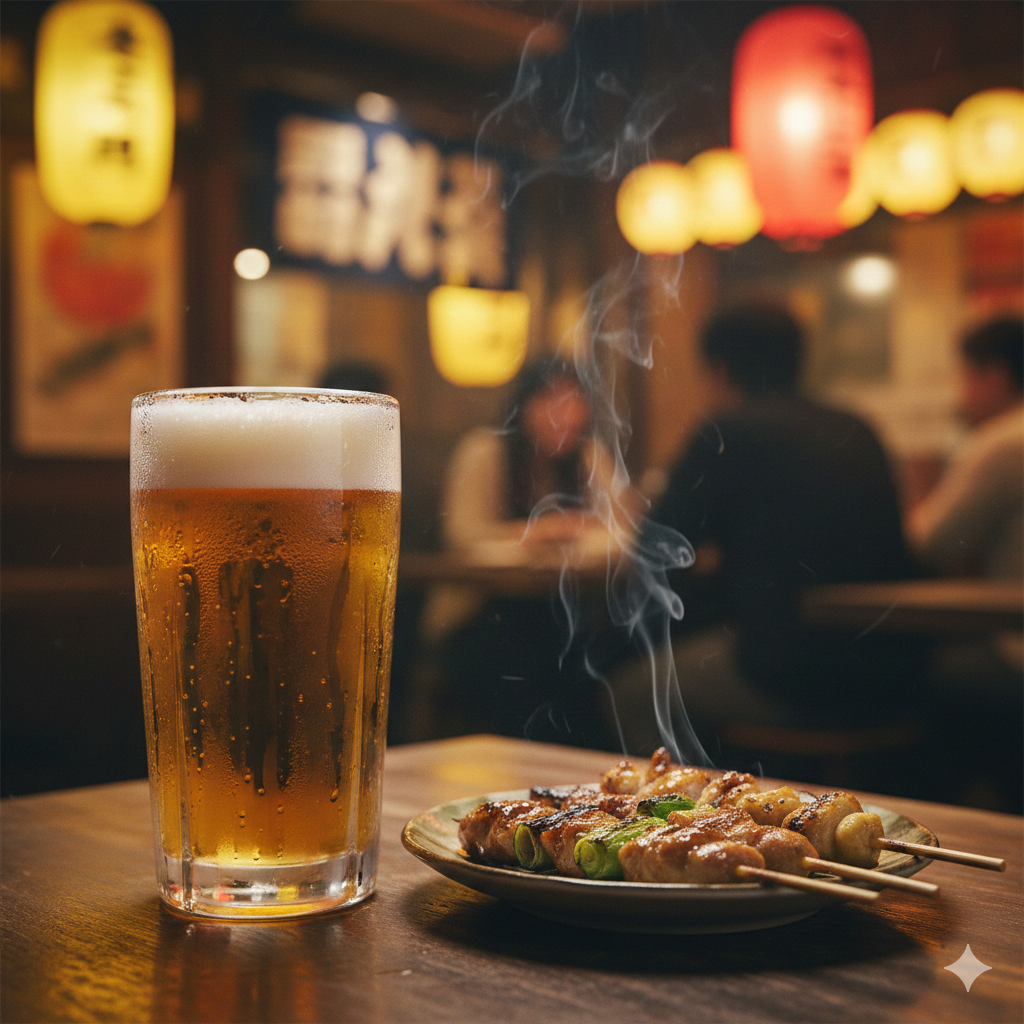
Close-up of a cold glass of beer and yakitori skewers on a table in a dimly lit, smoky Tokyo izakaya.
The moment that stayed with me wasn’t glamorous. Not sushi. Not neon. Not a temple.
It was me, sitting on a plastic milk crate in a smoky, cramped izakaya at 11 PM, staring at a skewer of something I couldn’t identify. The towel they handed me (the famous oshibori) was so hot it stung my palms. My clothes absorbed the smell of grilled meat and cigarette smoke within minutes. A group of salarymen beside me loosened their ties and slipped into a kind of relaxed, boisterous camaraderie that felt completely inaccessible to me.
I wanted a beer refill. But to get it, I had to shout.
“Sumimasen!”
Too loud? Too soft? Too foreign? I had no idea.
But the server heard me. He nodded. A cold beer landed in front of me seconds later, condensation already forming on the glass.
And something inside me shifted. Just a small, barely audible click. Not belonging, exactly. But participation. I wasn’t an intruder. I was part of the noise.
Tsukiji: Where Politeness Goes to Die (Temporarily)
The next morning, I made the pilgrimage to Tsukiji Outer Market with the kind of reverence you’d reserve for a cathedral.
That lasted about four minutes.
Tsukiji at 9 AM is not a zen garden. It’s a delicious, elbow-to-the-ribs scrum where little old women will absolutely body-check you if you’re blocking the tamagoyaki vendor. Tourists photograph grilled scallops like they’re endangered species. The corridors are so narrow that shuffling through them with a backpack feels like an act of physical intimacy with strangers.
But then I ate a 100-yen stick of tamagoyaki (sweet, custardy, still warm) while standing awkwardly near a trash can because eating while walking is taboo. It tasted better than anything I’d eaten in months, possibly because I was so stressed about where to stand that my brain had no capacity left for overthinking the flavor.
The chaos taught me something the guidebooks didn’t: Japanese order isn’t about eliminating mess. It’s about containing it, channeling it, giving it a specific place to exist. The market was loud and crowded and pushing the limits of fire safety, but everyone knew exactly how to move through it.
Everyone except me.
Omakase: An Exam I Didn’t Study For
Two nights later, I sat at an omakase counter that cost more than my flight.
The room was silent except for the sound of the chef’s knife against the cutting board. A rhythm so precise it felt like a heartbeat. Every movement he made looked effortless in that specific way that comes from decades of repetition. The other diners were Japanese businessmen who ate with the quiet confidence of people who’d done this a hundred times.
Then came my moment.
The chef placed a piece of sashimi directly in front of me. No plate, just on a polished hinoki leaf. I reached for it with my chopsticks, aiming for the graceful pinch-and-lift I’d been practicing in my hotel room.
The fish slipped.
Not off the chopsticks entirely, just enough to twist, rotate, and require a panicked mid-air correction that definitely did not look intentional. I managed to get it to my mouth, but the sushi knew what happened. The chef knew what happened. The hinoki leaf probably filed a police report.
He didn’t react. He just nodded slightly and began preparing the next piece, this time explaining (in careful English) that this fish was at its peak this week because of the water temperature.
The kindness in that moment stayed with me longer than any of the seventeen courses that followed. The way he smoothed over my fumble by simply continuing, as if nothing had happened.
It was stressful and expensive and deeply uncomfortable. And yes, the fish was transcendent. But what I remember most is realizing that my fear of imperfection was louder than anyone’s actual judgment.
The Shinkansen: A Moving Lesson in Shared Space
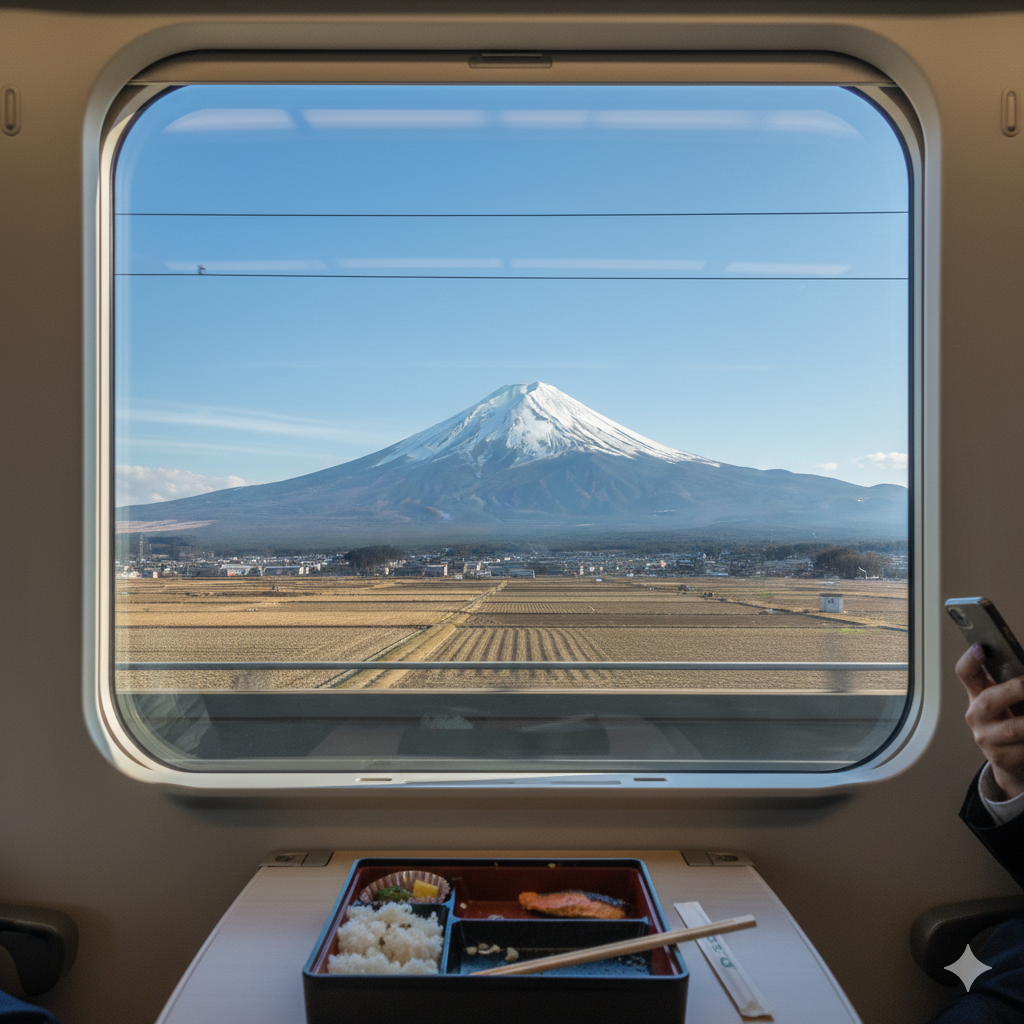
View of Mount Fuji with a snow-capped peak seen through the window of a Shinkansen bullet train against a clear blue sky.
The bullet train between Tokyo and Kyoto is where I learned that silence isn’t emptiness.
Everyone is quiet, but not tense. They’re reading, sleeping, looking out windows, eating ekiben with the concentration of people taking an exam. I unwrapped my chopsticks as carefully as possible, paranoid that the snap of wood separating would disturb the entire car.
It didn’t.
No one looked up.
The woman across from me was eating cold fried chicken from her bento without any self-consciousness whatsoever. The businessman next to her had his phone out but kept it on silent, thumbs moving across the screen in complete quiet.
I started eating my ekiben: cold rice, cold pickles, a small piece of grilled fish. Something about the temperature surprised me. In most places, cold food feels like leftovers, like something went wrong. But here, it tasted intentional. The flavors were sharper, cleaner, more distinct than they would’ve been hot.
Mount Fuji
At some point, Mount Fuji appeared in the window.
I’d planned my seat specifically for this. I’d read about which side of the train to sit on, and what time of day had the best visibility, how weather patterns affected your chances.
And there it was: hazy, distant, and a perfect snow-capped cone cutting through the blue winter sky. It looked like a special effect.
My tourist instinct kicked in violently. I wanted to gasp. I wanted to scramble for my camera. I wanted to tap the shoulder of the businessman next to me and say, “Look! It’s right there!”
But I didn’t move a muscle.
Because nobody else did.
The silence held. The businessman next to me didn’t look up from his laptop. The woman across the aisle kept reading her paperback.
For a second, I thought, Don’t they see it? Are they bored of miracles?
Then I looked closer at the businessman’s screen. The mountain was reflecting clearly off the glossy surface of his display. As the peak moved across his spreadsheet, his typing stopped. He didn’t turn his head. He didn’t take a photo. He just paused his hands, hovering over the keys for three distinct seconds until the mountain passed.
Then, he started typing again.
It wasn’t indifference. It was a private acknowledgment.
I realized then that my desire to make a scene—to gasp, to photograph, to validate the moment—was just clutter. The locals respected the mountain enough to let it just be, without needing to capture it.
I put my phone down. I watched the mountain slide behind a bank of clouds in silence, sharing the view with fifty strangers who saw no need to talk about it.
Kyoto: Beauty, Tradition, and the Weight of Doing It Wrong
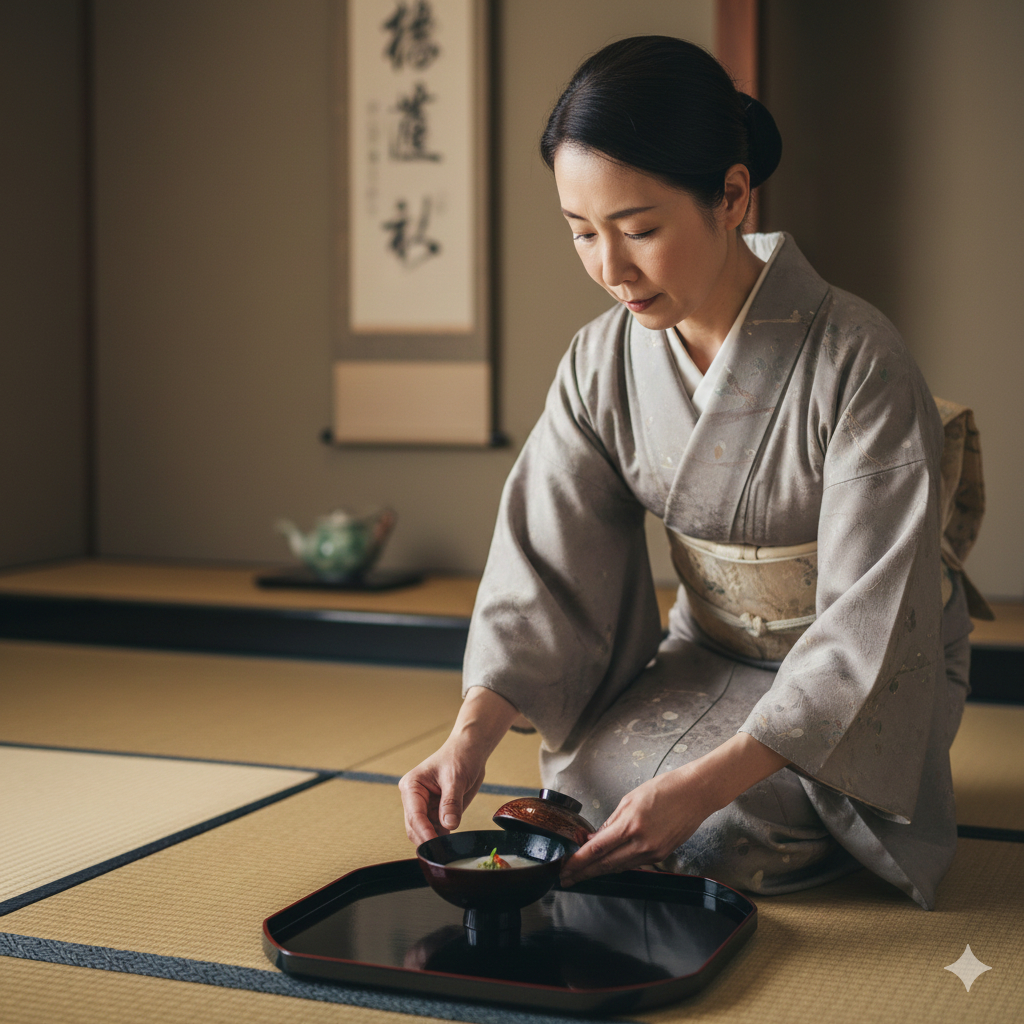
A server kneeling to present food
Kyoto is where etiquette stops being a theory and becomes a physical geometry.
During a kaiseki meal at a ryokan, I was seated seiza. Kneeling. Legs folded beneath me, back straight, hands resting on my thighs. The room was beautiful in a way that makes you afraid to breathe: tatami mats that smelled of dried straw, a single scroll hanging in the alcove, and silence so heavy it felt like a third person in the room.
I managed the position for approximately four minutes before my lower half filed for divorce.
It wasn’t just pain. It was a slow, creeping dissociation. My feet didn’t feel numb; they felt like they belonged to someone else, preferably someone in a different zip code.
The server, a woman moving with the fluid grace of water, knelt to present a bowl of clear soup. She placed it on the lacquer tray with a soundless tap.
This was the test. I needed to bow slightly to acknowledge the soup. But my center of gravity was currently held together by sheer panic.
What did I do next?
I tried to shift my weight to the left. Just a millimeter.
Crrrk.
In that vacuum of silence, my ankle joint sounded like a gunshot.
I froze. I waited for the spell to break, for the server to frown, for the scroll to fall off the wall in protest.
The server didn’t blink. She didn’t look at my legs. She didn’t glance at the ankle that had just violated the sonic integrity of the tea room. She looked exclusively at my eyes, smiling a smile that was so professionally polite it felt more devastating than a scold.
I realized then that Japanese hospitality (omotenashi) isn’t just about anticipating needs. It’s about aggressive blindness to your embarrassment. She knew I was in agony. She knew I was about to topple over like a felled tree. But she was granting me the dignity of pretending I was a samurai master in perfect repose.
I eventually gave up, unspooling my legs to the side in a clumsy sprawl. The blood rushed back in a pins-and-needles static storm that made me grimace.
She poured my tea. The level of liquid in the cup was perfect. Her hand was steady. She was treating me like a king, even though I was sitting there looking like a toddler who’d fallen out of a high chair.
Tradition has weight. In Kyoto, I learned that the heaviest part of that weight isn’t on your shins—it’s in the silence that refuses to judge you, even when you deserve it.
Nishiki Market: Where Real Kyoto Lives
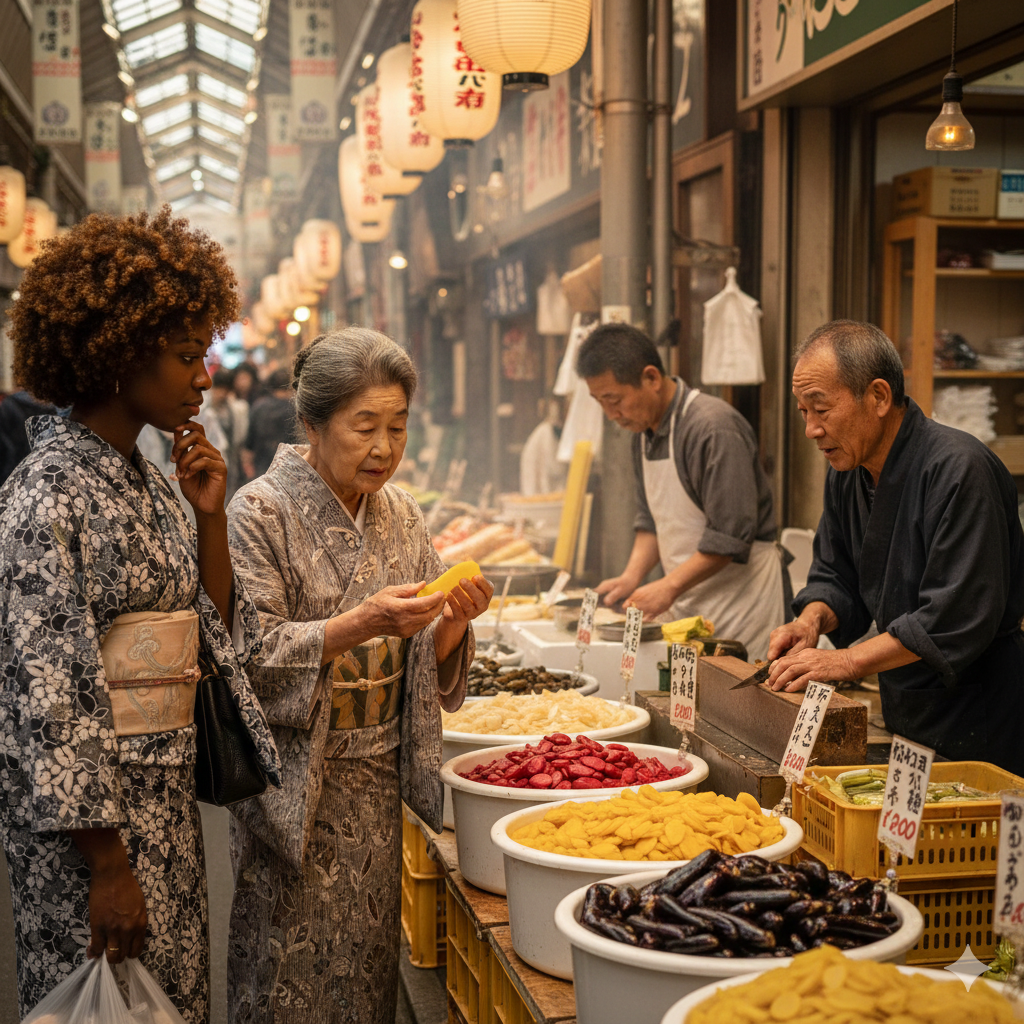
An elderly woman shopping for pickles in Nishiki market
The next morning, I walked through Nishiki Market trying to shake off the formality of the night before.
Nishiki is supposedly Kyoto’s “kitchen,” but during peak hours it’s more accurately described as a slow-moving human traffic jam punctuated by small moments of food-based salvation.
You shuffle forward. You dodge elbows. You question your personal space tolerance and possibly your life choices.
Then you eat tako tamago (a tiny candied octopus stuffed with a quail egg) and suddenly the claustrophobia feels worth it.
What struck me about Nishiki wasn’t the food itself, though the food was remarkable. It was seeing elderly women shopping for pickles with the same discerning eye I’d seen at the kaiseki restaurant. The pickle vendor explaining why this batch of daikon was better than last week’s. A knife shop where the owner was sharpening blades with a focus that bordered on meditation.
This was the Kyoto where actual people lived. Where tradition wasn’t a museum exhibit but dinner. The knife you inherited from your grandmother. Knowing which stall had the best tsukemono because you’d been buying from them for thirty years.
I bought a small package of pickled plums I didn’t need, mostly because the woman selling them explained their provenance with such pride that saying no felt criminal
Osaka: Permission to Be Human Again
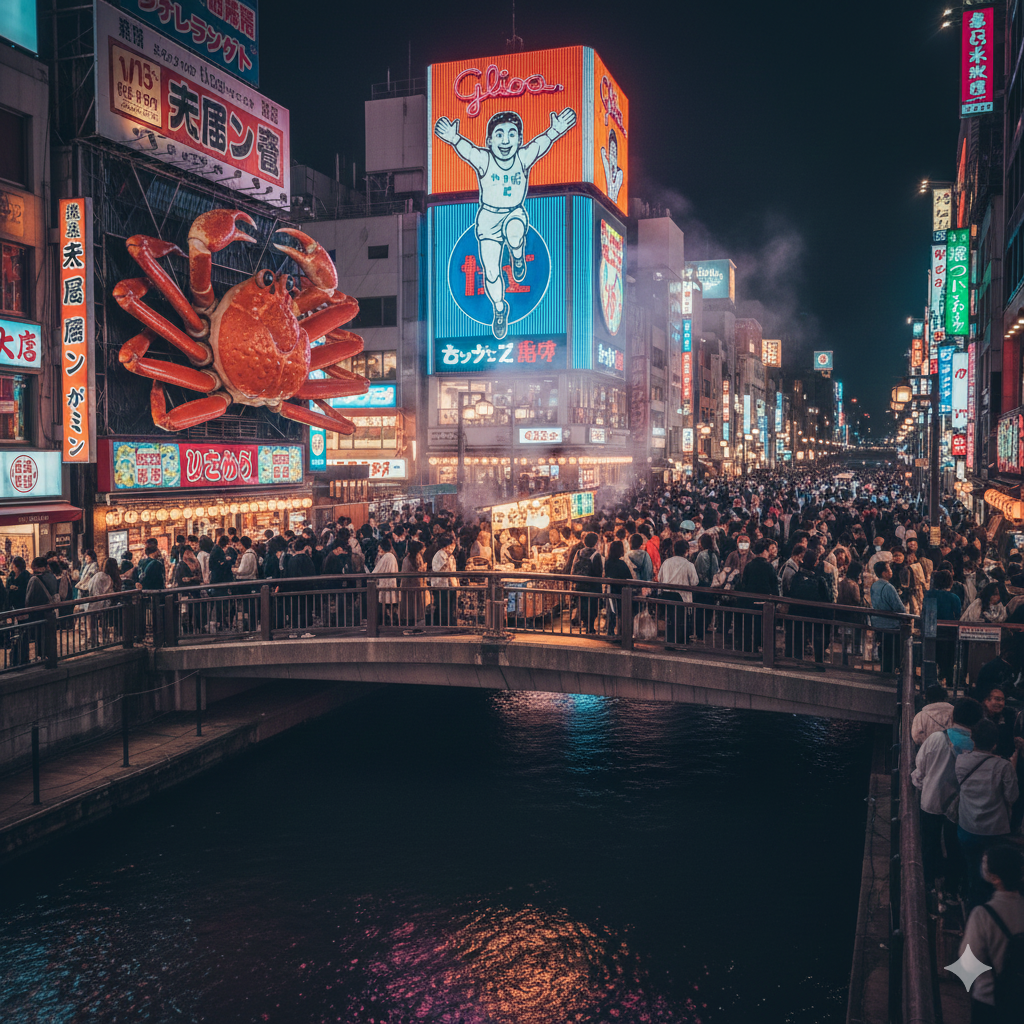
Neon signs reflecting on the canal water in Dotonbori, Osaka, with crowds of people on the bridge at night.
If Tokyo is control and Kyoto is ceremony, Osaka is exhale.
I realized this standing on a bridge in Dotonbori, wedged between a mechanical crab and a crowd dense enough to lift me off my feet. I was holding a paper boat of takoyaki—six golden, innocent-looking spheres buried under dancing bonito flakes.
In Tokyo, I would have looked for a designated eating zone. In Kyoto, I would have worried about dropping a flake on the pavement. Here, I just did what everyone else was doing: I gambled on physics.
I speared one with a toothpick and popped it in.
The structural betrayal of a takoyaki is specific: the outside is lukewarm and crispy, but the inside is a thermal grenade of batter that defies the laws of cooling.
Let’s see what happened
It exploded.
I didn’t just burn my mouth; I lost all motor control. My eyes watered, my hand flew up, and I began doing that universal, open-mouthed dragon breathing—hah-sah-hah-sah—trying to ventilate my own throat. Sauce smeared onto my chin. It was the exact kind of sloppy, loud, graceless spectacle I had spent ten days trying to avoid.
I froze, waiting for the shame.
But Dotonbori didn’t blink. A group of girls next to me were laughing at a selfie. A salaryman was shouting into his phone. The vendor was clanging his metal picks against the grill with a rhythmic violence.
In the silence of the Shinkansen, my heavy breathing would have been a crime. Here? I was just another instrument in the noise.
A guy passing by saw my watering eyes and the steam escaping my mouth. He didn’t look away politely. He grinned, pointed at his own mouth, and gave me a sympathetic thumbs up. You too, huh?
For the first time on the trip, I wasn’t a “foreign body” disturbing a calm pond. I was just a guy burning the roof of his mouth in a city that had no interest in being perfect. I wiped the sauce off my chin, took a breath, and went in for the second one.
Kushikatsu and the Sacred Rule
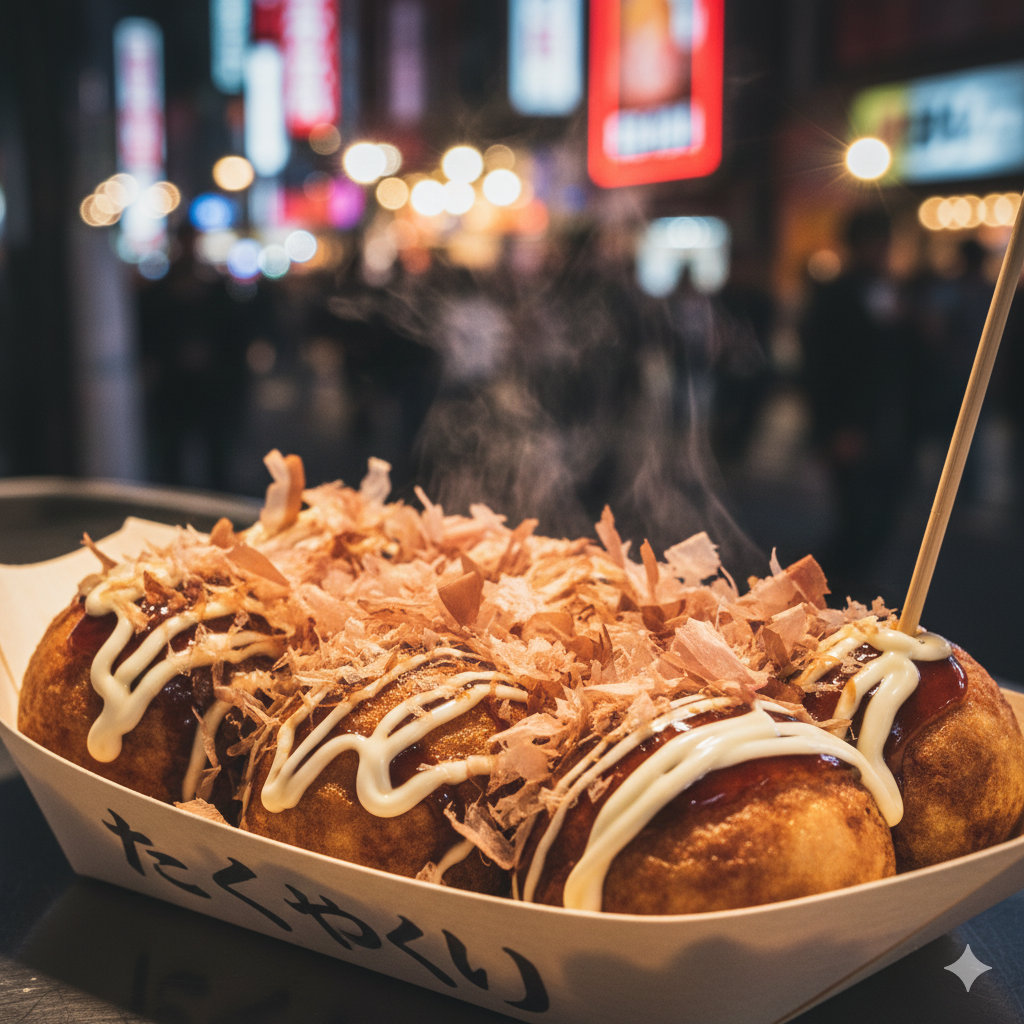
Freshly cooked Takoyaki octopus balls topped with sauce, mayonnaise, and dancing bonito flakes in a paper boat
Later that night, I ended up at a kushikatsu place. A narrow counter where everything is deep-fried on a skewer and served with a communal dipping sauce.
The rule, posted in five languages: NO DOUBLE DIPPING.
I watched the guy next to me dip his skewer once, eat half, then use the cabbage provided to scoop extra sauce for the second half. It was a system. An entire etiquette built around shared sauce and fried food.
I ordered octopus, lotus root, asparagus, and something the menu called “seasonal vegetable” that I’m still not entirely sure about. Each one came out golden and crispy, and each one taught me something about texture I didn’t know I needed to learn.
The woman running the counter noticed me struggling with the cabbage-scoop technique and demonstrated it again, slower, with the kind of patient amusement you’d show a child learning to tie their shoes.
I got it on the third try.
She nodded approvingly and said something in Japanese I didn’t understand, but the tone was clear: Good enough.
Osaka didn’t give me some poetic revelation. It just allowed me to stop performing. That was enough.
What Stayed With Me
I didn’t leave Japan with enlightenment. I didn’t master chopsticks or learn how to kneel without circulation issues. I didn’t dissolve into the harmony I was afraid of disturbing.
What I did learn (quietly, without trying) was this: Japan didn’t need me to be invisible. It just needed me to pay attention.
Attention to the mood of a room. Attention to the rhythm of a place. Attention to my own tendency to overthink every gesture.
The fear of being a nuisance never went away completely, but it softened. Because in the moments where I let myself be part of the scene (whether shouting for a beer, sitting in uncomfortable reverence, or burning my mouth like a fool), I wasn’t disturbing harmony.
I was participating in it. Just imperfectly. Just honestly. Just as myself.
And the sushi that slipped in my chopsticks? It still tasted perfect.