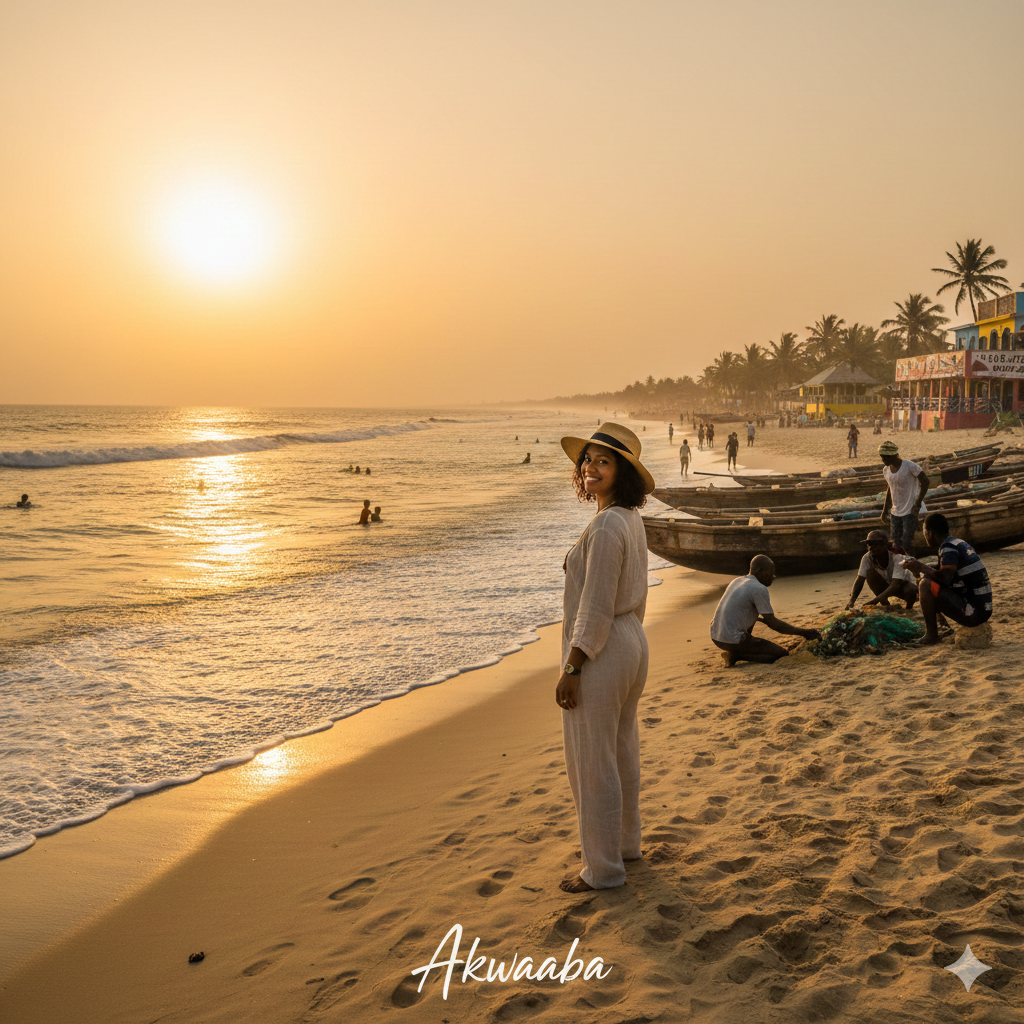

West Africa often sits at the bottom of the solo female travel bucket list—not because it lacks beauty, but because it lacks a clear roadmap. If you’ve been eyeing the vibrant shores of the Gulf of Guinea but feel held back by concerns over safety, logistics, or “going it alone,” you’ve come to the right place.
From the rhythmic pulse of Accra’s night markets to the haunting history of Cape Coast and the untouched, white-sand serenity of Sierra Leone’s Freetown Peninsula, West Africa is a masterclass in resilience and hospitality. As a traveler who navigates the nuances of the region’s infrastructure and cultural etiquette, I’m breaking down everything you need to know.
Why Ghana for Solo Female Travelers?
West Africa offers a different travel experience from safari-focused Southern and East Africa. Here, you’ll dive deep into culture, confront powerful history, dance to Afrobeats, taste incredible food, and experience the legendary warmth of West African hospitality. This guide will help you navigate Ghana confidently and prepare for broader West African adventures.
Ghana is widely considered West Africa’s safest country for solo female travelers. Here’s why:
West Africa’s Welcoming Gateway
Politically stable (strong democracy, peaceful transitions of power)
English-speaking (official language—no language barrier)
Low crime rates compared to regional neighbors
“Akwaaba” culture (welcome—genuine hospitality is the norm)
Well-developed tourist infrastructure (hotels, transport, guides)
Solo female travelers are common and respected
Year of Return initiative (2019) increased tourism infrastructure and awareness
Rich cultural heritage (Ashanti Kingdom, slave castles, festivals)
Affordable (one of Africa’s most budget-friendly destinations)
Why West Africa is Different
I began my journey to Africa with two amazing East African countries, Kenya and Tanzania, then toured two incredible South African countries, Botswana and Namibia. I can confidently tell the difference.
West Africa isn’t about safaris or wildlife (though there are some parks). It’s about:
Music and dance (highlife, Afrobeats, drumming circles)
History (slave trade heritage, independence movements, kingdoms)
Culture (kente cloth, adinkra symbols, festivals, crafts)
Food (jollof rice, banku, groundnut soup, kelewele)
Beaches (golden sand, surf breaks, fishing villages)
People (warmth, community, genuine connections)
Traveling solo in West Africa has never been about being fearless for me. It’s about choosing places that feel steady, cultures that value respect, and destinations where moving through the day alone feels natural rather than brave.
Ghana delivers on all counts.
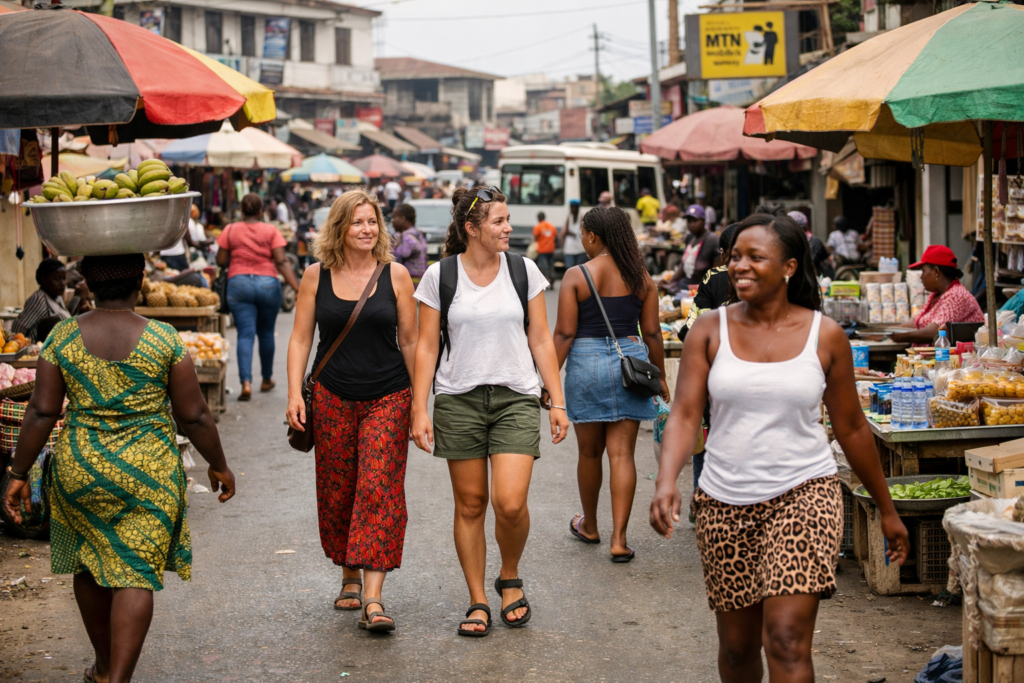
The West African Soul
Ghana is Best for: History buffs, culture seekers, beach lovers, music enthusiasts, first-time West Africa visitors, diaspora travelers reconnecting with roots, food lovers, and budget travelers.
What’s the Best Time to Visit Ghana?
- November-March: Dry season, festivals, perfect weather (25-30°C/77-86°F)
- July-August: Rainy but lush, fewer tourists, cultural festivals
- December-January: Peak season (Ghanaians return home for holidays, festivals everywhere)
Visa: Visa on arrival for most nationalities at Kotoka International Airport (Accra)
- Cost: Single-entry Visa $100 USD (expensive but straightforward—bring cash USD)
- Alternative: Apply for e-visa in advance (same price, less convenient)
Currency: Ghanaian Cedi (GHS) – approximately 1 USD = 12-14 GHS
Language: English (official), local languages (Akan/Twi, Ga, Ewe—not necessary but appreciated)
The Ghana Solo Travel Experience
Ghana is West Africa’s warm, welcoming introduction. Politically stable and English-speaking, it bursts with culture, history, music, and soul. This is the birthplace of the transatlantic slave trade’s “Door of No Return,” the land of vibrant kente cloth and powerful Ashanti kingdoms, the place where highlife music and jollof rice reign supreme.
Ghanaians are famously friendly. “Akwaaba” (welcome) isn’t just a word—it’s a way of life. Expect to be greeted everywhere, invited to events, asked about your family, and called “sister” or “my dear” by strangers who genuinely care about your wellbeing.
As a solo female traveler, Ghana felt incredibly safe and welcoming. Yes, you’ll get attention (especially if you’re not Black—tourists still relatively rare outside Accra), but it’s friendly curiosity, not harassment. Locals went out of their way to help me, offer directions, recommend restaurants, and ensure I felt safe.
My Ghana Journey: 2 Weeks Solo
I spent two weeks in Ghana, exploring Accra’s pulsing energy, Cape Coast’s painful history, Kumasi’s cultural richness, and beaches that felt like paradise.
My Route: Accra (4 days) → Cape Coast (2 days) → Kumasi (2 days) → Busua Beach (3 days) → Kokrobite Beach (3 days)
Accra: The Heartbeat of Ghana
Accra is Best for: Music lovers, markets, street food, nightlife, cultural museums, Year of Return historical sites, urban energy, beach access
Population: ~2.3 million (Greater Accra: 5+ million)
Vibe: Chaotic, energetic, colorful—traffic jams, street vendors, Afrobeats blasting, ocean breezes, entrepreneurial hustle
Where I Stayed: Big Milly’s Backyard in Kokrobite Beach (30 minutes from central Accra)—a legendary beachfront hostel with live music, bonfires, drumming circles, female dorms, and a chill, bohemian vibe. Perfect for solo travelers seeking community.
Alternative Accommodations:
- Labadi Beach Hotel (mid-range, beach access, $60-90/night)
- African Regent Hotel (Accra central, budget-friendly, $30-50/night)
- Airbnb in Osu (apartments, solo-friendly neighborhoods, $25-60/night)
Arriving in Ghana
I arrived at Kotoka International Airport late afternoon. Immigration was straightforward:
- Visa on arrival: Join the queue, fill out form, pay $100 USD cash (they accept USD only—have exact bills)
- Collect luggage
- Currency exchange: Airport rates are decent (change $50-100 to start)
- SIM card: MTN or Vodafone kiosks in arrivals.
- Transport: Official airport taxis (negotiate fare before entering)
Solo Female Traveler Tip: Airport taxis are safe and official. Agree on price before getting in. Uber operates in Accra but not at the airport itself.
I took a shared taxi to Big Milly’s in Kokrobite. The 30-minute drive introduced me to Ghana: chaotic traffic, street vendors balancing goods on heads, colorful painted buildings, music everywhere, people waving and shouting greetings.
Arriving at Big Milly’s, I was immediately greeted with smiles, drumming, and the smell of grilled fish. The hostel sits directly on Kokrobite Beach—golden sand, crashing waves, local fishermen hauling nets. Perfect.
Day 1—Settling into Accra’s Rhythm (Kokrobite Beach)
After checking into a female dorm, I spent the afternoon at Kokrobite Beach—golden sand stretching for miles, warm Atlantic waves, local fishermen pulling in nets with dozens of men chanting work songs, kids playing soccer with makeshift goals.
The beach vibe was mellow but social. Travelers from around the world lounged in hammocks, locals sold fresh coconuts, and reggae music drifted from beachside shacks.
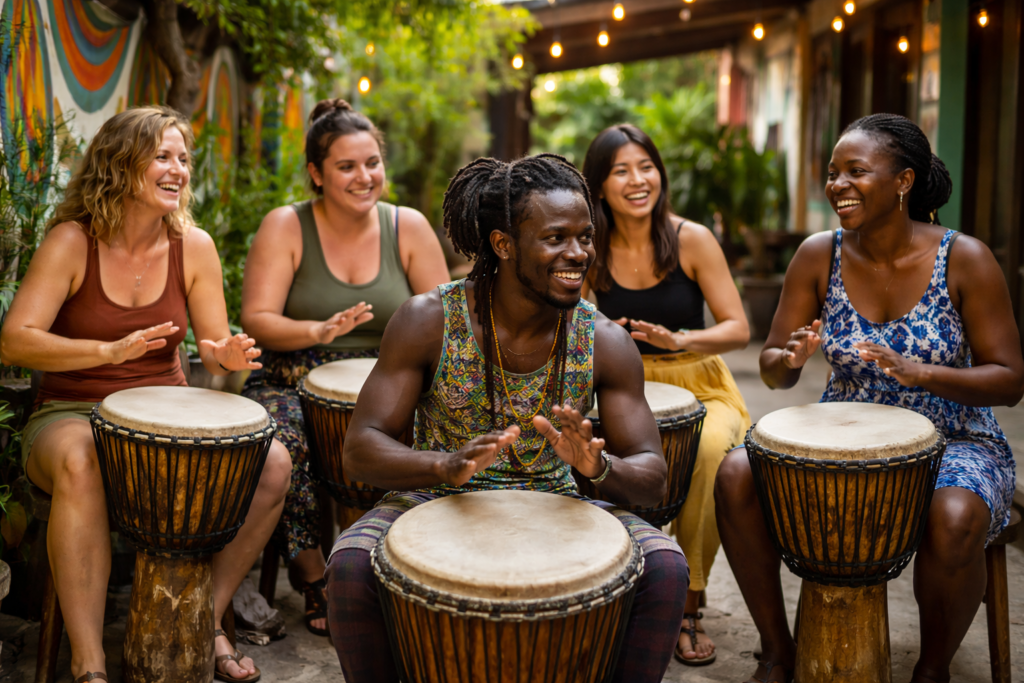
At 4 PM, I joined a djembe drumming lesson at the hostel (1.5 hours). A Ghanaian drummer named Kwame taught us traditional rhythms, starting slow, building to fast, complex polyrhythms. My hands were sore, but I couldn’t stop smiling.
The rhythm of the drums, the ocean crashing, the community singing—I felt connected to something ancient and joyful.
What I learned: West African drumming isn’t just music—it’s communication, community, history. Each rhythm tells a story or marks an occasion.
That evening, I ate jollof rice (Ghana’s national dish—spicy tomato rice) with grilled tilapia and fried plantains at a beachside shack. Delicious, huge portions, cheap.
Solo Dinner Experience: Eating alone in Ghana is no big deal. Locals are curious and friendly. I chatted with the cook about her recipe, and she sent me home with extra kelewele (spiced fried plantains) “for my breakfast, sister.”
We gathered around a bonfire after dinner. A local musician played highlife guitar (Ghana’s original popular music—jazzy, upbeat, joyful). I danced barefoot in the sand with travelers and locals.
This is Ghana’s magic: music, community, joy.
Day 2—Accra’s Markets and Museums
I took a tro-tro (shared minibus—Ghana’s chaotic, but cheap public transport) into central Accra (45 minutes). Tro-tros are an experience: cramped, loud, colorful, drivers’ assistants hanging out windows shouting destinations, gospel music, or Afrobeats blasting.
Solo Female Safety Note: Tro-tros are safe but crowded. Keep valuables close. Sit near the front if possible. Ask locals for help—they’ll tell you which tro-tro to take.
First stop: Makola Market, Accra’s sprawling, sensory-overload central market.
Makola Market: Organized Chaos
Makola is massive—blocks and blocks of narrow alleys packed with vendors selling everything: fabrics, spices, yams, fish (fresh and dried—the smell!), electronics, beauty products, shoes, live chickens.
Sensory overload: colors everywhere, vendors calling out, smells mixing (spices, fish, sweat), heat, humidity, constant motion.
I bought:
- Colorful kente fabric (negotiated from 150 GHS to 100 GHS/$8)
- Ankara print fabric for a dress (80 GHS/$6.50)
- Shea butter (locally made, 20 GHS/$1.60)
- Spices (ground ginger, pepper, 15 GHS/$1.20)
Bargaining Tips:
- Start at 50% of asking price
- Bargain with a smile—it’s friendly, not aggressive
- Walk away if price too high—they’ll often call you back
- Build rapport (“Where are you from?” “Your fabrics are beautiful!”)
- Know when to stop—they need to make a living too
Solo Female Experience: I got lots of attention—”Sister! Obroni (foreigner)! Come see my shop!” But it was friendly, not threatening. When I said “No thank you” politely, vendors smiled and moved on.
Getting Lost: I got lost multiple times. Asked a woman selling tomatoes for directions. She walked me three blocks out of her way to my next destination, chatting about her children the whole time. Pure Ghanaian hospitality.
Kwame Nkrumah Mausoleum
After Makola’s chaos, I visited the Kwame Nkrumah Mausoleum—a peaceful memorial honoring Ghana’s first president and pan-African hero.
Kwame Nkrumah led Ghana to independence from Britain in 1957 (first sub-Saharan African country to do so) and championed pan-African unity. The memorial is serene: beautiful gardens, a reflecting pool, museum exhibits on independence, Nkrumah’s tomb in a simple marble structure.
Time needed: 1-2 hours
I learned about Ghana’s independence movement, Nkrumah’s vision for African unity (much of which remains unrealized), and the complex legacy of post-independence African leaders.
Solo Reflection: Visiting alone allowed me to take my time, sit quietly, and process the weight of history. A guide approached offering tours, but I politely declined, preferring to absorb it at my own pace.
Lunch at Buka Restaurant
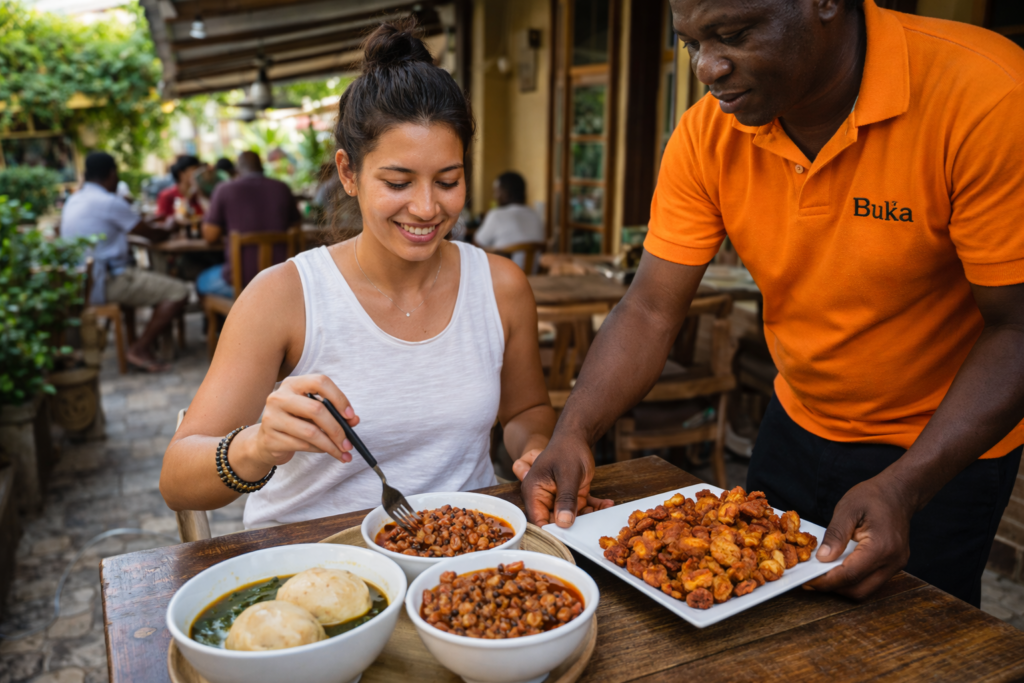
Buka Restaurant (Osu neighborhood) serves authentic Ghanaian food in a casual setting.
I tried:
- Banku and okra stew (fermented corn/cassava dough balls with slimy okra soup—sounds weird, tastes amazing)
- Red-red (black-eyed peas cooked in palm oil with fried plantains—sweet and savory)
- Kelewele (spiced fried plantains—addictive!)
- Fresh coconut water
Eating Solo: I ate with my hands (traditional for banku), watched a Ghanaian family at the next table, and chatted with the waitress who gave me recipe tips.
Jamestown: Historic Fishing Community
Later, I took a taxi to Jamestown, Accra’s historic fishing neighborhood on the coast.
What I saw:
- Colorful fishing boats lined up on the beach (painted with names like “God’s Time,” “No Fear”)
- Fishermen mending nets, smoking fish over open fires
- Kids playing in the waves
- Jamestown Lighthouse (built 1871)—climb to the top for panoramic views of Accra and the coast.
Boxing Day Gym: Jamestown is famous for outdoor boxing gyms where champions like Azumah Nelson trained. I watched young boxers sparring on the beach—raw talent, incredible discipline.
The neighborhood is gritty but vibrant—not touristy, very authentic. I felt safe walking around during the day, though I kept my camera hidden when not using it.
Evening: Accra Nightlife Tour
That evening, I joined an Accra Nightlife Tour (organized through the hostel).
We hit local bars and live music spots in Osu (Accra’s expat/nightlife neighborhood):
- Republic Bar & Grill (live band playing highlife and Afrobeats)
- Django Bar (rooftop bar, dancing, cocktails)
- +233 Jazz Bar & Grill (smooth jazz, sophisticated crowd)
Dancing to Afrobeats and highlife with Ghanaians who taught me the moves (azonto, shoki, alanta)—so much fun. Ghanaians know how to party. The energy was joyful, welcoming, inclusive.
Solo Female Experience: I felt safe the entire night. The tour group was mixed (solo travelers, couples), and Ghanaians in the bars were friendly, respectful. No one harassed me. Women dance together, men dance with women, everyone just enjoys the music.
My Uber to the hostel was safe and easy.
Day 3—Year of Return Historical Sites
2019 was Ghana’s “Year of Return,” marking 400 years since the first enslaved Africans arrived in America. Ghana welcomed diaspora travelers to “return home,” and many historical sites focus on this powerful, painful legacy.
W.E.B. Du Bois Centre
W.E.B. Du Bois was an African-American scholar, civil rights activist, and pan-Africanist who moved to Ghana in 1961 (at Nkrumah’s invitation) and lived there until his death in 1963.
The W.E.B. Du Bois Centre includes:
- His former home (preserved as a museum)
- Research library
- His tomb in the gardens
I walked through his home—books lining walls, typewriter on his desk, personal effects. The museum shares his work on pan-Africanism, his disillusionment with American racism, and his decision to become a Ghanaian citizen.
Emotional moment: Standing at his tomb, I thought about his journey—from the US to Ghana, from struggle to peace, from seeking belonging to finding it. Many African-Americans visit this site as part of their own return.
Independence Square & Black Star Gate
Independence Square (also called Black Star Square) is where Ghana declared independence on March 6, 1957.
The massive parade ground, Independence Arch, and Black Star Gate (representing African freedom) are powerful symbols of Ghana’s liberation from colonialism.
I stood in the square imagining the celebrations on independence day—the hope, the pride, the new beginning. Ghana’s independence inspired liberation movements across Africa.
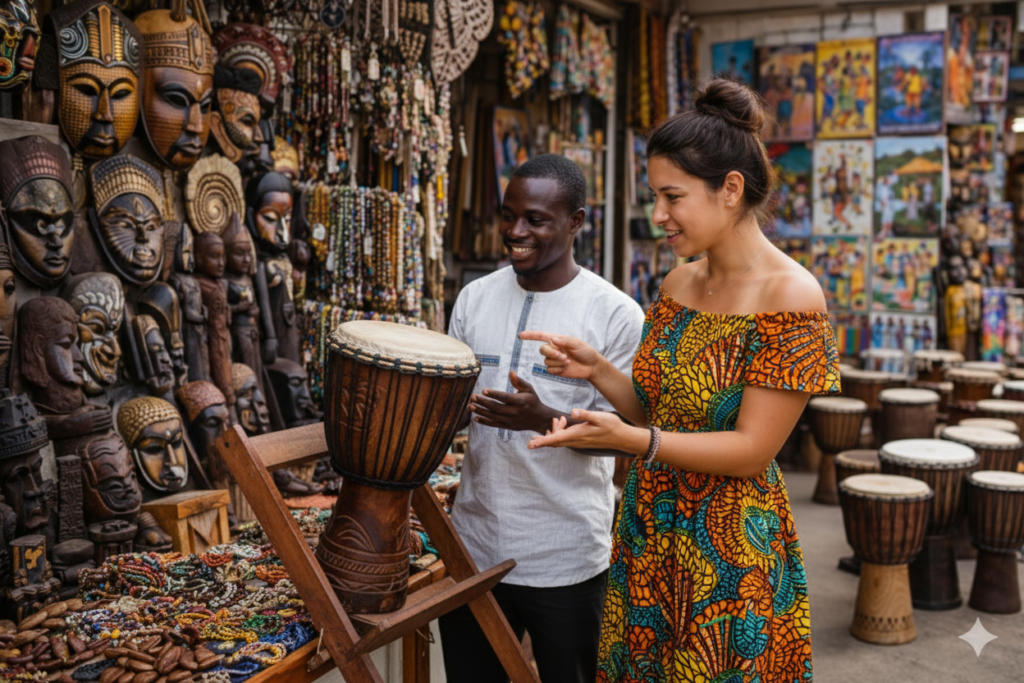
Bargaining for a drum in Accra Arts Centre
Accra Arts Centre
The Accra Arts Centre (near Independence Square) is a large market selling crafts, carvings, paintings, textiles, jewelry.
I browsed:
- Wood carvings (masks, statues, stools)
- Kente cloth scarves
- Beaded jewelry
- Paintings
- Drums
Bargaining is intense here—vendors start high. I bought a small drum (from 200 GHS down to 120 GHS/$10) and a kente scarf (from 80 GHS to 50 GHS/$4).
Solo Female Tip: Vendors can be pushy. Politely say “No thank you, just looking” and keep walking. Once you show interest, they’ll follow you. It’s sales tactics, not harassment, but it can feel overwhelming.
Accra Quick Hits
Must-Do Experiences:
- Makola Market (sensory overload, bargaining practice)
- Drumming lessons at Kokrobite Beach
- Jamestown and lighthouse (authentic fishing community)
- Kwame Nkrumah Mausoleum (independence history)
- Accra nightlife (Osu—live music, dancing, Afrobeats)
- W.E.B. Du Bois Centre (diaspora history)
- Beach time at Kokrobite or Labadi
Where to Eat:
- Jollof rice (everywhere—Ghana’s national dish, every cook has their version)
- Banku and tilapia (traditional, delicious)
- Kelewele (spicy fried plantains—street food perfection)
- Red-red (black-eyed peas in palm oil with fried plantains)
- Fresh coconut water on the beach (5-10 GHS/$0.40-0.80)
- Waakye (rice and beans with toppings—breakfast favorite)
Restaurants to Try:
- Buka Restaurant (Osu—authentic Ghanaian)
- Azmera (Osu—Ethiopian food)
- Chez Clarisse (Osu—Ivorian cuisine)
- Republic Bar & Grill (Osu—continental + local)
Budget Breakdown (4 days Accra):
- Accommodation: $60-80 (Big Milly’s)
- Food: $3-8/day = $20
- Transport (tro-tros, taxis, Uber): $15
- Activities (drumming, museums, nightlife): $40
- Shopping (fabrics, crafts): $30
- Total: ~$165
Pro Tips:
- Stay at Kokrobite for beach vibes, community, safety
- Use tro-tros for authentic experience, taxis/Uber for convenience and speed
- Makola Market: go early (cooler, less crowded), bring small bills, leave valuables at hostel
- Accra traffic is terrible (especially mornings/evenings)—plan extra time
- Ask locals for restaurant recommendations—they’ll steer you right
- “Akwaaba” (ah-KWAH-bah) = welcome/hello
- “Medaase” (meh-DAH-seh) = thank you
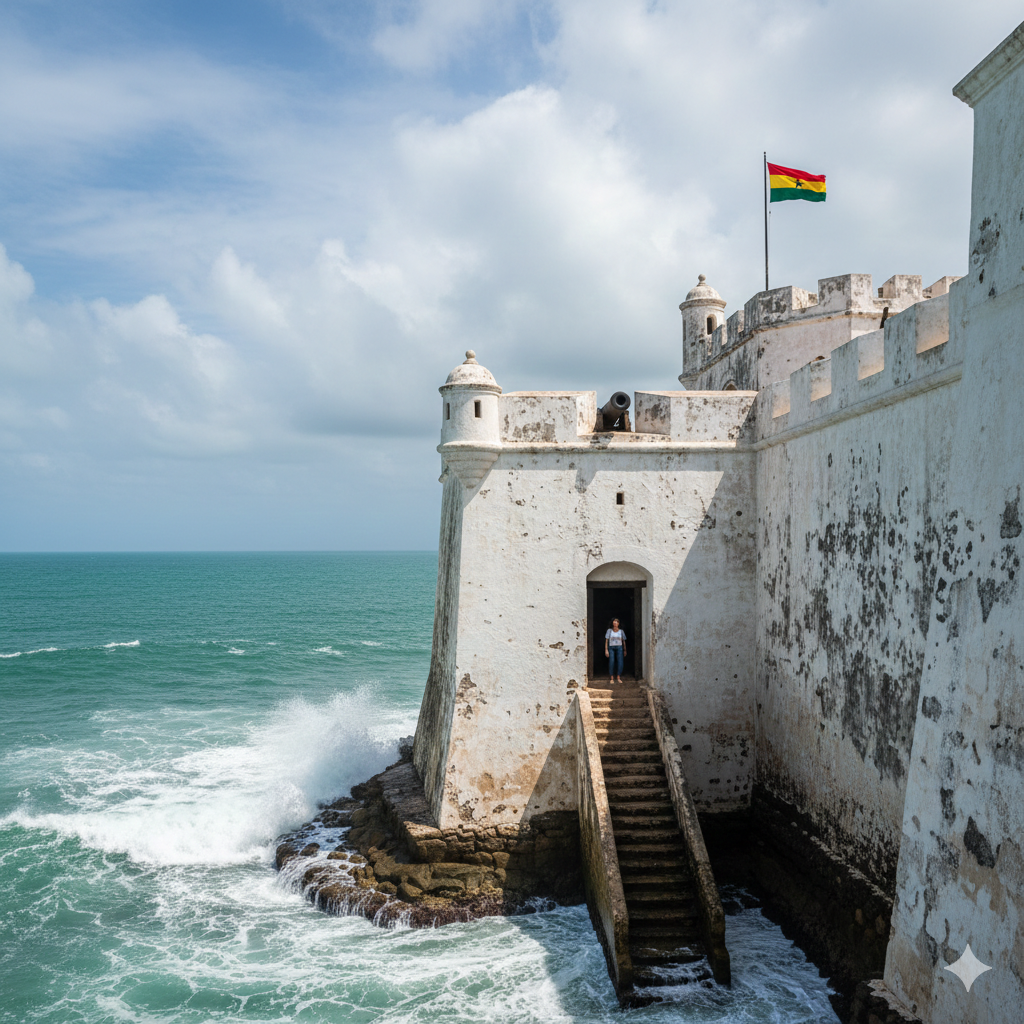
Cape Coast Castle Ghana slave trade Door of No Return
Cape Coast & Elmina: Confronting History
Cape Coast is Best for: Slave castle tours, painful but essential history, coastal beauty, deep reflection, understanding the transatlantic slave trade
Distance from Accra: 150 km (93 miles), 3 hours by bus
Cape Coast and neighboring Elmina, on Ghana’s central coast, are home to slave castles—fortresses where millions of Africans were imprisoned before being shipped across the Atlantic to slavery in the Americas.
This is heavy, emotional, necessary travel.
I took a VIP bus from Accra to Cape Coast (3 hours). Comfortable, air-conditioned, safe. Buses leave from Kaneshie Station (3 GHS).
Where I Stayed: Oasis Beach Resort—a budget hotel directly on the beach with clean rooms, and restaurant with ocean views. Solo-friendly and safe.
Alternative: Elmina Beach Resort (mid-range)
Day 1—Cape Coast Castle
I visited Cape Coast Castle in the morning.
The tour, led by a knowledgeable Ghanaian guide, walked us through the castle’s horrifying history:
- Dungeons where enslaved Africans (men, women separately) were held in darkness, sometimes for months, in unspeakable conditions—no sanitation, minimal food/water, disease, death
- The Door of No Return—the gate through which captives passed to waiting ships, never to return to Africa
- European living quarters above—the brutal contrast between the luxury where European traders lived and the horror in the dungeons below
- The governor’s bedroom—directly above the women’s dungeon, a physical symbol of the dehumanization and sexual violence
Standing in the women’s dungeon—dark, hot, claustrophobic, the guide turning off the lights so we could experience the blackness—I tried to imagine the suffering, the terror, the despair. I couldn’t. Tears streamed down my face.
Passing through the Door of No Return, looking out at the ocean that swallowed so many, I felt the weight of history and the resilience of those who survived.
The guide’s perspective: Our guide spoke about remembrance, resilience, and the importance of diaspora travelers returning to bear witness. He emphasized that this history belongs to all of us—Africans, descendants of enslaved people, descendants of enslavers, everyone.
Who should visit: Everyone. Especially if you’re American, British, or from countries that participated in or benefited from the slave trade. This is essential, uncomfortable, transformative education.
Emotional impact: I walked along Cape Coast beach afterward, processing, crying, reflecting. Several other travelers (including African-Americans on heritage trips) sat on the beach, equally overwhelmed.
Solo Travel Note: I’m glad I visited alone. The experience is so personal, so heavy—I needed space to feel everything without worrying about a companion.
Day 2—Elmina Castle and Kakum National Park
Elmina Castle
Elmina Castle (15 minutes from Cape Coast by taxi) is the oldest European structure in sub-Saharan Africa, built by the Portuguese in 1482.
Similar to Cape Coast Castle—dungeons, Door of No Return, painful history—but Elmina was also a major gold trading post before shifting to the slave trade.
The tour guide emphasized resilience and remembrance—yes, acknowledge the horror, but also honor those who survived, their descendants, and Africa’s ongoing journey.
I spent time in the museum, learning about the scale of the trade (12+ million Africans forcibly taken, 2+ million died during the Middle Passage), the economics, the resistance, the abolition movements, and the lasting impacts.
Why visit both castles? Each has a slightly different focus. Cape Coast is more emotionally intense; Elmina has better historical context and museum. Both are UNESCO World Heritage Sites.
Kakum National Park: Canopy Walkway
In the afternoon, I visited Kakum National Park (30 minutes from Cape Coast).
Kakum is famous for its canopy walkway—a suspension bridge 40 meters (130 feet) above the rainforest floor, stretching 350 meters through the treetops.
Walking the swaying bridge, surrounded by lush green rainforest, bird calls echoing, monkeys (Diana monkeys, if lucky) swinging through branches—thrilling and beautiful.
Why visit after the castles? Kakum provided a needed counterbalance to the morning’s emotional heaviness. Nature, beauty, life—a reminder that Ghana is more than painful history.
Solo Traveler Experience: The canopy walk is popular—you’ll be with a group (I joined a Ghanaian family and some European backpackers). Guides are knowledgeable about the forest ecology.
Cape Coast Quick Hits
Must-Do Experiences:
- Cape Coast Castle tour (essential, emotional, transformative)
- Elmina Castle tour (historical context, resilience narratives)
- Kakum National Park canopy walk (nature, beauty, adventure)
- Beach walks for reflection
- Eat fresh fish at local chop bars (cheap, delicious)
Where to Eat:
- Oasis Beach Restaurant (fresh seafood, ocean views)
- Castle Restaurant (local food, near Cape Coast Castle)
- Local chop bars (fried fish, banku, kenkey—super cheap)
Practical Tips:
- Wear comfortable shoes (castle tours involve walking/stairs)
- Bring tissues (you may cry—I did, many do)
- Photography allowed but be respectful (no photos in dungeons)
- Guides provide context—listen to their perspectives
- These sites are emotionally heavy—take time to process
- Solo travelers: you’re not alone—many visit alone for the personal journey
Budget Breakdown (2 days Cape Coast):
- Accommodation: $60-80
- Transport (bus from Accra, tro-tros, taxis): $15
- Castle entries (2): $6.40
- Kakum National Park: $5.60 (includes guided nature walk + canopy walk)
- Food: $15
- Total: ~$105
Emotional Preparation:
- These castles are not tourist attractions—they’re memorial sites
- Allow time for reflection after tours
- It’s okay to cry, to feel overwhelmed
- Talk to fellow travelers if you need to process
- Journal, walk on the beach, give yourself space
- This history is painful but essential to understand
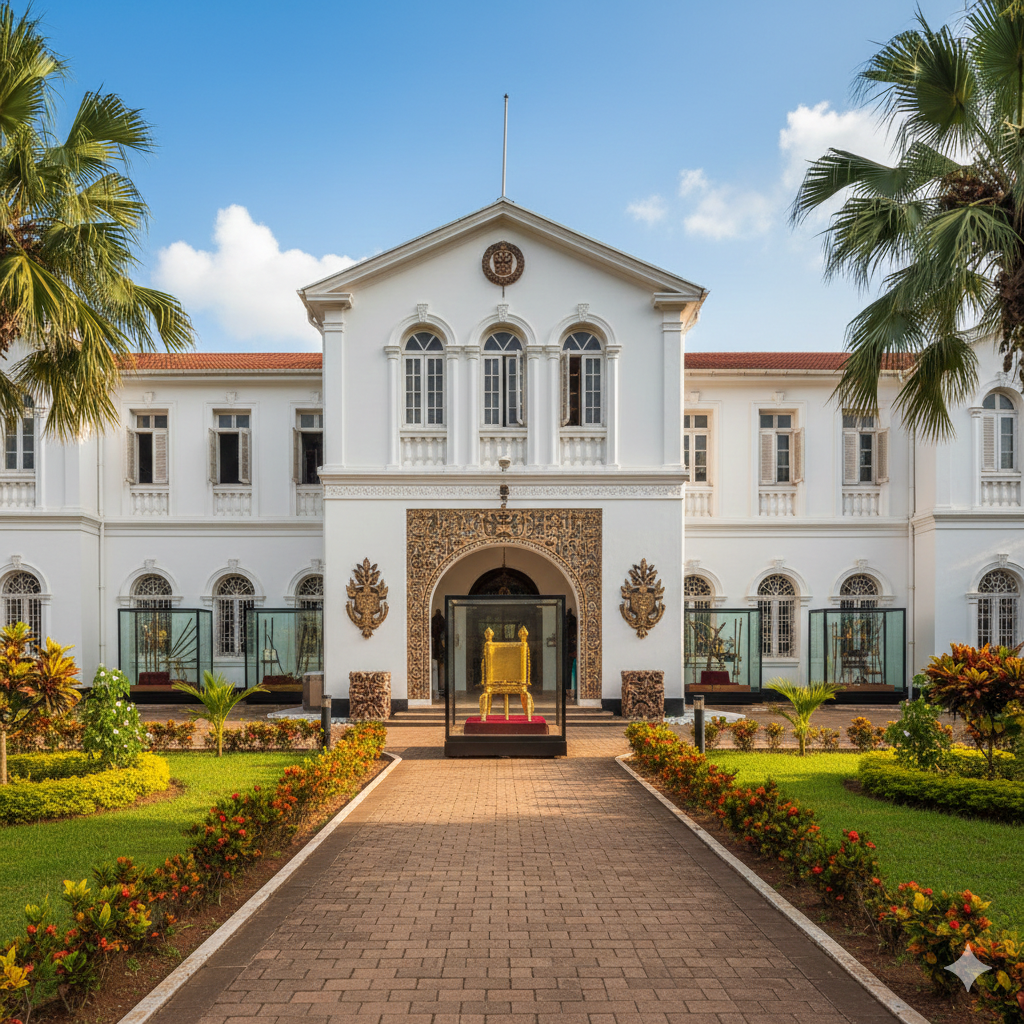
Palace museum exterior
Kumasi: The Ashanti Kingdom
Kumasi is Best for: Ashanti culture immersion, kente cloth weaving, traditional markets, craft villages, cultural history, festivals (if timing aligns)
Distance from Cape Coast: 220 km (137 miles), 5 hours by bus
Population: ~3.3 million (Ghana’s second-largest city)
Kumasi is the heart of the Ashanti Kingdom, Ghana’s most powerful and culturally rich ethnic group. The Ashanti are known for:
- Kente cloth (colorful woven fabric with symbolic patterns)
- Gold culture (the Ashanti had vast gold reserves, resisted British colonization)
- Strong matrilineal traditions
- Adinkra symbols (symbolic language in art/textiles)
- Festivals (Akwasidae Festival every six weeks honors Ashanti kings)
I took a VIP bus from Cape Coast to Kumasi.
Where I Stayed: Four Villages Inn—a mid-range guesthouse with clean rooms, friendly staff, breakfast included, and a peaceful garden. Solo-friendly.
Alternative: Royal Basin Resort (mid-range with a pool)
Day 1—Manhyia Palace and Kente Weaving Village
Manhyia Palace Museum
The Manhyia Palace Museum was the former seat of the Asantehene (Ashanti king). The current king lives in a new palace nearby, but the old palace is now a museum.
The museum showcases:
- Ashanti history (kingdom founded ~1670)
- Royal regalia (gold stools, crowns, swords)
- Resistance to British colonization (multiple wars)
- Cultural artifacts (kente, jewelry, weapons)
- The Golden Stool legend (symbol of Ashanti unity and power, said to have descended from heaven)
What I learned: The Ashanti resisted British colonization fiercely. The British exiled the king multiple times, but the Ashanti eventually negotiated favorable terms and retained significant autonomy.
Solo Female Experience: The museum is small, well-organized, and educational. A guide walked me through (tipping expected—10 GHS). I asked lots of questions, and he patiently answered.
Cultural Insight: The Ashanti are matrilineal—inheritance passes through the mother’s line. Women hold significant power in families and communities.
Bonwire: Kente Weaving Village
I took a taxi (round trip with waiting time) to Bonwire, a village 20 km from Kumasi, famous for kente cloth weaving.
Kente cloth is Ghana’s most iconic textile—brightly colored, intricately patterned, handwoven on traditional looms. Originally worn only by royalty, it’s now popular for weddings, festivals, graduations.
Watching weavers create kente was mesmerizing:
- Sitting at large wooden looms
- Hands and feet moving in practiced rhythm
- Colorful threads forming complex geometric patterns
- Hours of work for each small piece
Watching the kente weavers, their hands moving in practiced rhythm, I realized that every thread carried history, identity, pride.
I bought a small kente scarf (100 x 30 cm) for 120 GHS ($10)—handmade, supporting local artisans, beautiful. Larger pieces cost 500-2,000 GHS depending on size/complexity.
Solo Female Tip: The weavers are friendly and happy to explain the process. No pressure to buy, but purchasing directly supports their livelihoods.
Day 2—Kejetia Market and Adinkra Village
Kejetia Market: Organized Chaos
Kejetia Market is one of West Africa’s largest open-air markets—allegedly the biggest in West Africa.
It’s overwhelming:
- Thousands of vendors
- Narrow, maze-like alleys
- Everything for sale (fabrics, food, spices, electronics, traditional medicine, live animals)
- Constant noise, motion, smells
I hired a local guide through my guesthouse (for 2 hours—worth every cedi to avoid getting hopelessly lost).
What I bought:
- African wax print fabrics (50-80 GHS per 6 yards)
- Spices (ground pepper, ginger, nutmeg—cheap!)
- Handmade baskets (40 GHS)
- Shea butter (raw, locally made—15 GHS)
Solo Female Experience: I got lost once (guide temporarily disappeared in the crowd). Asked a woman selling yams for help—she held my hand and walked me back to the fabric section, chatting about her children. Ghanaian kindness strikes again.
Bargaining: Intense at Kejetia. Start low, smile, be patient. Vendors respect good bargainers.
Ntonso: Adinkra Village
Ntonso is a village known for adinkra cloth—traditional fabric stamped with symbolic designs.
Adinkra symbols are visual language representing concepts, proverbs, historical events. Examples:
- Gye Nyame (except God—symbol of God’s supremacy)
- Sankofa (return and get it—learn from the past)
- Dwennimmen (ram’s horns—humility and strength)
I also participated in a adinkra workshop:
- Choose symbols from carved wooden stamps
- Dip stamps in natural black dye (from tree bark)
- Stamp your own cloth
Fun, cultural, hands-on. I stamped a small piece of fabric with Sankofa (my favorite symbol—looking back to move forward).
What I learned: Adinkra cloth was traditionally worn at funerals, but now it’s also worn for celebrations. Each symbol tells a story or teaches a lesson.
Kumasi Quick Hits
Must-Do Experiences:
- Manhyia Palace Museum (Ashanti royalty and history)
- Bonwire kente weaving village (watch artisans, buy directly)
- Kejetia Market (organized chaos, bargaining practice)
- Ntonso adinkra cloth village (hands-on workshop)
- Try fufu (pounded cassava/plantain with soup—Ashanti specialty)
Where to Eat:
- Vic Baboo’s Café (Ghanaian and continental)
- Vienna City (popular local chain, affordable)
- Chopbars near Kejetia (ultra-local, ultra-cheap, delicious)
Cultural Events (if timing aligns):
- Akwasidae Festival (every 6 weeks—Ashanti celebrate their king)
- Adae Kese (special festival twice a year)
- Check dates before traveling—festivals are spectacular
Budget Breakdown (2 days Kumasi):
- Accommodation: $70-90
- Transport (bus from Cape Coast, taxis): $25
- Activities (museum, weaving village, adinkra workshop, guide): $30
- Food: $15
- Shopping (fabrics, baskets, kente): $50
- Total: ~$190
Pro Tips:
- Hire a guide for Kejetia Market (easy to get lost, guides know best vendors)
- Bargain respectfully—vendors need to earn a living
- Kumasi is hot and humid—hydrate constantly!
- Learn a few Twi phrases (local Akan language—people love it)
- “Maakye” (mah-CHAY) = good morning
- “Medaase” (meh-DAH-seh) = thank you
- Kente and adinkra make great souvenirs/gifts
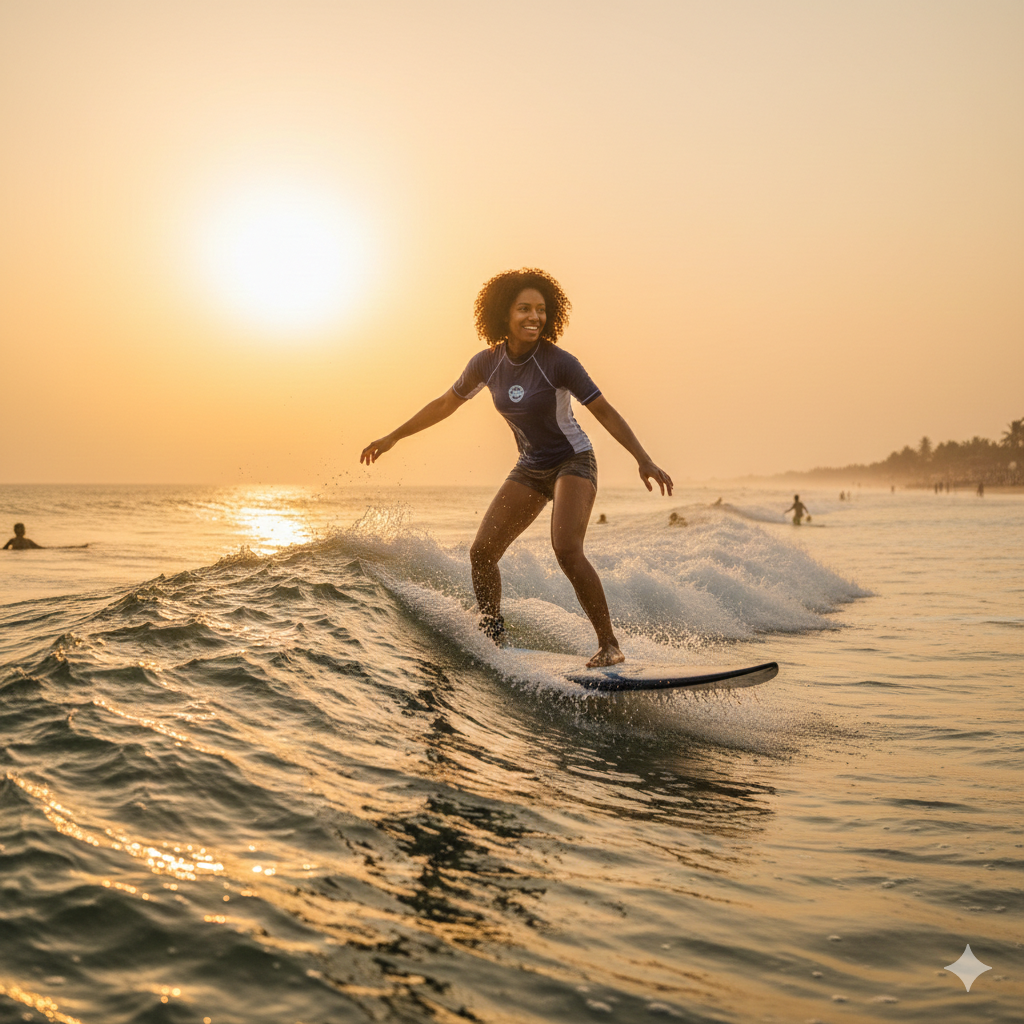
Surf lesson scene and sunset surf vibes
Ghana Beaches: Busua & Kokrobite
Ghana’s Beaches are Best for: Surfing, relaxation, reggae vibes, budget beach towns, community, escaping city chaos, fresh seafood
After cultural immersion in Kumasi, I craved beach time. Ghana’s coast offers golden sand, warm Atlantic waves, fishing villages, and chill vibes.
Busua Beach: Hidden Gem
Busua Beach is a small fishing village on Ghana’s western coast with:
- Great surf breaks
- Budget guesthouses and surf hostels
- Laid-back reggae vibes
- Fewer tourists than Kokrobite
- Authentic village life
Distance from Kumasi: 280 km (174 miles), 6 hours by tro-tro (challenging) or bus
I took a bus to Takoradi (5 hours), then tro-tro to Busua (1 hour).
Where I Stayed: Scorpion Hill Lodge, beachfront hammocks, communal kitchen, and nightly bonfires. Perfect for solo travelers.
What I did:
- Surfing (badly—I fell a lot, laughed a lot, got tumbled by waves, eventually caught a few rides)
- Beach walks at sunset
- Fresh grilled fish with banku at beachside shacks
- Bonfire hangouts with travelers and locals
- Day trip to Nzulezo stilt village (fascinating village built entirely on water)
Solo Female Experience: Busua felt like a hidden gem. Fewer tourists, authentic village interactions, safe and welcoming. Locals were friendly but not pushy. I felt completely comfortable walking alone.
Budget (3 days):
- Accommodation: $45
- Surf lessons: $20
- Food: $20
- Transport: $10
- Total: ~$95
Kokrobite Beach: Drumming and Dancing
I returned to Kokrobite Beach (near Accra) for my final days in Ghana.
Why return? I loved Big Milly’s Backyard—the community, the drumming circles, the bonfire dancing. It felt like home.
What I did:
- More drumming lessons (I got better!)
- Swimming in warm Atlantic waves
- Eating jollof rice and grilled tilapia
- Dancing barefoot around bonfires
- Watching fishermen haul nets at sunrise
- Reflecting on my Ghana journey
The Perfect Ending: My last night, a local musician played highlife guitar, travelers and locals danced together, and I felt profound gratitude. Ghana had welcomed me, taught me, moved me, and sent me home changed.
Ghana Beach Quick Hits
Best Beaches:
- Kokrobite (near Accra—drumming, backpacker vibe, community)
- Busua (western coast—surfing, quiet, authentic)
- Anomabo (near Cape Coast—peaceful, fishing village)
- Axim (far west—beautiful, remote)
What to Do:
- Surf lessons (most beaches offer—$15-25)
- Drumming and dancing
- Fresh grilled fish and jollof rice
- Sunset beach walks
- Bonfire hangouts
- Support local fishermen (buy fish directly)
Solo Female Safety:
- Beach towns feel safe (tight-knit communities)
- Avoid walking alone late at night
- Stay at reputable hostels/guesthouses
- Beach vendors are friendly, not aggressive
Budget Breakdown (2 Weeks Solo)
| Category | Budget Range | My Spending |
|---|---|---|
| Visa on arrival | One-time cost | $150 |
| Accommodation (hostels/budget hotels) | $10-40/night | $280 |
| Food (mix of local food and restaurants) | $5-10/day | $100 |
| Transport (buses, tro-tros, taxis) | Between cities + local | $75 |
| Activities (castle tours, drumming, museums, surfing) | Tours and lessons | $120 |
| Shopping (fabrics, crafts, souvenirs) | Kente, baskets, etc. | $100 |
| Miscellaneous (SIM card, tips, snacks) | $40 | |
| TOTAL | $865 |
Budget Traveler Total: $700-900
Mid-Range Traveler Total: $1,000-1,400
Comfort Traveler Total: $1,500+ (nicer hotels, more tours)
Ghana is one of Africa’s most budget-friendly destinations!
Money-Saving Tips for Ghana
Stay in hostels (Big Milly’s, local guesthouses—$10-25/night)
Eat local food (chop bars, street food—$1-3/meal vs $8-15 at restaurants)
Use tro-tros (super cheap but chaotic—authentic experience)
Bargain at markets (respectfully—start at 50% of asking price)
Free activities: Beaches, walking tours, chatting with locals, drumming circles at hostels
Bring a reusable water bottle (refill with filtered water—avoid buying bottled constantly)
Travel in shoulder season (April-June, September-October—lower prices, fewer tourists)
Splurge-Worthy Experiences in Ghana
Kakum National Park canopy walk ($5.60—totally worth it)
Professional drumming workshop ($30-50 for private lesson)
Nzulezo stilt village day trip ($40-60—unique experience)
Akwasidae Festival (if timing aligns—free, but budget for transport/guide)
Overnight at Wli Waterfalls (eastern Ghana—beautiful, remote)
Cape Coast/Elmina castle tours with private guide ($50—deeper historical context)
Sierra Leon
Note: This guide currently focuses on Ghana (the most accessible, safest West African country for solo female travelers). Find a complete Sierra Leone guide covering:
Freetown: Capital city, beaches, history
Bunce Island: Slave trade historical site
Tokeh Beach & River Number 2: Stunning beaches
Tacugama Chimpanzee Sanctuary
Tiwai Island Wildlife Sanctuary
Safety considerations (Sierra Leone requires more caution than Ghana)
Budget breakdown and practical tips
Why add Sierra Leone?
- Beautiful beaches (some say West Africa’s best)
- Rich history (founded by freed slaves)
- Emerging tourism (off-the-beaten-path)
- Friendly, welcoming people
- Combined Ghana + Sierra Leone itinerary possibilities
Check the full Sierra Leone guide!
Safety, Health & Practical Tips
Safety for Solo Female Travelers in Ghana
Overall Assessment: Ghana is safe for solo female travelers with basic precautions.
What I Experienced:
- Zero harassment in 2 weeks
- Locals went out of their way to help me
- Never felt unsafe, even in markets or on public transport
- Attention from locals was friendly curiosity, not threatening
- Solo female travelers are common and respected
General Safety Tips:
- Use common sense (don’t walk alone late at night in cities)
- Keep valuables hidden (don’t flash expensive cameras/phones)
- Use registered taxis or Uber (cheap and safe—avoid unmarked taxis)
- Stay in reputable accommodations with good reviews
- Trust your instincts always
- Dress modestly in cities (shoulders/knees covered shows respect)
- Beach towns: more relaxed dress codes
- Tell hostel staff where you’re going for the day
Street Harassment:
- Minimal compared to many countries
- “Obroni!” (foreigner) shouted frequently—it’s not harassment, just acknowledgment
- Vendors may be persistent—polite “No thank you” works
- Men may approach to chat—usually friendly, not threatening
- If uncomfortable, walk into a shop or ask a woman for help
Solo Female Specific:
- Ghanaian women are amazing allies—ask them for help/advice
- Tro-tros: sit near other women if possible
- Markets: keep bags zipped and close
- Beaches: avoid isolated areas alone at night
- Hostels: female dorms available at most backpacker spots
Emergency Numbers:
- Police: 191 or 112
- Fire: 192
- Ambulance: 193
Health & Vaccinations for West Africa
Required Vaccinations:
- Yellow Fever: MANDATORY (carry certificate—checked at airport)
- Hepatitis A & B: Highly recommended
- Typhoid: Recommended
- Tetanus: Ensure up to date
- Meningitis: Recommended (West Africa is in the meningitis belt)
- Rabies: Optional (only if planning remote areas/animal contact)
Malaria Risk:
- Ghana: Malaria risk year-round throughout the country (high risk)
- Prevention is CRITICAL
Malaria Prevention:
- Take antimalarial medication (Malarone, Doxycycline—consult travel doctor)
- Use insect repellent with DEET 30%+ (reapply frequently)
- Sleep under mosquito nets (most accommodations provide)
- Wear long sleeves/pants at dawn and dusk
- Consider permethrin-treated clothing
Water & Food Safety:
- Tap water: NOT safe to drink—always drink bottled or filtered
- Carry a filtered water bottle (LifeStraw, Grayl—saves money)
- Avoid ice in drinks (made from tap water)
- Street food generally safe IF busy (high turnover = fresh)
- Peel fruits yourself
- Eat at busy local spots (chop bars with locals are safer than empty restaurants)
- Wash hands frequently or use hand sanitizer
Common Travel Illnesses:
- Traveler’s diarrhea: Common. Bring Imodium, stay hydrated
- Malaria: Take prevention seriously. If fever develops, see a doctor IMMEDIATELY
- Heat exhaustion: Drink 3+ liters water daily, wear sun protection
- Skin infections: Humid climate—keep cuts clean, dry thoroughly after showers
Healthcare in Ghana:
- Accra has decent private clinics and hospitals
- Rural areas: limited healthcare
- Always have travel insurance with medical evacuation coverage
- Bring a first aid kit with essentials
Travel Insurance:
- Mandatory—don’t skip!
- Must cover: medical treatment, evacuation, hospital stays
- Recommended: World Nomads, SafetyWing
- Keep policy details on your phone AND printed
First Aid Kit Essentials:
- Antimalarial medication
- Anti-diarrheal (Imodium)
- Pain relievers (ibuprofen, acetaminophen)
- Antihistamines (allergic reactions, itching)
- Antibacterial ointment
- Band-aids, blister treatment
- Oral rehydration salts (diarrhea/dehydration)
- Prescription medications (bring extras)
- Thermometer
- Hand sanitizer, wet wipes
Money & Budgeting in Ghana
Currency:
- Ghanaian Cedi (GHS) – symbol: ₵
- Exchange rate: ~12-14 GHS = 1 USD (fluctuates)
ATMs & Cards:
- ATMs widely available in cities (Accra, Kumasi, Cape Coast)
- Ecobank, Stanbic, GCB have reliable ATMs
- Visa/Mastercard accepted at hotels, upscale restaurants, tour operators
- Cash is king in Ghana—markets, street food, tro-tros, small vendors
Cash Recommendations:
- Withdraw in cities before traveling to rural areas
- ATM withdrawal limits: often 800-2,000 GHS ($65-160 USD) per transaction
- Carry small bills (10, 20, 50 GHS notes—vendors often don’t have change for 200 GHS)
- Keep 200-300 GHS cash on you for daily expenses
Banking Tips:
- Inform your bank before traveling (avoid card blocks)
- Carry two different cards (Visa + Mastercard from different banks—backup)
- ATM fees: ~5-10 GHS per withdrawal + your bank’s fees
- Exchange USD at forex bureaus (better rates than hotels/airport)
Tipping Guidelines:
- Restaurants: 10% if no service charge (check bill first)
- Tour guides: 20-50 GHS per day (depending on group size)
- Taxi drivers: Round up fare
- Drummers/cultural performers: 10-20 GHS
- Hotel porters: 5-10 GHS
- Hostel staff: 10-20 GHS per week
Budget Expectations:
- Budget Traveler: $30-50/day (hostels, street food, tro-tros, free activities)
- Mid-Range Traveler: $60-90/day (guesthouses, mix of local/restaurants, taxis, tours)
- Comfort Traveler: $100+/day (hotels, restaurants, private drivers, all activities)
Transport in West Africa
Between Countries:
- Flights: ASKY, Ethiopian Airlines, Africa World Airlines (regional carriers)
- Overland buses: Possible but slow (Ghana to Togo, Benin, Burkina Faso, Côte d’Ivoire)
- Borders: Straightforward with valid visas
Within Ghana:
- Tro-tros: Shared minibuses, cheap (2-10 GHS for most trips), chaotic, authentic, slow
- VIP/STC buses: Comfortable, air-conditioned, safer, punctual (Accra to Kumasi: 30-50 GHS)
- Taxis: Everywhere in cities (negotiate fare before entering—10-40 GHS for short trips)
- Uber: Available in Accra only (reliable, safe, cashless)
- Rental cars: Available but expensive ($40-70/day), traffic is chaotic
Tro-Tro Tips (Essential Ghana Experience):
- Ask locals which tro-tro to take (they’ll help)
- Board at official stations when possible
- Sit near the front (easier exit, less cramped)
- Keep valuables close, zipped bags
- Drivers’ assistants (mates) collect fares—have small bills ready
- Be patient—they leave when full, not on schedule
- It’s chaotic but safe (millions of Ghanaians use them daily)
Long-Distance Bus Tips:
- VIP and STC are the main companies (reliable, safe)
- Book tickets at bus stations or online (some routes)
- Buses are punctual (arrive 30 min early)
- Bring snacks, water, earplugs (movies play LOUD)
- Toilets at rest stops (sometimes questionable—use before leaving)
Communication & Connectivity
Language:
- English: Official language, widely spoken (huge advantage for solo travelers!)
- Local languages: Akan/Twi (Ashanti), Ga (Accra), Ewe (eastern Ghana)
- No language barrier—English is sufficient everywhere
Useful Twi Phrases (Ashanti):
- Akwaaba (ah-KWAH-bah) = Welcome
- Maakye (mah-CHAY) = Good morning
- Maaha (mah-HAH) = Good afternoon
- Medaase (meh-DAH-seh) = Thank you
- Yoo (yoh) = Okay/yes
- Daabi (DAH-bee) = No
- Wo ho te sɛn? (woh-hoh-teh-SEN) = How are you?
SIM Cards & Data:
- Providers: MTN (best coverage), Vodafone, AirtelTigo
- Where to buy: Airport (arrivals), shops in cities, street vendors
- Cost: SIM card ~5-10 GHS, data bundles 20-50 GHS for 2-5 GB
- Registration: Bring passport (required by law)
Coverage:
- Cities and towns: Excellent 3G/4G
- Rural areas: Spotty but improving
- Beaches (Kokrobite, Busua): Decent coverage
- Remote villages: Limited or none
Data Usage:
- 2-3 GB sufficient for 2 weeks (maps, WhatsApp, email)
- Download offline maps before traveling (Maps.me, Google Maps)
Apps to Download:
- WhatsApp: Everyone uses it (locals, hostels, tour operators)
- Maps.me: Offline maps (essential)
- Google Translate: Offline mode (helps with local languages)
- XE Currency: Exchange rates
- Uber: For Accra
Cultural Etiquette in Ghana
General Behavior:
- Ghanaians are warm, friendly, and welcoming
- Greetings are IMPORTANT—always say “Good morning” / “Good afternoon” before asking questions
- Handshakes common (right hand—left hand considered unclean)
- Elders are deeply respected—greet older people first
- Patience valued—don’t rush interactions
- Smiling goes a long way
Dress Code:
- Cities: Modest dress appreciated (cover shoulders/knees in Accra, Kumasi)
- Beaches: More relaxed (shorts, tanks okay)
- Churches: Very modest (women cover shoulders, knees, sometimes heads)
- Rural areas: Modest preferred
- Bright colors welcome (Ghanaians love color!)
Dining Etiquette:
- Traditional food eaten with hands (right hand only)
- Wash hands before meals (bowls provided at restaurants)
- Tipping 10% if no service charge
- Try local dishes—hosts appreciate it
- Don’t waste food (considered disrespectful)
Photography:
- Always ask before photographing people (“May I take your photo?”)
- Market vendors may expect small payment (5-10 GHS)
- Children love being photographed (ask parents first)
- Don’t photograph military/police installations
- Slave castles: Photography allowed but be respectful (no photos in dungeons)
Gift-Giving:
- If invited to someone’s home, bring small gift (drinks, snacks, fruit)
- Teachers, guides, helpful locals appreciate small gifts
- Don’t give money to children (encourages begging)
Bargaining:
- Expected at markets (start at 50% of asking price)
- NOT expected at restaurants, fixed-price shops, supermarkets
- Bargain with a smile—it’s friendly negotiation
- Know when to stop—vendors need to make a living
- Walking away often gets a better price
Taboos to Avoid:
- Don’t use left hand for eating, greeting, or giving/receiving
- Don’t point with index finger (use whole hand or thumb)
- Don’t show public affection (holding hands okay, kissing not really)
- Don’t disrespect elders or chiefs
- Don’t refuse food/drink offered by hosts (politely accept small amount)
Packing List for West Africa (Ghana Focus)
Clothing:
- 3-4 t-shirts/tank tops (lightweight, breathable)
- 2 pairs shorts (modest length—to knees)
- 2 long skirts or pants (cultural sites, cities)
- 1-2 sundresses (modest—cover shoulders/knees)
- Swimwear
- Light cardigan/shawl (air-conditioned buses, modest covering)
- Rain jacket (lightweight—rainy season or sudden showers)
- Underwear and socks (quick-dry)
- Comfortable walking shoes (sneakers or sandals with support)
- Flip-flops (hostels, beaches)
- Sun hat (wide brim—sun is INTENSE)
- Scarf/buff (dust, sun protection, mosque covering)
Gear Essentials:
- Daypack (20-30L for daily outings)
- Headlamp (power outages common, handy for dorms)
- Reusable water bottle with filter (LifeStraw, Grayl—ESSENTIAL)
- Sunscreen SPF 50+ (hard to find in Ghana, bring from home)
- Insect repellent DEET 30%+ (malaria prevention—bring from home)
- Sunglasses
- Quick-dry towel
- Power bank (10,000-20,000mAh—for long bus rides)
- Universal adapter (Type D and G for Ghana—UK-style plugs)
- Ziplock bags (protect electronics from humidity)
- Padlock (hostel lockers)
Health/Toiletries:
- Antimalarial medication (CRITICAL—see Health section)
- First aid kit (see above)
- Prescription medications (bring extras)
- Hand sanitizer (use constantly)
- Wet wipes (toilets often don’t have TP)
- Toilet paper (bring a small roll)
- Feminine hygiene products (bring from home—expensive/hard to find)
- Sunscreen
- Lip balm with SPF
- Mosquito net (if accommodation doesn’t provide—check ahead)
- After-bite cream (mosquito bites itch!)
Documents:
- Passport (valid 6+ months)
- Yellow fever vaccination certificate (MANDATORY—carry at all times)
- Travel insurance details (printed + digital)
- Copies of passport, visa, insurance (digital + physical)
- Emergency contact info
- Cash USD (for visa on arrival, emergencies)
Optional but Nice:
- Kindle or book (beach/bus downtime)
- Journal (solo travel reflection)
- Playing cards (social icebreaker at hostels)
- Small gifts from home (to give to helpful locals)
- Snorkel gear (if going to beaches)
Solo Travel Lessons in West Africa
Ghana—and West Africa more broadly—shattered every expectation I had. Traveling solo through Ghana challenged me, humbled me, filled me with joy, and showed me the power of culture, history, and human connection.
From confronting painful history at Cape Coast Castle to dancing barefoot around bonfires at Kokrobite, from bargaining in Makola Market to learning ancient rhythms on a djembe drum, every moment felt like a gift.
West Africa taught me that solo travel isn’t about being alone—it’s about being open. Open to new places, new people, new cultures, new histories, and new versions of yourself.
Yes, Ghana requires preparation. You’ll need vaccinations (yellow fever is mandatory), malaria prevention, cultural awareness, and patience for chaos (tro-tros, markets, Accra traffic). The food might upset your stomach at first. The heat and humidity are intense. History is heavy.
But the magic—oh, the magic—makes it all worth it.
As a solo female traveler, I felt safe (with basic precautions), welcomed, and endlessly inspired. Ghanaians went out of their way to help me, teach me, feed me, and make sure I felt at home. The “Akwaaba” culture is real—hospitality isn’t a marketing slogan, it’s a way of life.
My advice for solo female travelers to West Africa:
Start with Ghana (safest, easiest West African country)
Learn basic greetings (Ghanaians LOVE when you try)
Embrace the chaos (tro-tros, markets—it’s part of the adventure)
Take malaria prevention seriously (antimalarials + DEET)
Visit the slave castles (painful but essential)
Eat the street food (where locals eat is usually safe—and delicious)
Stay in hostels (meet people, share stories, save money)
Join a drumming circle (music is West Africa’s heartbeat)
Talk to locals (they have the best recommendations)
Beach time is essential (balance cultural intensity with relaxation)
Go with an open heart (Ghana will fill it)
West Africa is waiting for you. Ghana’s warmth is waiting. The drums are waiting. Jollof rice is waiting.
Pack your bags, get your yellow fever vaccine, book that flight, trust that you’re ready, and go.
Akwaaba. Welcome home.
Frequently Asked Questions (FAQ)
Is Ghana safe for solo female travelers?
Yes! Ghana is widely considered West Africa’s safest country. I felt safe throughout my 2-week journey. Basic precautions apply: don’t walk alone late at night, use registered taxis/Uber, stay in reputable accommodations. Locals are friendly and helpful, not threatening.
How much does solo travel in Ghana cost?
Budget: $30-50/day (hostels, street food, tro-tros). Mid-range: $60-90/day (guesthouses, restaurants, taxis). Ghana is one of Africa’s most affordable destinations. Total for 2 weeks: $700-900 (budget) or $1,000-1,400 (mid-range)..
What vaccinations do I need for Ghana?
Yellow fever (mandatory—carry certificate), hepatitis A & B, typhoid, tetanus, meningitis. Antimalarial medication is critical, as Ghana is prone to malaria year-round. Consult a travel doctor 6-8 weeks before departure.
Can I drink tap water in Ghana?
No. Always drink bottled or filtered water. Bring a filtered water bottle (LifeStraw, Grayl) to save money and reduce plastic waste. Also, avoid ice in drinks.
Is street food safe in Ghana?
Generally, yes, IF the vendor is busy (high turnover = fresh food). Avoid places with flies or sitting food. I ate street food throughout my trip with zero issues. Jollof rice, kelewele, and waakye are must-tries!
Can I travel solo in Ghana as a woman?
Absolutely! I traveled solo for 2 weeks and felt safe, welcomed, and supported. Ghanaian women are wonderful allies. Solo female travelers are respected. You’ll meet many other solo travelers at hostels.
Save this guide, pack your bags, book your flight, get your yellow fever vaccine, and discover West Africa. Ghana is calling.
Akwaaba!