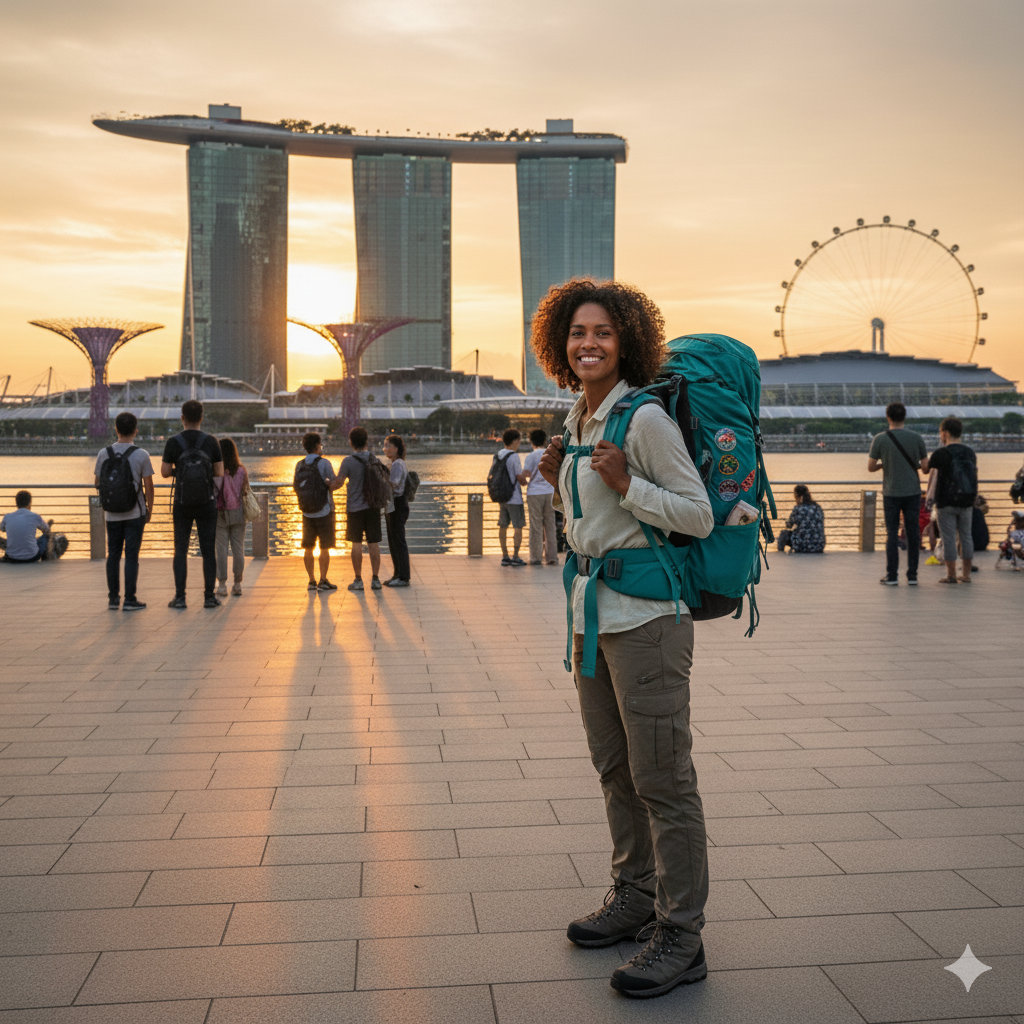

The email from my friend landed in my inbox at 2 AM: “You’re really going to Asia? Alone?”
Fair question. Three months earlier, I couldn’t find Thailand on a map without squinting. Now I was about to spend twelve weeks solo-traveling through five Asian countries, armed with nothing but a backpack, questionable Duolingo skills, and a growing suspicion that I’d lost my mind.
Well, Asia isn’t just safe for solo female travelers; it’s transformative. From Singapore’s midnight street walks to Japan’s heartwarming kindness, from Thailand’s infectious warmth to Vietnam’s bold adventures. These five countries became my training ground for confidence, resilience, and the art of being gloriously, unapologetically alone.
What follows is my real story: the moments I got hopelessly lost, the times strangers became lifelines, the street food that made me cry (both from joy and accidental chili overload), and everything in between.
Is Asia Safe for Solo Female Travel? (What You Need to Know)
Singapore, Japan, Thailand, Malaysia, and Vietnam rank among the world’s most visited solo travel destinations, with low violent crime rates, well-developed tourist infrastructure, and cultures known for hospitality towards solo women.
That said, “safe” doesn’t mean “nothing goes wrong.” Petty theft happens. Scams exist. Bag snatching is a real risk in specific areas. The five countries in this guide earn their safety reputation through very low rates of violent crime — but they reward the kind of awareness that any solo traveler should bring anywhere.
This guide tells you exactly what makes each one safe, what each one costs, and which one to start with based on your travel style.
At-a-Glance: Safety Comparison for Solo Female Travel Asia
| Country | 2025 GPI Rank | Solo Safety Score | Primary Safety “Vibe” | Top Safety Concern |
| Singapore | #6 | 10/10 | The Gold Standard. Virtually zero street crime; 24/7 safe walking. | Hefty fines for minor law breaks (littering/gum). |
| Japan | #12 | 10/10 | Respectful & Zen. High social order and deep respect for personal space. | Chikan (groping) on crowded rush-hour trains. |
| Thailand | #86* | 9/10 | Established & Social. A massive “backpacker trail” with safety in numbers. | Petty transport scams and “party scene” drink safety. |
| Malaysia | #13 | 9/10 | Modern & Accessible. High English levels make getting help very easy. | Bag snatching in crowded city centers (KL/Penang). |
| Vietnam | #38 | 8/10 | Bold & Energetic. Generally safe, but requires the most “street smarts.” | Motorbike-related phone snatching and chaotic traffic. |
Note: Thailand’s GPI rank is often skewed by regional border issues; however, the tourist path (Bangkok, Chiang Mai, and the islands) is globally recognized as highly safe for women.
- Singapore’s Strength: Strict law enforcement. It is the best place to “find your feet” as a first-timer.
- Japan’s Strength: Culture of “Omotenashi” (hospitality). Locals will often go far out of their way to help a lost traveler.
- Solo Tip: Use the Women-Only Carriages on the Tokyo Metro during morning/evening rush hours.
- Thailand’s Strength: The “Backpacker Infrastructure.” Because so many women travel here solo, hostels and tour operators are highly tuned to your needs.
- Malaysia’s Strength: Communication. Unlike Japan or Vietnam, almost everyone speaks English, which reduces the “lost in translation” anxiety that can feel unsafe.
- Vietnam’s Strength: Busy Streets. Vietnamese culture happens outdoors. Even at night, streets are filled with families and food stalls, meaning you are rarely “alone” in a dark alley.
Why Asia is Perfect for Women Traveling Alone
Before I booked my ticket, I spent weeks reading forums and watching YouTube videos, trying to quiet the voice in my head that kept asking, “What if something goes wrong?”
What I discovered changed everything. Many Asian countries have invested heavily in tourism infrastructure, creating environments where solo female travelers can explore confidently. Efficient public transportation systems, tourist-friendly police forces, and English signage in major cities make independent travel surprisingly accessible; even for complete beginners like I was.
My first destination became Singapore. From the moment I stepped off the plane at Changi Airport, I felt in good hands. The city-state became my gentle introduction to Asia, a place where East meets West so seamlessly that I could grab laksa for breakfast and afternoon tea by 3 PM without missing a beat.
Then came Japan, where my preconceived notions were both confirmed and utterly shattered. Yes, the trains run precisely on time (seriously, down to the second), and yes, people bow when they greet you. But nothing prepared me for the warmth behind the politeness, how a simple “arigatou gozaimasu” would light up faces when locals realized I was trying to speak their language.
Thailand hits differently: both laid-back and energizing at the same time. Even when I was fumbling through ordering pad thai without accidentally asking for extra spice (spoiler alert: I failed multiple times), everything felt like an adventure rather than a mistake.
Now, let me take you along on this journey through the top five countries that transformed me from a nervous first-timer into a confident solo traveler. First, you need to understand the different currencies.
Currency Quick-Reference Guide
Managing five different currencies across a 12-week trip can lead to serious “mental math fatigue.” Use this quick-reference table to keep your spending on track.
| Country | Currency | Approx. Exchange (per $1 USD) | The “Vibe” |
| Singapore | SGD (Dollar) | $1.28 | High-Value: Similar to USD/AUD. Easy to track, but prices are high. |
| Japan | JPY (Yen) | ¥160 | The 2026 Winner: Exceptionally weak Yen means luxury experiences are currently at a “discount” for Westerners. |
| Thailand | THB (Baht) | ฿32 | Budget King: Everything feels affordable, but watch the flat 220 THB ATM fees. |
| Malaysia | MYR (Ringgit) | RM 3.94 | Middle Ground: Great value for food; expensive for alcohol due to high taxes. |
| Vietnam | VND (Dong) | ₫26,300 | Millionaire Status: You’ll be dealing in millions. Drop the last three zeros to simplify your math! |
1. Singapore: The Safest Country in Asia for Solo Female Beginners
Who will love it? First-time solo travelers who want to ease into Asia
Communication: English proficiency is excellent
Solo travel comfort: 10/10
Singapore ranks 6th on the Global Peace Index 2025 — above the UK, Canada, and every other country in Southeast Asia. It has one of the lowest violent crime rates on earth. Walking alone at 3 AM through its streets felt safer than most neighborhoods I’ve lived in.
Why Singapore is Perfect for Solo Travel
The secret to Singapore’s accessibility is its world-class infrastructure.
- The MRT (Mass Rapid Transit): It runs until midnight, is spotlessly clean, and features English signage everywhere.
- Grab App: Southeast Asia’s version of Uber is cheap, reliable, and trackable, ensuring you’re never stranded.
- Walkability: Every major attraction—from the Marina Bay Sands to the local hostels—is designed with pedestrian safety in mind.
A Solo Foodie’s Guide to Singapore Hawker Centers
Singapore’s food scene offered a delicious introduction to Asian cuisine. Hawker centers became my obsession. These open-air food courts are where locals eat, and the variety is mind-blowing.
My Favorite Hawker Centers: They are affordable, social, and perfectly suited for someone dining alone.
- Old Airport Road: Go here for the legendary Hainanese chicken rice. The ginger-chili sauce is life-changing.
- Maxwell Food Centre: Home to the world-famous Tian Tian Chicken Rice. (Tip: Try the smaller stalls nearby for shorter lines!)
- Tiong Bahru Market: Perfect for a quiet morning ritual of chwee kueh (steamed rice cakes).
- Tekka Centre: Located in Little India, this is the spot for aromatic biryani and fresh sugar cane juice.
- Chinatown Complex: Dim sum for breakfast, claypot rice for dinner. This place had everything, and the prices were unbeatable.
Local tip: Skip Newton Food Centre and Lau Pa Sat’s pricier stalls. They’re expensive and tourist-trappy.
Singapore Hawker Center Etiquette for Solo Diners
Cultural customs at hawker centers initially confused me, but locals were patient teachers. “Choping a table” means reserving your seat by placing a tissue packet on it. Actually seemed bizarre at first. Yet this quirky Singaporean custom works. Nobody touches a “choped table,” and you’re free to order your food without worrying someone will steal your spot.
Cleaning my table at hawker centers felt natural once I saw locals doing it. Returning your tray to the designated stations shows respect for the space and the people who maintain it.
Many older vendors speak limited English. They might seem curt, but they’re not rude. Just direct and efficient during rush hours. A smile and pointing at the menu goes a long way. Better yet, ask a local diner for recommendations. These casual interactions led to some of my warmest encounters and best food discoveries.
Best Things to Do in Singapore Alone
Everyone visits Marina Bay Sands, Sentosa Island, and Gardens by the Bay. And, yes, you should! But Singapore revealed its soul in hidden, quieter corners.
Beyond the Iconic Attractions
Haji Lane became my afternoon sanctuary. Colorful shophouses line this narrow street in the Arab Quarter, each one housing boutiques, cafes, and photo-worthy corners. Sipping teh tarik at a cozy cafe there, surrounded by street art and indie shops, felt like discovering a creative haven that guidebooks barely mention.
Pulau Ubin offered a step back in time. A short ferry ride transported me to what Singapore looked like decades ago. Renting a bike and pedaling through rustic trails, past zinc-roofed houses and jungle paths, gave me a completely different perspective on the city-state.
Pack your drinking water and sunscreen because the island gets hot and there aren’t many shops.
Haw Par Villa was delightfully weird. This free park features vivid dioramas of Chinese mythology, including the rather terrifying Ten Courts of Hell. It’s quirky, slightly unsettling, and completely off the beaten path—exactly my kind of adventure.
MacRitchie Reservoir’s Treetop Walk delivered breathtaking rainforest canopy views. The suspension bridge swayed gently as I crossed, monkeys chattering in the trees around me. Going early morning meant fewer crowds and better chances of spotting wildlife.
Evening Adventures and Cultural Depth
Clarke Quay came alive at night. While I’m not huge on clubbing, the riverside energy was infectious. Sitting at a riverside bar with fellow travelers, watching boats glide past illuminated buildings, made for perfect people-watching evenings.
Fort Canning Park offered serene escapes within the city. Ancient trees, historical markers, and peaceful paths made it ideal for morning runs and afternoon reading sessions under the shade.
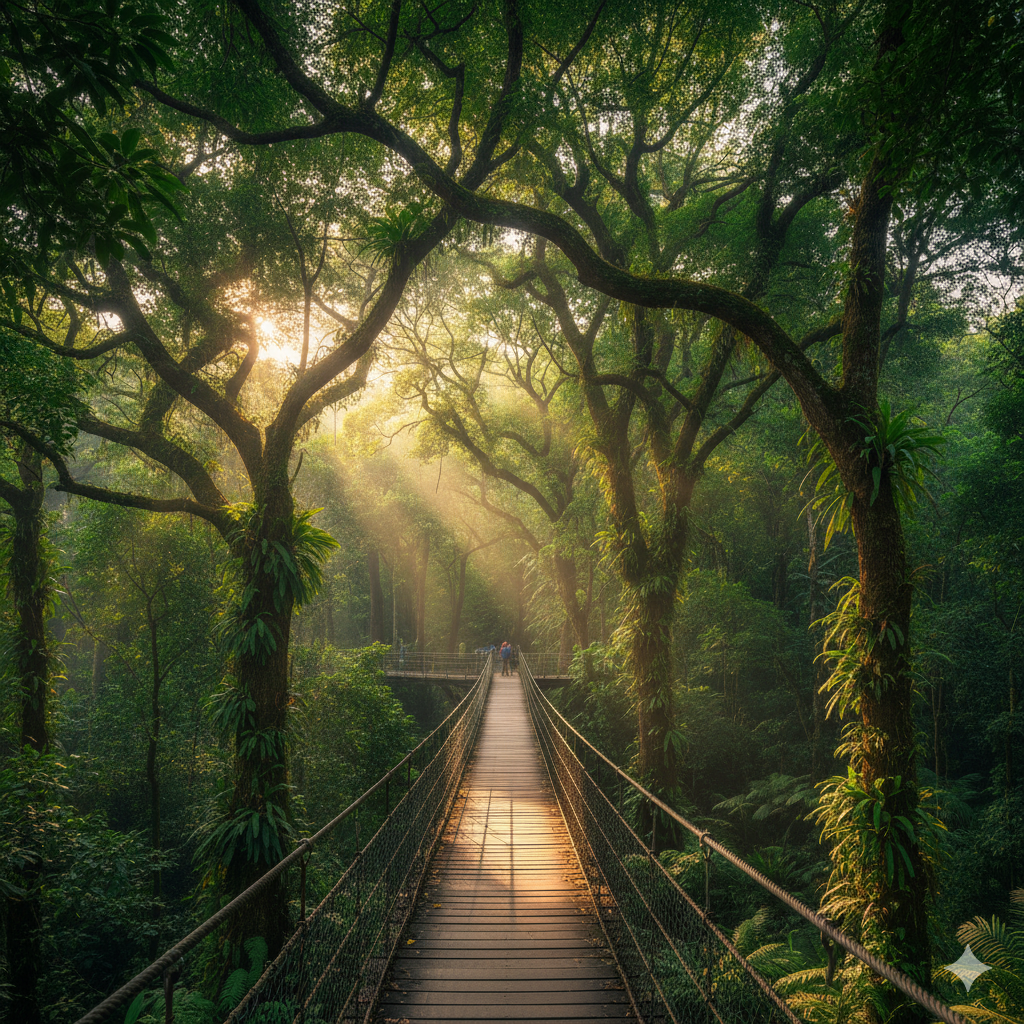
Wooden boardwalk through lush green canopy at MacRitchie Reservoir Treetop Walk
Cultural attractions deepened my understanding of the region. The Asian Civilisations Museum traces the artistic heritage of Asia, with free guided tours that bring the exhibits to life. National Gallery Singapore houses the world’s largest public collection of Southeast Asian art. It’s another spot with excellent free tours.
Religious sites added spiritual richness to my journey. The Buddha Tooth Relic Temple in Chinatown is stunning, with intricate architecture and a rooftop garden that few tourists discover. Sri Mariamman Temple, Singapore’s oldest Hindu temple, welcomed me with vibrant colors and the scent of incense.
Pro tip: If you have extra time, Tioman Island is a beach getaway that’s easily accessible from Singapore. Crystal-clear waters and jungle trails make it worth the ferry ride.
Where to Stay in Singapore: Top Hostels for Women
For a solo female traveler, picking the right neighborhood is key to your safety.
Capsule Pod Boutique Hostel (Chinatown) became my home base. Its pod-style beds offered privacy while the common area buzzed with energy. Meeting other solo female travelers over morning coffee in the lounge, swapping stories and tips, reminded me I wasn’t alone in this adventure.
Another excellent option is The Bohemian on Mosque Street. The lively atmosphere and central location near hawker centers and the MRT made it popular with the backpacker crowd.
Daily Solo Budget Tiers
Singapore was my most expensive destination, but still manageable. Hawker center meals cost what a coffee does back home. Accommodation prices vary widely; hostels keep costs reasonable, while hotels can get pricey. The splurges (like the view from Marina Bay Sands) felt worth it because I saved money on incredible street food.
Here is a realistic daily budget breakdown for 2026, categorized by travel style.
| Category | Budget (Hostels & Street Food) | Mid-Range (Boutique & Cafes) | Luxury (5-Star & Fine Dining) |
| Accommodation | $35 – $60 (Dorm/Capsule) | $120 – $220 (3-4★ Hotel) | $400+ (MBS / Raffles) |
| Food & Drink | $15 – $25 (Hawker Centers) | $45 – $70 (Cafes/Food Courts) | $150+ (Rooftop/Michelin) |
| Transport | $5 – $10 (MRT & Walking) | $15 – $25 (MRT & Grab) | $50+ (Private/Premium Grab) |
| Activities | $0 – $15 (Free Parks/Temples) | $30 – $50 (Cloud Forest/Zoo) | $100+ (Private Tours/Sentosa) |
| Total Daily | ~$60 – $110 USD | ~$210 – $365 USD | ~$700+ USD |
The Spending Breakdown
1. Accommodation: Sleeping Solo
- Female-Only Hostels: For 2026, a high-quality female-only dorm (like KINN Capsule: HER Space) averages $45 – $65 USD.
- Neighborhood Savings: Little India and Geylang offer the cheapest rates, while Chinatown and Boat Quay offer better “walkability” for a slightly higher price.
2. Food: The Hawker Advantage
- The $5 Meal: A plate of Hainanese Chicken Rice or Laksa at a hawker center still costs between $4 – $7 SGD ($3 – $5 USD).
- The “Plus Plus” (++) Warning: In restaurants, menus list prices like $25++. The first “+” is a 10% service charge, and the second is the 9% GST (tax). Hawker centers are “net,” meaning the price you see is the price you pay.
3. Transport: Efficiency is Cheap
- The Singapore Tourist Pass: If you plan to zip around, a 3-day unlimited pass for $34 SGD is a steal.
- Grab: A typical 15-minute city ride costs $12 – $18 SGD. It’s safe, trackable, and perfect for when your feet give out.
4. Alcohol: The “Sin Tax”
- This is where your budget can die. A pint of beer at a bar is often $15 – $22 SGD.
- Solo Hack: Buy your beer at a convenience store or a hawker center stall ($6–$8) and enjoy it by the waterfront at Marina Bay for free.
Top 3 Money-Saving Tips for Singapore
- Skip the Bottled Water: Tap water in Singapore is 100% safe to drink. Carry a reusable bottle and save $3 a day.
- The “Free” Skyline: Instead of paying $35 for the Sands Skypark, visit the Supertree Grove light show at 7:45 PM or 8:45 PM. It’s free and arguably more magical.
- Happy Hour is Real: Nightlife districts like Clarke Quay have “Early Bird” happy hours. If you want that Singapore Sling, go before 7 PM!
Essential Safety Tips for Women in Singapore
Singapore has strict laws around littering, jaywalking, and drug possession. These aren’t tourist traps — they’re enforced. The environment is clean because the rules are real. Don’t bring in chewing gum (it’s technically illegal to sell). Don’t assume what flies at home will fly here.
Related guide: What to pack for solo female travel Asia. Singapore’s aggressive air conditioning means you’ll want a light layer even in 32°C heat.
2. Japan: A Safe Haven for Culture and Kindness
Ideal for: Culture lovers and safety-conscious travelers
Ease of communication: Japan’s English proficiency is moderate (improving rapidly)
Safety and independence: 10/10
Japan sits at #12 on the Global Peace Index and has one of the lowest rates of sexual assault in the developed world. Solo female travelers consistently report Japan as the country where they felt most at ease — not because of police presence or security measures, but because of a cultural environment where strangers intervene helpfully rather than ignore, and where respecting others’ space is a deeply embedded social value.
One evening in Tokyo, I got hopelessly lost on a side street in Asakusa, trying to find my hostel. A local couple noticed me staring at my phone with growing panic. They stopped, pulled out their phones, and walked me fifteen minutes out of their way to my door. No shared language. Just genuine human kindness.
Top Solo Travel Destinations in Japan: Tokyo, Kyoto, and Osaka
Tokyo: Electric Chaos Meets Ancient Calm
Shibuya Crossing was my movie moment. Standing in the middle of the world’s busiest intersection, surrounded by thousands of people crossing in organized chaos, I felt simultaneously tiny and completely alive.
Mornings in Asakusa became sacred. Senso-ji Temple at dawn, before the crowds arrived, offered quiet moments of reflection. The scent of incense mingled with fresh taiyaki (fish-shaped pastries) from Nakamise-dori street vendors. Grabbing one still warm from the griddle, I’d wander through history, feeling transported.
Akihabara was my nerdy paradise. Arcades, manga shops stacked floor to ceiling, and themed cafes created sensory overload in the best way. The maid cafe experience made me giggle through the awkwardness. It’s touristy but uniquely Japanese.
Ueno Park provided contrast. Sipping matcha at a traditional teahouse, I watched cherry blossoms drift past (I was lucky with timing), felt worlds away from Akihabara’s neon chaos. Yet it was just a few subway stops.
Shinjuku’s Golden Gai surprised me most. Tiny izakayas, barely fitting six people with line narrow alleyways. Each bar has its own personality and regulars. Squeezing onto a barstool, sipping warm sake, and chatting with locals and travelers in broken English and lots of laughter became my favorite evenings.
But Tokyo had so much more to offer! I loved hitting Harajuku’s Takeshita Street for the wild fashion and those giant crepes. Then there was Odaiba. Totally futuristic, with amazing views of the Rainbow Bridge. And for a needed break, Shinjuku Gyoen was perfect for a peaceful garden stroll, reminding me to just slow down for a minute..
Tokyo Skytree offered stunning skyline views, though I preferred the free observation deck at the Tokyo Metropolitan Government Building. Same views but no ticket required.
Where I Stayed in Tokyo
Khaosan Tokyo Kabuki (Asakusa) felt like home. Pod-style beds provided privacy, while the communal vibe made meeting other travelers effortless. Swapping stories over breakfast, getting recommendations, and sometimes exploring together added a social dimension I craved after days of solo wandering.
For a central option, Nui. Hostel and Bar Lounge (Kuramae) offers a trendy cafe vibe with excellent coffee and a more design-forward aesthetic if that’s your style.
Kyoto: The Heart of Traditional Japan
If Tokyo is the pulse, Kyoto is the soul. It’s where time slows down, making it the perfect sanctuary for solo reflection.
Fushimi Inari’s endless red torii gates felt like walking through a dream. I was there at sunrise and felt like I had the mountain mostly to myself. The higher I climbed, the fewer tourists I encountered, until it was just me, the gates, and the forest.
Arashiyama’s bamboo groves delivered pure magic. Go at dawn when golden light filters through towering stalks. The rustling leaves create nature’s meditation soundtrack.
A tea ceremony in Gion taught me about patience. Every movement deliberate, every gesture meaningful. I left that traditional teahouse carrying a sense of calm that lasted days.
Kaiseki dinners felt like edible poetry. Multiple courses, each beautiful enough to photograph but too delicious not to devour immediately. These meals weren’t cheap, but they were art, culture, and sustenance combined. Worth every yen.
Best place to crash your night in Kyoto? Hostel Niniroom in Okazaki is a female-only hostel. 30-minute bus ride from Kyoto Station.
Osaka: Food Heaven
I took a day trip to Osaka. Literally 50 mins, drive from Kyoto.
Dotonbori assaulted my senses in the best way. Neon lights, excited crowds, and the smell of grilling food everywhere. Takoyaki (octopus balls) from street vendors, okonomiyaki (savory pancakes) at tiny restaurants, and kushikatsu (fried skewers) at standing bars. Osaka fed my soul.
Laughing with locals at a kushikatsu stall, skewer in hand, sauce dripping, reminded me that food creates universal connection. We didn’t need perfect language when we had delicious food and genuine smiles.
Beyond the Big Cities
Hiroshima broke my heart and lifted it simultaneously. The Peace Memorial Park and Museum were humbling, confronting the reality of nuclear war through personal stories and artifacts. Yet the city’s resilience shone through vibrant streets, bustling cafes, and the best Hiroshima-style okonomiyaki I’ve ever tasted.
Kanazawa felt like stepping into old Japan. Kenrokuen Garden’s meticulous beauty and the historic Higashi Chaya teahouse district transported me back centuries. Smaller and quieter than Kyoto, it offered similar charm without the crowds and the absolute best sushi in Japan.
Why Japan is Uniquely Safe for Women
Japan goes above and beyond to ensure solo travelers feel comfortable.
- Women-Only Carriages: Look for the pink signs on train platforms. During rush hours, most major lines offer cars reserved exclusively for women to ensure a stress-free commute.
- The “Konbini” Culture: 24-hour convenience stores (7-Eleven, Lawson, FamilyMart) are everywhere. They are well-lit, safe havens where you can withdraw cash, buy high-quality meals, or ask for directions at any hour.
- Vending Machines: You are never truly “stranded.” Even in remote areas, well-lit vending machines are available every few blocks, providing a sense of security and utility.
The Honest Warning
Japan’s “chikan” (groping on trains) problem is real, particularly in Tokyo during rush hours. Women-only carriages exist on most metro lines (marked on the platform) and are there for a reason. This shouldn’t deter anyone from visiting — it’s a well-acknowledged problem with practical solutions — but don’t let anyone tell you Japan is completely without issues for women.
Japan Cost Insights
While Singapore is the “predictable” budget, Japan is the “strategic” one. In 2026, the cost of Japan travel has shifted due to a significant price hike in the Japan Rail (JR) Pass, making it more important than ever to plan your route carefully to avoid overspending.
The Japan “Yen-sational” Opportunity
The Japanese Yen has reached a historic low against the US Dollar (hovering around 160 Yen per $1 USD). For solo female travelers, this is a massive win for both safety and comfort. In previous years, a mid-range hotel in Tokyo might have been out of reach for a budget traveler; in 2026, your “budget” goes significantly further.
- Safety: The weak currency means you can splurge on a “Women-Only” floor at a boutique hotel or a safe, private “Green Car” (first class) seat on the Shinkansen without breaking your bank.
- The Pro-Tip: While Japan is cheaper than ever, it is still a “cash-heavy” society in 2026 compared to Singapore. Always keep a stash of ¥1,000 and ¥5,000 notes for smaller shrines, local cafes, and vending machines.
Here is your realistic solo female travel budget for Japan in 2026.
| Category | Budget (Hostels & Konbini) | Mid-Range (Business Hotels) | Luxury (Ryokans & Fine Dining) |
| Accommodation | $25 – $50 (Capsule/Hostel) | $80 – $150 (3★ Business Hotel) | $350+ (Ryokan/Luxury) |
| Food & Drink | $20 – $35 (Ramen/Convenience) | $50 – $80 (Casual Dining) | $150+ (Kaiseki/Sushi) |
| Transport | $10 – $20 (Local Subway) | $30 – $50 (Subway + Shinkansen*) | $80+ (Taxis/Private) |
| Activities | $5 – $15 (Temples/Shrines) | $20 – $60 (Museums/Tea Ceremony) | $100+ (Disney/Private Tours) |
| Total Daily | ~$60 – $120 USD | ~$180 – $340 USD | ~$680+ USD |
*Shinkansen costs are averaged over a multi-day trip.
How you can spend in Japan
1. Accommodation: The “Business Hotel” Sweet Spot
- Female-Only Capsules: In 2026, high-end capsules (like The Millennials Shibuya) average $45 – $55 USD.
- Business Hotels: Brands like APA, Toyoko Inn, or Dormy Inn are the secret weapon for solo women. They are spotlessly clean, very safe, and provide pajamas and skincare kits. Expect to pay $85 – $110 USD for a single room.
2. Food: High Quality, Low Stress
- The “Konbini” (Convenience Store): You can get a fresh, healthy bento or onigiri breakfast for $5 – $8 USD.
- The Lunch Special: Many mid-range restaurants offer “Teishoku” (set meals) at lunch for $10 – $15 USD that would cost double at dinner.
- The “Depachika” Hack: Visit the basement level of department stores (like Isetan or Mitsukoshi) after 7 PM. They heavily discount high-end sushi and ready-to-eat meals.
3. Transport: The 2026 JR Pass Reality
- The JR Pass Hike: The 7-day Ordinary Pass is now ¥50,000 (~$335 USD). Unless you are zipping across the country (e.g., Tokyo → Kyoto → Hiroshima → Kanazawa → Tokyo), it is often cheaper to buy individual Shinkansen tickets or use local regional passes.
- Local IC Cards: Use a digital Suica or Pasmo on your phone. Most subway rides are $1.50 – $2.50 USD.
4. Experiences: Budgeting for Culture
- Temples & Shrines: Most are free or cost a nominal $3 – $5 USD.
- Onsens: A visit to a local public bath (Sento) is only $4 – $6 USD, whereas a luxury hot spring resort can be $30+.
Saving Tips
- Drink the Water: Tap water is safe and delicious. Look for “water refill” stations in stations to save on $2 vending machine bottles.
- Night Buses: If you’re on a strict budget, use a “Willer Express” night bus between Tokyo and Kyoto. It saves you one night of accommodation and the cost of a Shinkansen ticket ($40 vs. $90).
- Free Views: Skip the Tokyo Skytree ($20+). The Tokyo Metropolitan Government Building in Shinjuku offers a stunning 45th-floor view for free.
Japan’s Transportation Magic: Navigating the JR Pass and Shinkansen
The train system deserves its reputation. English signage, punctual schedules (trains apologize for 30-second delays), and helpful staff made navigation surprisingly easy. A JR Pass proved worthwhile for my multi-city itinerary, though calculate whether it makes sense for your specific route.
3. Thailand: The Best Budget-Friendly Destination for Solo Women
Best for: Budget travelers and social butterflies
English proficiency: Good in tourist areas
Solo-friendly factor: 10/10
Thailand’s Global Peace Index ranking looks alarming at first — #86 — but this reflects political instability and regional border tensions rather than tourist safety. For solo female travelers sticking to the established tourist trail (Bangkok, Chiang Mai, the islands), Thailand has a strong safety record and one of the world’s most developed backpacker infrastructures. Violent crime against tourists is rare. The risks are specific and avoidable.
The Southeast Asian country felt like coming home to a place I’d never been. The locals’ smiles are infectious, and their warmth makes every day brighter. A street vendor in Chiang Mai patiently taught me how to order pad thai in Thai (“Pad Thai ka ผัดไทย ค่ะ), repeating phrases until I got the tones right.
Top Solo Travel Cities in Thailand: From Bangkok to Chiang Mai
Bangkok: A Masterclass in Beautiful Chaos
Bangkok’s vibrant chaos thrilled me from the start. Riverside Golden temples like Wat Arun and Grand Palace gleamed in the sunlight, their intricate details demanding hours of admiration. Solo Tip: Use the Chao Phraya Express Boat; it’s a cheap, scenic, and safe way to skip the city’s notorious traffic.
Chatuchak Weekend Market sprawled endlessly; 15,000 stalls of clothing, handicrafts, street food, and treasures I didn’t know I needed.
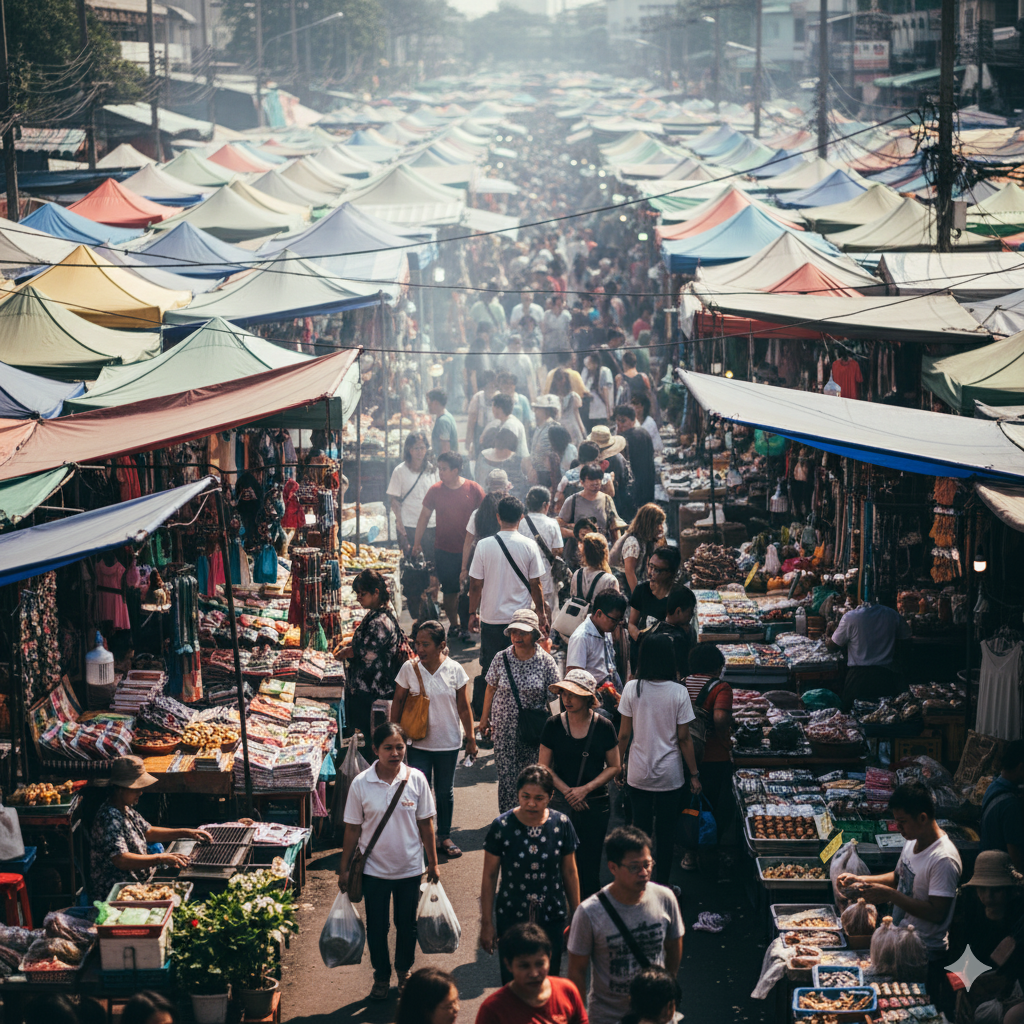
Haggling became an art form. Start low, smile a lot, and be willing to walk away. Vendors respect the dance, and I scored handmade souvenirs at great prices while having fun.
Modern Comforts: Neighborhoods like Ari and Thonglor offer a quieter, local vibe with incredible cafes, while Chinatown (Yaowarat) is the ultimate destination for street food lovers.
Transportation made life easy. The BTS Skytrain and MRT moved me efficiently around the city. For late-night rides, Grab became my safety net. It’s cheap, reliable, and trackable. This helped me avoid tuk-tuk scams (always agree on the price before getting in).
The 24-Hour Safety Net: In Bangkok, you’re never truly alone. Between the 1155 Tourist Police hotline and the sheer number of 7-Elevens (your go-to for everything from water to emergency SIM cards), help is always nearby.
Chiang Mai: Mountain Magic
If Bangkok is the energy, Chiang Mai is the soul. It is consistently rated as one of the safest cities for women globally.
- The Old City: Its compact, walkable layout makes it easy to explore temples like Wat Phra Singh without needing a map.
- Digital Nomad Community: Because it’s a hub for remote workers, the cafes and coworking spaces are filled with other solo travelers. It’s the easiest place to strike up a conversation.
- Ethical Encounters: Visit the Elephant Nature Park. Jetgurl Pro Tip: Always research sanctuaries beforehand; look for “no-riding” policies to ensure your visit supports animal welfare.
Chiang Mai’s laid-back vibe
The exact place I needed after Bangkok’s intensity. The Elephant Nature Park became a highlight of my entire Asian journey. Feeding gentle giants bananas, watching them play in mud baths, and learning about ethical sanctuaries made me tear up. Skip the elephant riding tours. They harm animals, however choose sanctuaries where elephants roam freely and visitors observe respectfully.
The Sunday Night Market was a sensory overload in the best way. Street food stalls, handicraft vendors, and live music created an atmosphere that made me want to stay for hours. Mango sticky rice, pad see ew, and those little coconut pancakes became my dinner, dessert, and second dessert.
Exploring the Old City’s temples on foot became my daily meditation. Wat Phra Singh, with its golden chedi, offered peaceful moments away from tourist crowds.
A Thai cooking class taught me to master green curry. I visited a local market with the instructor, learnt about ingredients, then created a meal I could actually taste and be proud of. Pure joy.
Pai deserved its reputation. Renting a scooter (be honest about your skill level since those mountain roads get intense), I zipped through countryside to hot springs and Pai Canyon. The backpacker-friendly atmosphere, with cafes and hostels lining the streets, made meeting people effortless.
Island Hopping in Thailand: Safety in the South
Krabi’s beaches delivered postcard-perfect beauty. Limestone cliffs jutted from turquoise waters, creating dramatic backdrops for my kayaking adventures through Phang Nga Bay. Paddling through emerald lagoons and sea caves felt like exploring a secret world.
Koh Phi Phi lived up to the hype. Maya Bay (from “The Beach”) was stunning, though crowded. Beach bars at night buzzed with energy. I met fellow travelers and we danced in the sand, watching fire shows that created those quintessential backpacker moments.
Koh Tao was a gem for snorkeling. Crystal waters and vibrant coral reefs teeming with fish amazed me even without diving certification. Guided snorkeling tours kept me safe while showing me the best spots.
Koh Phangan: Beyond the Full Moon Party, this island has a thriving wellness and yoga community.
Phuket Old Town: A colorful, historic alternative to the busy beach resorts, perfect for solo wandering and photography.
Watching the sunset in Phuket with a mango smoothie in hand, I realized how much I’d grown as a solo traveler. Thailand gave me the courage to embrace the unknown, whether navigating Bangkok’s hectic streets or joining strangers for a cooking class.
A Unique Experience
The Women’s Massage Center by Ex-Prisoners in Chiang Mai combined relaxation with social good. Run by formerly incarcerated women, the center provides job training and second chances. The Thai massage was excellent, and knowing I supported a meaningful cause made it even better.
Where to stay in Thailand: Social & Secure
Lub d Bangkok Siam became my sanctuary. Central location, top-notch security, and a rooftop bar where I met fellow travelers over sunset beers made it perfect for balancing socializing with safety.
In Chiang Mai, Stamps Backpackers had great energy—think communal dinners and group outings. In Koh Phi Phi, PP Charlie Beach Resort offered easy beach access without the party hostel intensity.
Is Thailand safe for solo female travelers?
Yes, with awareness. The established tourist trail in Thailand has a strong safety record for solo women. The risks are mostly petty theft, drink spiking at party destinations (Koh Phi Phi, Koh Samui), and transport scams — all of which have practical countermeasures. Violent crime against tourists is rare. Dress modestly at temples, use Grab not random tuk-tuks, and trust the instinct that something’s off when something’s off.
Avoiding Common Thailand Scams
Bangkok has a well-documented scam ecosystem targeting tourists — particularly the Grand Palace “closed today” scam, tuk-tuk gem shop tours, and taxi refusals to use meters. These are nuisances, not serious safety threats, but they’re real. Our solo female safety guide covers every common Thailand scam with specific scripts for handling them.
Daily Solo Budget
Thailand is the destination where you’ll see your money go the furthest of all five countries on your list. In 2026, despite a slight rise in transportation costs, it remains the ultimate “backpacker’s luxury” destination.
Here is the 2026 budget breakdown for you.
| Category | Budget (Hostels & Street Food) | Mid-Range (Boutique & Cafes) | Luxury (Resorts & Fine Dining) |
| Accommodation | $12 – $20 (Dorm bed) | $40 – $90 (Boutique Hotel) | $180+ (Pool Villa/5★) |
| Food & Drink | $10 – $15 (Night Markets) | $25 – $45 (Cafes/Sit-down) | $80+ (Rooftop Bars/Fine Dining) |
| Transport | $5 – $10 (BTS & Songthaews) | $15 – $30 (Grab & Bolt) | $60+ (Private Driver) |
| Activities | $5 – $15 (Temples/Beaches) | $40 – $80 (Island Tours/Cooking) | $150+ (Private Yacht/Spas) |
| Total Daily | ~$35 – $60 USD | ~$120 – $245 USD | ~$470+ USD |
Spending Breakdown
1. Accommodation: Hostels vs. Flashpacking
- The “Flashpacker” Suite: In 2026, you can get a stunning private room in a high-end hostel (like Lub d or Siam Stadium Hostel) for $30 – $45 USD.
- Island Premiums: Be aware that prices on islands like Phuket or Koh Samui can be 30-40% higher than in Chiang Mai or Bangkok.
2. Food: The 2026 Street Food Reality
- Market Pricing: A plate of Pad Thai at a local market is still a steal at $1.50 – $2.50 USD (฿50-80).
- The “Western” Tax: If you crave a flat white or an avocado toast in a trendy Chiang Mai cafe, expect to pay $8 – $12 USD—nearly Western prices.
- Pro Tip: Look for “Food Courts” in malls like Terminal 21. They are air-conditioned, incredibly clean, and have street-food prices.
3. Transport: The “Grab vs. Bolt” Battle
- Ride-Hailing: Bolt is significantly cheaper than Grab in Thailand (sometimes by 30%), but the wait times can be longer.
- Motorbike Taxis: For solo travelers, a “GrabBike” is the fastest way to beat Bangkok traffic and costs only $1 – $3 USD for most short city hops.
- Island Transport: This is where you’ll spend the most. A taxi from Phuket Airport to the beach can cost $20 – $30 USD, even though it’s a relatively short distance.
4. Experiences: Budgeting for Ethics
- Ethical Elephant Sanctuaries: A full day at a reputable, no-ride sanctuary like Elephant Nature Park in Chiang Mai is roughly $75 – $80 USD (฿2,500). It’s a splurge, but it includes transport and a massive buffet lunch.
- Island Tours: A group speedboat tour to the Phi Phi Islands or Phang Nga Bay typically runs $45 – $60 USD.
Saving Tips for Thailand
- The 7-Eleven “Life Raft”: Thai 7-Elevens are legendary. You can get a toasted ham and cheese sandwich (a backpacker staple) and a coffee for under $3 USD.
- Avoid ATM “Double Dipping”: Thai ATMs charge a flat $6 – $7 USD fee per withdrawal. To save, withdraw the maximum amount (usually ฿20,000) at once to minimize these fees.
- Domestic Flights: Airlines like AirAsia and Nok Air are incredibly cheap if you book 3-4 weeks out. You can often fly from Bangkok to the islands for $35 USD, which is barely more than a long-distance bus.
4. Malaysia: A Multicultural Gem with Excellent English Proficiency
Three cultures, one country, one of the world’s great food scenes
A top pick for: Foodies and culture enthusiasts
Ease of communication: Excellent English proficiency
Solo-friendly factor: 9/10
Malaysia doesn’t get the attention it deserves from first-time Asia travelers. It ranks 13th globally on the Peace Index — significantly ahead of Thailand and comparable to many European destinations. English proficiency is excellent (a legacy of British colonial education). The multicultural character — Malay, Chinese, and Indian cultures layered over each other for centuries — creates a cultural richness that feels different from anywhere else in the region.
Exploring Kuala Lumpur
Landing in KL, I was immediately struck by the chaotic blend of modern skyscrapers, bustling street markets, and the hum of multicultural life. The Petronas Towers dominated the skyline, their gleaming twin spires making me feel like I’d stepped into a movie.
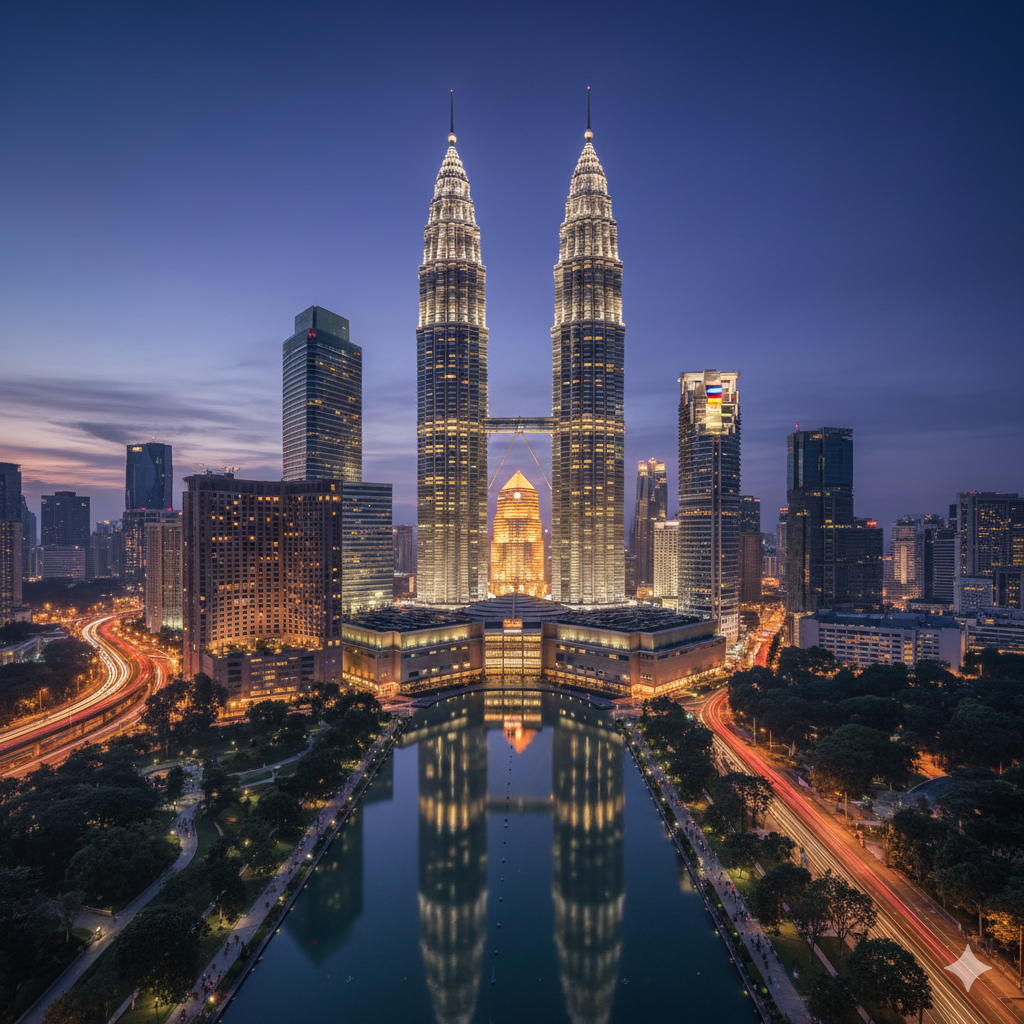
Twin Petronas Towers illuminated at night dominating Kuala Lumpur skyline
Pro tip: Book Skybridge tickets in advance online. The views are jaw-dropping, and slots fill up fast.
Solo Tip: Walk through KLCC Park early in the morning for a peaceful, safe start to your day.
Batu Caves: Climb the 272 rainbow-colored stairs to visit the iconic limestone shrines. It’s an easy, safe train ride from the city center.
Chinatown’s Petaling Street became my happy place. The night market’s energy made me feel alive and connected, even solo. Hawker stalls served everything from spicy laksa to crispy roti canai. My taste buds danced (and maybe sweated a little—Malaysian food doesn’t shy away from spice).
Jalan Alor & Bukit Bintang, other food streets, introduced me to nasi lemak—coconut rice with sambal, anchovies, and a boiled egg. Love at first bite doesn’t begin to describe it.
Safety in KL
KL felt like any big city. A friend who’d visited before advised me about bag-snatching in crowded areas. Keeping my crossbody bag zipped and in front of me became habit. Staying alert in busy markets and using well-lit streets at night felt like common sense rather than paranoia.
Grab (Malaysia’s ride-hailing app) was a lifesaver and super affordable. Late-night rides home from food street adventures never broke the bank or made me worry about safety.
Penang: Art, History, and Incredible Food
George Town stole my heart completely. This UNESCO World Heritage Site is an open-air gallery. Its colorful street art adorns every corner. The famous “Kids on Bikes” mural and dozens of others made wandering the streets an adventure in itself.
Colonial architecture and vibrant shophouses created endless photo opportunities. Beyond the aesthetics, George Town felt alive with history and culture.
The food in Penang reached another level entirely. Hunting down the best char kuey teow (stir-fried noodles) at a Gurney Drive hawker stall became an obsession. Penang’s famous Assam laksa—tangy, spicy, unlike anything I’d tasted—challenged and delighted my palate.
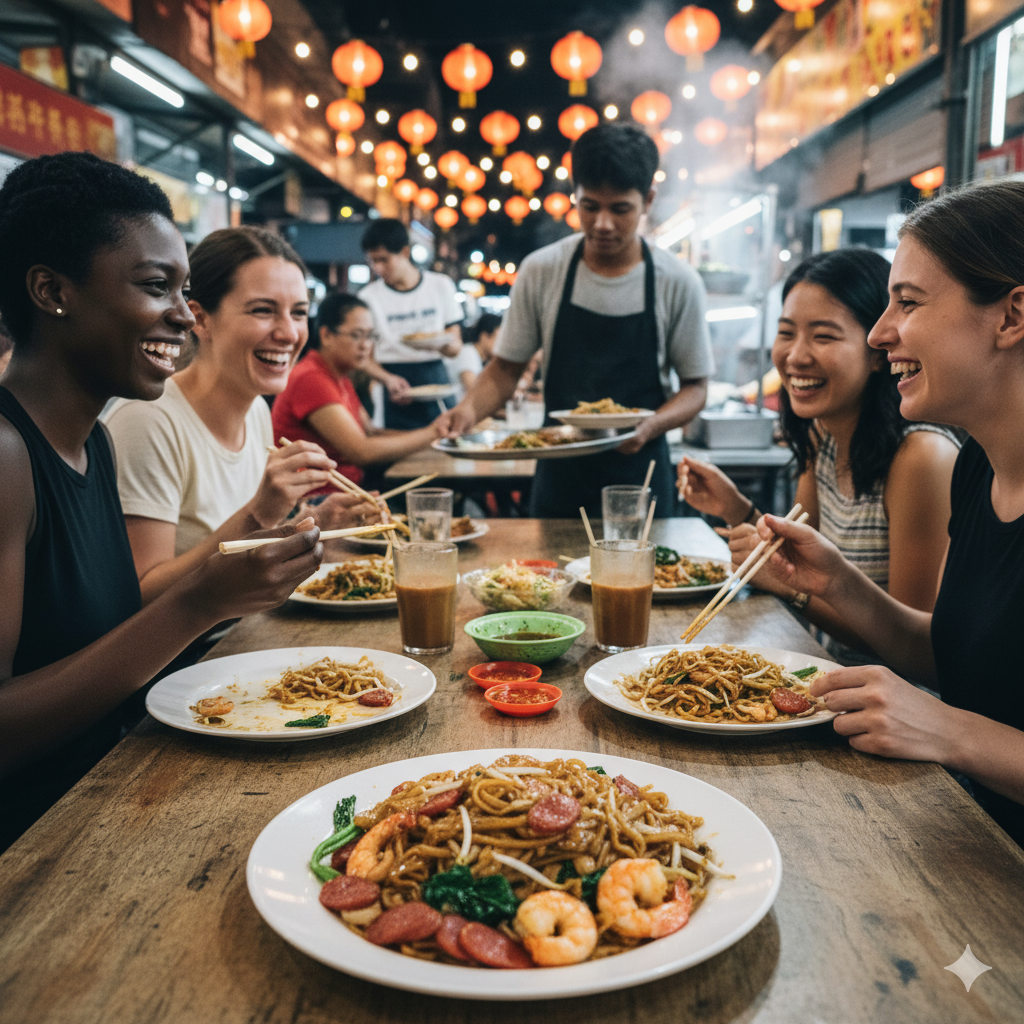
Enjoying a plate of char kuey teow stir-fried noodles with prawns and vegetables
Street Art Hunting: Rent a bike or simply wander. Finding the famous murals like “Kids on Bikes” is a fun way to navigate the city’s charming alleys.
Hawker Heaven: Head to Gurney Drive or the Chulia Street Night Market. The char kuey teow (stir-fried noodles) here is world-famous.
A Safe Community: Penang has a massive solo travel community. You’ll find that cafés and hostels are naturally social spaces where it’s easy to make friends.
Staying in a George Town hostel meant meeting other travelers easily. The chill vibe led to spontaneous night market crawls with new friends, reminding me that solo travel doesn’t mean always being alone.
Timing tip: Penang gets packed during festivals like Chinese New Year. Plan around these for a quieter experience. Also, comfortable walking shoes are essential. Remember, the cobblestone streets look charming but murder flip-flops.
Malacca: History Comes Alive
Malacca offered a quick escape—just a bus ride from KL. Colorful rickshaws, Dutch colonial buildings, and a laid-back riverfront created old-world charm.
Jonker Street Night Market buzzed with energy. Stalls sold everything from mango sticky rice to quirky souvenirs. One night was enough to soak in the atmosphere, though staying overnight let me enjoy the town at a slower pace.
Safety-wise, Malacca felt very comfortable even at night. Sticking to the busy market areas and main streets, I never felt concerned as a solo female traveler.
History buffs should check out the Stadthuys (Dutch colonial building) and A Famosa fort—stepping into these sites felt like time travel.
Cameron Highlands: Nature’s Retreat
Craving greenery after city life, I headed to the Cameron Highlands. Rolling hills covered in tea plantations, cool mountain air, and a completely different pace made the journey worthwhile.
Visiting BOH Tea Estate became a highlight. Sipping fresh tea while staring at postcard-worthy views of endless green hills felt like a dream. A short hike through the tea fields gave me that earned-this-teh-tarik feeling afterward.
Honest take: Some travelers feel Cameron Highlands isn’t worth the travel time for a short trip. The bus journey takes several hours, and roads get winding. For nature lovers like me, though, it delivered exactly what I needed. Fresh air, beautiful landscapes, and a break from urban intensity.
Pack a light jacket because the elevation makes it surprisingly chilly, especially in the mornings.
Where You Can Stay in Malaysia
BackHome Kuala Lumpur in Chinatown was perfectly positioned for exploring KL’s cultural districts. Common areas facilitated meeting other solo travelers, and the location made walking to major attractions easy.
Why Malaysia is a Solo Traveler’s Secret Weapon
- The Language Advantage: Because English is so widely spoken, the “anxiety of the unknown” is virtually gone. Booking a bus, ordering food, or asking for help is as easy as it is at home.
- Safety Infrastructure: Malaysia’s Grab app works flawlessly. It’s my go-to for safe, transparently priced transport, especially after sunset.
- Modern Healthcare: Should you need a pharmacy or a quick clinic visit, Malaysia’s medical infrastructure is top-tier and very accessible for tourists.
Cultural Respect: The “Modesty” Rule
Malaysia is a predominantly Muslim country, and while cities like KL and Penang are quite liberal, showing cultural respect goes a long way:
- Dress the Part: When visiting mosques or rural kampongs (villages), ensure your shoulders and knees are covered. Carry a light scarf in your bag—it’s the ultimate multi-purpose travel tool.
- Public Etiquette: Avoid loud or aggressive behavior. A calm, soft-spoken approach is the local norm and will earn you plenty of warm smiles and help.
Is Malaysia Affordable?
Malaysia fell in the middle budget-wise. More affordable than Singapore, slightly pricier than Thailand, but the English proficiency and cultural diversity made it excellent value. Food remained incredibly cheap and delicious—eating at hawker stalls and local restaurants kept costs low while delivering authentic experiences.
The “Affordable Luxury” Budget
| Category | Budget (Dorms & Hawkers) | Mid-Range (3★ & Cafes) | Luxury (5★ & Fine Dining) |
| Accommodation | $12 – $20 (Pods/Hostels) | $45 – $75 (Boutique/3★) | $130+ (5★ Luxury) |
| Food & Drink | $10 – $15 (Hawker Stalls) | $25 – $40 (Cafes/Bistros) | $80+ (Fine Dining/Cocktails) |
| Transport | $4 – $8 (MRT/LRT) | $12 – $20 (Grab & Intercity) | $50+ (Private/Flights) |
| Activities | $5 – $10 (Museums/Free sites) | $20 – $40 (Snorkeling/Tours) | $100+ (Private Island trips) |
| Total Daily | ~$35 – $55 USD | ~$105 – $180 USD | ~$360+ USD |
- The “Luxury” Hack: You can often find 5-star hotels in Kuala Lumpur (like the JW Marriott or Shangri-La) for under $120 USD—a price that wouldn’t even get you a 2-star motel in London or NYC.
- Alcohol Alert: Because of high taxes, a single cocktail at a rooftop bar can cost $12 – $15 USD, which might be more than your entire day’s food budget! However, Langkawi Island is a “Duty-Free” exception if you want to enjoy a drink on a budget.
Is Malaysia Safe? Solo Travel Tips for Women
Malaysia has conservative attitudes toward dress and behavior in rural areas and smaller towns outside KL and Penang. What’s fine in the city may not be fine in a kampong village or at a mosque. Carry a scarf and read the room. Also, some areas of KL (notably parts of Chow Kit) are rougher than others. Stick to well-lit streets at night, and the standard safety habits apply.
Get to know more about Malaysia in our comprehensive solo female travel guide to Malaysia
5. Vietnam: Bold Adventures for the Confident Solo Traveler
Great choice for: Adventure seekers and food lovers
Language barrier: English proficiency is moderate (improving in cities)
Vibe for solo wanderers: 8/10
Vietnam gives an 8/10 rather than the 10s of Singapore and Japan, not because it’s dangerous but because it rewards awareness more actively. It ranks #38 on the Global Peace Index. Phone snatching from motorbikes happens in HCMC. Street crossing in Hanoi requires faith and a specific technique (walk slowly and steadily — the motorbikes part around you; hesitating causes accidents). Petty theft in crowded markets is real. None of this should stop anyone — Vietnam is extraordinary — but it’s the country on this list where staying switched-on matters most.
Navigating the Chaos of Ho Chi Minh City
Nervous about navigating the chaos, I joined a motorbike food tour my first night. Strangers became friends as we zipped through traffic, stopping at street stalls for the best banh mi I’ve ever had. Hopping on the back of a motorbike driven by a local guide, weaving through traffic while clutching their waist, felt terrifying and exhilarating simultaneously.
District 1 became my home base. It’s the backpacker hub where Bui Vien Street pulsed with life. Mai’s Red Dot Hostel was perfectly secure, central, and staffed with locals who went above and beyond to make me feel welcome. Their restaurant and tour recommendations never missed a thing.
Ben Thanh Market offered my first real haggling challenge. Prices start high, but expect friendly negotiation and locals who respect you. Buying souvenirs there, I learned to smile, offer half the asking price, and be willing to walk away. Usually, vendors called me back with better offers.
A kind local warned me to keep my phone secure. Pickpocketing happens in crowded areas. Keeping valuables in my crossbody bag, staying aware in busy markets, and using common sense kept me safe throughout my stay.
Surprisingly, I felt more comfortable walking back to my hostel at night in HCMC than in some cities back home. The streets stay busy, locals are friendly, and the energy feels vibrant rather than threatening.
Using Grab for rides was a game-changer. It’s cheap, reliable, and stress-free navigation through chaotic traffic without needing to drive myself.
The Magic of Hoi An and Ha Long Bay
From HCMC, I quickly flew to Da Nang and headed to Hoi An. I discovered a town that stole my heart completely. The ancient village glowed with colorful lanterns at night, casting magical reflections on the Thu Bon River.
I spent my days cycling through rice paddies, visiting tailor shops for custom-made dresses (affordable and beautifully made), and eating at Café 43, where the cao lầu was divine.
Hoi An suited my travel style perfectly. I loved soaking in local life without feeling rushed. I joined a basket boat ride in the coconut village, laughing as I tried to paddle without tipping over. The local guides made it fun and welcoming.
An Bang Beach offered relaxing days when I needed breaks from sightseeing. Less crowded than other Vietnamese beaches, it provided peaceful moments with a book and a coconut.
Mui Ne: Unexpected Beach Paradise
Returning to HCMC, I boarded a bus to Mui Ne, just 200 kilometers away. Reading lukewarm reviews, I wasn’t sure what to expect. Three nights turned into falling completely in love with the place.
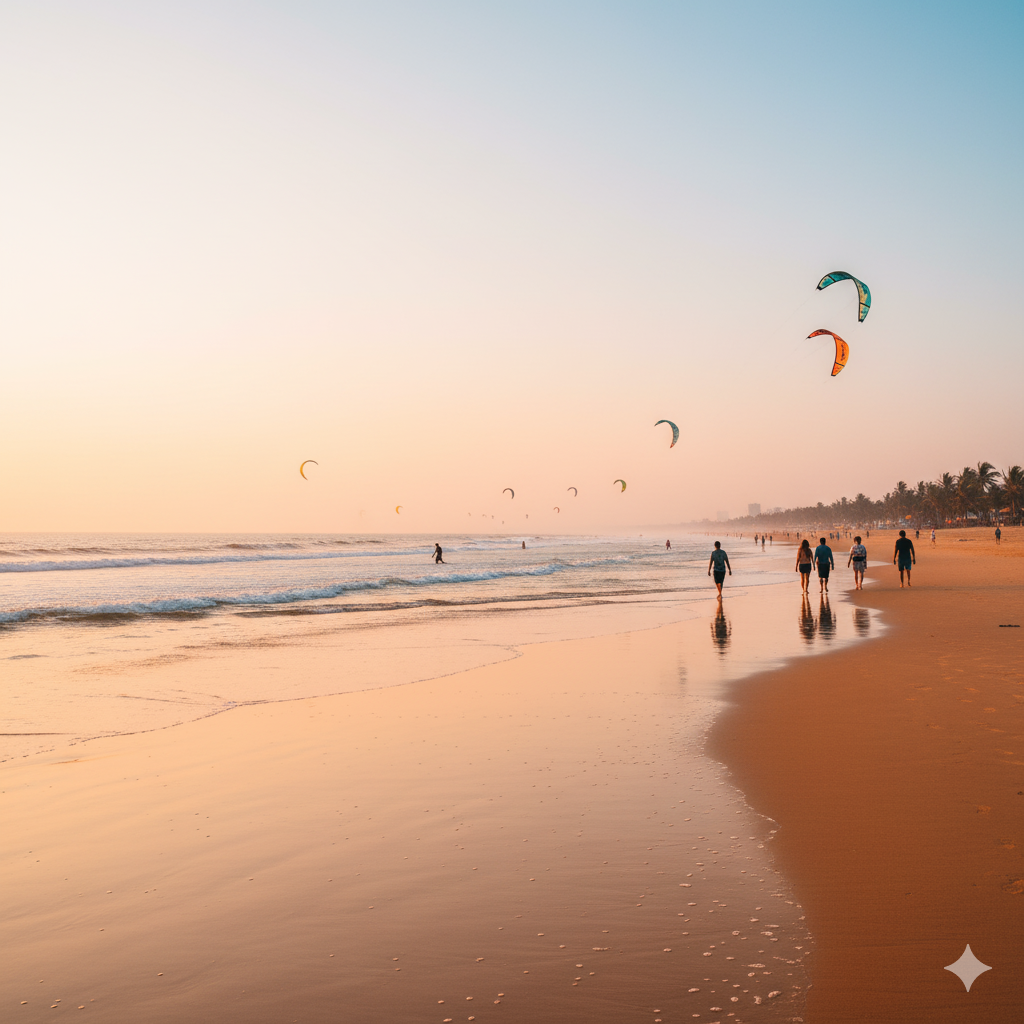
Peaceful beach with kite surfers and fewer crowds along Mui Ne coastline
The beaches might not have Thailand’s postcard-perfect reputation, but they have authenticity. Dipping into the ocean every day without fighting crowds for beach space felt liberating.
Golden sands, vibrant kite-surfing scenes, and iconic red and white sand dunes created desert-like landscapes that felt surreal. Watching sunrise over the dunes, with wind-sculpted patterns creating natural art, became one of my favorite Vietnamese memories.
Safety note: Mui Ne felt very safe and welcoming. The laid-back vibe extended to locals and other travelers. Sticking to well-lit areas at night and avoiding carrying valuables on the beach were my only precautions.
Where to Stay in Mui Ne
Villa Aria Muine offered beachfront access with clean, modern rooms perfect for solo travelers. Walking straight from my room to golden sand made mornings effortless.
For something special, Bamboo Village Beach Resort & Spa features lush gardens, a pool, and a yoga room. Stylish wooden and bamboo rooms created a peaceful atmosphere right by Phan Thiet Beach.
Booking tip: Mui Ne’s best accommodations fill up fast, especially December through April (dry season). Confirm your stay before arriving—late-night arrivals can be tricky.
Hanoi: Organized Chaos
My journey ended in Hanoi. Exploring Hoan Kiem Lake, sipping egg coffee at a cozy café, and braving the chaotic streets taught me confidence I didn’t know I possessed. Crossing streets in Hanoi requires faith. Walk slowly and steadily because motorbikes part around you like a choreographed dance. Hesitating causes more problems than confident, steady movement.
A day trip to Ninh Binh’s Tam Coc was absolutely worth it. Gliding through emerald rice fields in a small boat, surrounded by limestone karsts rising from the water, felt like stepping into a painting. The boat drivers (often local women) row with their feet—impressive and mesmerizing to watch.
Mixed reviews about Hanoi prepared me for a challenging city, but I found it thrilling. The Old Quarter’s vibrant energy, narrow streets packed with vendors and cafes, created sensory overload in the best way.
Language barriers meant lots of smiling and pointing when ordering food, which always ended in delicious surprises. Locals were kind, even when communication required creative hand gestures and translation apps.
Ha Long Bay: A Dream I Didn’t Want to End
A cruise through Ha Long Bay delivered the most magical experience of my entire Asian adventure. Emerald waters, towering limestone karsts, and floating villages created a dreamscape I didn’t want to wake up from.
Sleeping on a traditional junk boat, waking up to mist-covered karsts, and kayaking through hidden lagoons made every penny spent feel worthwhile. This splurge topped my Vietnam expenses but remains one of my best travel memories ever.
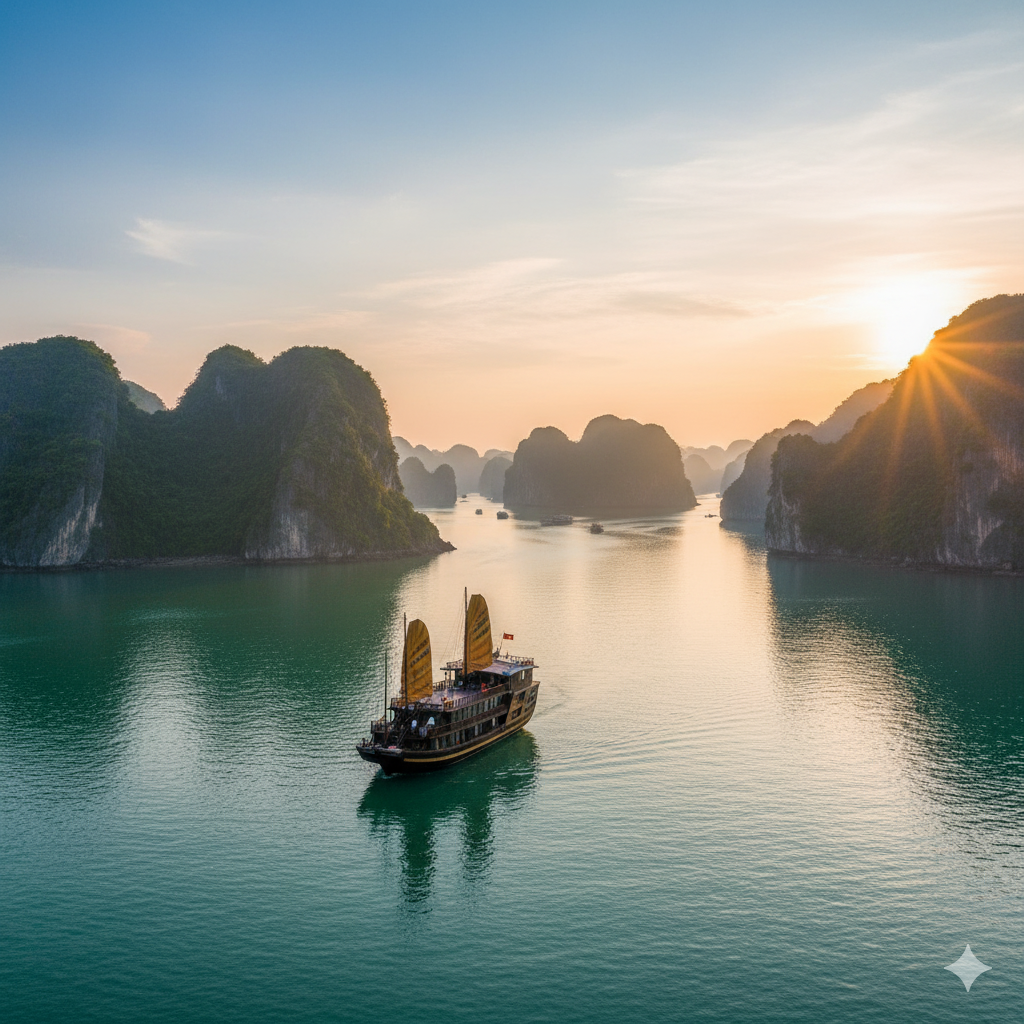
Emerald waters of Ha Long Bay with towering limestone karsts and traditional junk boat
Daily Cost Perspective
Vietnam was incredibly affordable, and it’s perfect for stretching a backpacker budget. It remains the most budget-friendly country on this list. Your purchasing power here is immense thanks to the exchange rate (approx. 25,000 VND to 1 USD).
| Category | Budget (Dorms & Pho) | Mid-Range (Boutique & Tours) | Luxury (Resorts & Cruises) |
| Accommodation | $8 – $15 (Social Hostels) | $30 – $55 (Boutique Hotels) | $120+ (High-end Resorts) |
| Food & Drink | $8 – $12 (Street Food) | $20 – $35 (Cafes/Restaurants) | $70+ (Fine Dining/Wine) |
| Transport | $3 – $6 (Buses/GrabBike) | $10 – $25 (GrabCar/Trains) | $50+ (Private Drivers/Flights) |
| Activities | $3 – $8 (Temples/Walking) | $25 – $55 (Day Cruises/Cooking) | $180+ (Luxury Overnight Cruises) |
| Total Daily | ~$25 – $45 USD | ~$85 – $160 USD | ~$420+ USD |
The “Bia Hoi” Factor: You can find “fresh beer” on street corners in Hanoi for as little as $0.25 USD a glass. It is officially the cheapest beer in the world.
Sleeper Buses: A 10-hour journey between cities costs about $12 – $18 USD and saves you a night’s accommodation cost.
Coffee is King: A high-quality Vietnamese iced coffee (Ca Phe Sua Da) is only about $1.00 USD at a local stall.
The Honest Warning
Grab (the regional ride-hailing app) is essential in HCMC and Hanoi. Random motorbike taxis (“xe ôm”) from the street are a mixed bag on pricing and safety. More critically: keep your phone in your front pocket or bag — not in your hand — when walking near traffic. Phone snatching from bags on moving motorbikes is the most common tourist crime in HCMC.
Always use the official government website evisa.gov.vn for visas as third-party sites are rampant and can inflate the cost.
Quick Value Takeaways
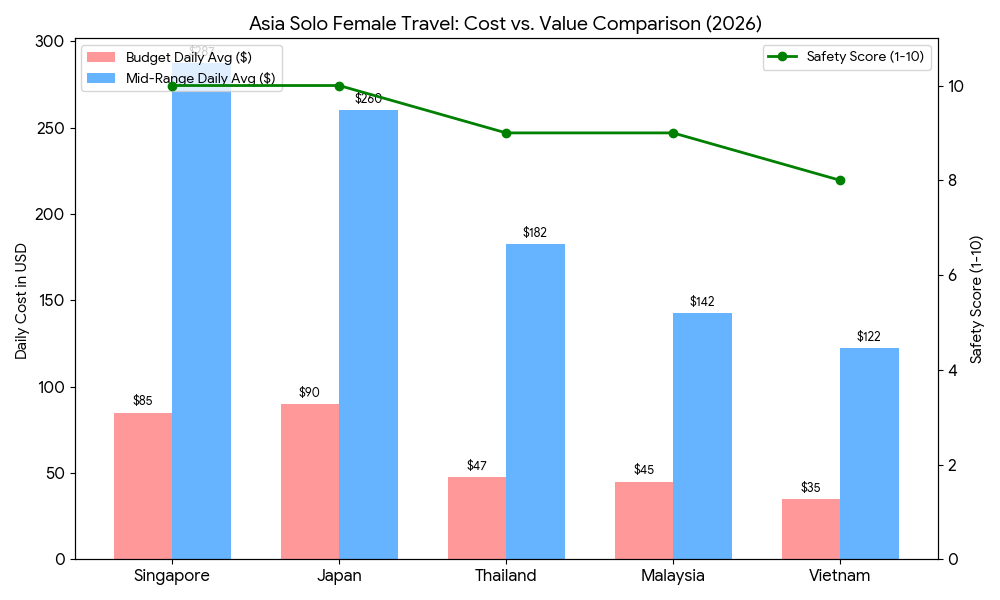
This comparison chart provides a clear visualization of the “Value Proposition” for each country, balancing the average daily cost against the safety scores.
- The Budget Champion: Vietnam ($35/day avg) offers the most “adventure for your dollar,” though it requires the most street smarts (Safety Score: 8/10).
- The Efficiency Leader: Malaysia ($45/day avg) is nearly as affordable as Thailand but offers a higher Safety Score (9/10) and better English proficiency, making it a hidden value gem.
- The Premium Safest: Singapore ($85/day avg for budget) is the most expensive entry point but guarantees a 10/10 safety experience, perfect for nervous first-timers.
- The Culture Splurge: Japan ($90/day avg for budget) is the ultimate safe haven where your money buys a level of respectful, zen-like travel that is hard to find anywhere else.
Safety Basics That Made My Life Easier
Carry your accommodation’s address in the local language. This saved me countless times when dealing with taxi drivers or asking locals for directions.
Use official transportation apps. Grab (Southeast Asia) and similar ride-hailing services provide safe, reliable transport with trackable routes and upfront pricing.
Trust your gut. If something feels off, remove yourself from the situation. Your instincts are usually right.
Stay connected. Regular check-ins with loved ones back home provided peace of mind for everyone. International SIM cards or eSIMs kept me connected affordably.
Cultural Respect Goes a Long Way
Taking time to learn basic local customs showed respect and opened doors. Singapore taught me the ‘choping’ custom. In Japan, bowing appropriately and removing shoes before entering homes became second nature. In Thailand, never pointing feet at people or religious images, and dressing modestly at temples, shows respect.
Small efforts at learning local phrases. Even just “hello,” “thank you,” and “excuse me” earned warm smiles and patience from locals everywhere.
Say Yes to the Unexpected
Spontaneous moments created my best stories. Joining a stranger’s invitation to a local festival, taking a cooking class on a whim, or hopping on a last-minute boat tour—these unplanned adventures became highlights I never could have scheduled.
Solo travel means freedom to be flexible. Embrace it.
How to Meet People Without Trying Too Hard
I stayed in hostels naturally and created social opportunities. Common areas, shared kitchens, and organized hostel events made meeting fellow travelers effortless.
Joining group tours for day trips or activities meant instant travel companions without the commitment of traveling together long-term.
Food tours, cooking classes, and walking tours attracted solo travelers—built-in conversation starters with shared experiences.
Sometimes I craved solitude, and that was perfectly okay too. Solo travel means choosing when to be social and when to recharge alone.
Solo Dining in Asia: How to Eat Alone (Without the “Table for One” Anxiety)
If the thought of sitting alone in a restaurant makes you want to hide in your hotel with a bag of chips, I have good news: Asia is a solo diner’s paradise. In many of these cultures, eating alone is not just accepted; it’s the norm for busy professionals and locals alike.
- Embrace “Counter Culture”: Seek out ramen bars or individual dining booths (like Ichiran in Japan). Sitting at a counter removes the “all eyes on me” feeling of a large table.
- Use the “Choping” Hack: In Singapore or Malaysia, place a tissue packet on a hawker center table to save your spot while you order—it’s the local signal for “this seat is taken.”
- Carry a “Prop”: Use a physical journal or a Kindle. Scribbling notes or reading a book makes you look like a focused travel writer and provides a comfortable “shield” if you feel awkward.
- Avoid the “Phone Scrawl”: While it’s an easy crutch, looking up from a book occasionally makes you more approachable and helps you soak in the atmosphere.
- Time Your Meals: Eat slightly “off-peak” (like 6 PM for dinner). The staff will be less stressed, more likely to chat, and you won’t feel like you’re taking up space during a rush.
- Join a Group Food Tour: Book this on your first night in a new city. It builds your confidence in ordering local dishes and often introduces you to fellow solo travelers.
Why Solo Travel in Asia Will Change Your Life
Traveling alone in Asia wasn’t just about seeing new places. I discovered my own strength. Each destination gave me a safe space to grow, connect with incredible people, and collect memories I’ll carry forever.
Starting nervous and ending confident, I learned that solo travel isn’t about being fearless. It’s about being brave enough to feel the fear and go anyway.
These five countries offer perfect training grounds for first-time solo female travelers. Safe, welcoming, and full of wonder, they’ll teach you that the world is kinder than fear suggests.
Singapore eases you in with familiar comforts and flawless infrastructure. Japan shows you that kindness transcends language. Thailand wraps you in warmth and teaches you to embrace chaos. Malaysia surprises you with its multicultural richness. Vietnam pushes you to be bolder than you thought possible.
Each destination builds on the last, growing your confidence until solo travel feels less like bravery and more like coming home to yourself.
Planning Your Journey: Practical Considerations
Where to Start: A First-Timer’s Roadmap
The five countries connect naturally as a multi-country itinerary. A common logical route runs Singapore → Malaysia → Thailand → Vietnam, with Japan added either before or after depending on budget and season. Here’s how to think about sequencing:
If This Is Your First Solo Trip Ever
Start in Singapore. It functions as a confidence-building bootcamp: flawless infrastructure, English everywhere, extreme safety, great food. Spend 5–7 days until you feel settled. Cross to Malaysia — still English-friendly, slightly more adventurous. Next, Thailand. Then Vietnam. Japan can fit either at the start (high infrastructure, reassuring) or end (you’ll appreciate it differently after Southeast Asia).
If You’ve Traveled Solo Before
Skip Singapore if budget is tight (it’s expensive relative to the others) and open with Japan or Thailand. Both deliver immediate solo-travel satisfaction without requiring Singapore’s price tag as a warm-up.
How Long Should You Go?
Minimum recommended: 2-3 weeks to visit 2-3 countries
Ideal: 4-8 weeks to explore all five countries comfortably
What I did: 12 weeks, spending 2-3 weeks in each country
Longer stays let you move on your own pace, dive deeper, and avoid burnout from constant packing and transit. You’ll also have time to rest when needed. Solo travel is exhilarating but can be exhausting.
The Best Time for Solo Female Travel Beginners to Visit Asia
The most social, safe, and easily manageable time for a beginner to visit is generally from November to February, focusing on the popular and affordable countries of Southeast Asia.
Why it’s great for beginners: This is the dry season in much of the region, offering the best weather with less humidity, plenty of sunshine, and minimal rain. It’s ideal for sightseeing, island hopping, and outdoor activities. You’ll enjoy a beautiful fall foliage, and less risk of the heavy rain.
The Vibe: The busiest and most social time. It’s easy to meet other travelers in hostels, on tours, and in social spots. Infrastructure is well-developed for tourists.
November is often mentioned as an excellent, less-crowded month for Japan.
Trade-offs: It’s peak season, meaning higher prices and larger crowds at popular spots.
March to May: Pleasant, mild weather, and the spectacular cherry blossoms in Japan. It’s the hot season so, fewer tourists, better deals, but temperatures soar (especially in Thailand)
The Vibe: Exceptionally safe, efficient public transport, and a high level of respect for personal space.
June to October: Monsoon season in many areas, thus, cheapest prices, fewest tourists, but expect rain (though it’s often short afternoon showers, not all-day downpours)
My experience: I traveled February through April, catching the tail end of peak season and the start of hot season. Weather was mostly excellent, with occasional rain in Vietnam.
Visa Requirements
Singapore: 90-day visa-free entry for most Western passport holders
Japan: Americans and most Western passport holders get a 90-day visa-free entry
Thailand: 30-day visa-free entry (extendable), 60-day e-visa available
Malaysia: Most Western passport holders and Americans enjoy a 90-day visa-free entry
Vietnam: E-visa available (30 days, single entry), some nationalities get visa-free entry
Always check out our comprehensive visa guide of the 5 coutries.
Vaccinations and Health
Consult a travel clinic 6-8 weeks before departure. Common recommendations include:
- Hepatitis A and B
- Typhoid
- Routine vaccinations (MMR, tetanus, etc.)
- Japanese encephalitis (if spending extended time in rural areas)
- Rabies (if you’ll be around animals)
Malaria is minimal in urban areas and tourist zones. Singapore and Japan have no malaria risk. Thailand, Malaysia, and Vietnam have low risk in cities but higher risk in rural/jungle areas.
Travel insurance is non-negotiable. Medical emergencies, lost baggage, or trip cancellations happen. Choose coverage that includes medical evacuation.
What I didn’t need but packed: Too many clothes (I could wash easily everywhere), heavy guidebooks (phone worked fine), excessive toiletries (available everywhere).
Money Management
Credit cards: Widely accepted in cities, less so in rural areas. Notify your bank before traveling to avoid fraud blocks.
ATMs: Available everywhere in cities. Withdraw larger amounts less frequently to minimize fees.
Cash: Still king in many places, especially street food stalls, markets, and rural areas. Keep small bills for taxis, street vendors, and tips.
Currency exchange: Airport rates are terrible. Use city exchange counters or ATMs for better rates.
Digital payment: Grab and similar apps accept credit cards, making cashless transport easy.
How to Stay Connected in Asia
Local SIM cards offer the best value. Available at airports and convenience stores:
- Singapore: Singtel, StarHub
- Japan: Mobal, IIJmio
- Thailand: AIS, DTAC
- Malaysia: Maxis, Celcom
- Vietnam: Viettel, Vinaphone
Data packages are cheap (often $10-20 for several gigabytes). Having GPS, translation apps, and communication tools available anytime was invaluable for safety and convenience.
Useful apps:
- Google Maps: Offline maps saved my life countless times
- Google Translate: Download languages for offline use
- Grab: Ride-hailing across Southeast Asia
- XE Currency: Real-time exchange rates
- Hostelworld/Booking.com: Last-minute accommodation
- Rome2Rio: Transport route planning
Frequently Asked Questions
Is Asia safe for solo female travelers?
Yes, Asia is generally very safe for solo female travelers. Countries like Singapore, Japan, and parts of Thailand consistently rank high in global safety indices, offering established tourist infrastructure, highly efficient public transport, and cultures known for respect and helpfulness. This makes Asia an ideal choice for beginners.
What is the safest country in Asia for solo female travelers?
Singapore is consistently cited as the safest country in Asia for solo female travelers. Late-night MRT, 24-hour taxi ranks, and the Grab app mean you’re never stranded. The city’s cleanliness and strict law enforcement extend to street safety in a way that’s genuinely unusual.
What if I don’t speak the language?
English proficiency is excellent in Singapore and Malaysia, good in tourist areas of Thailand and urban Japan, and moderate in Vietnam. Translation apps, friendly locals, and lots of pointing and smiling bridge most gaps. Learning basic phrases shows respect and opens doors.
Will I be lonely traveling alone?
Only when you want to be. Hostels, group tours, and the robust backpacker trail across Asia make meeting people incredibly easy. Solo travel gives you flexibility—be social when you want company, enjoy solitude when you need space.
How do I deal with unwanted attention?
Dress modestly when appropriate (covered shoulders and knees at temples, conservative in rural areas). Firm but polite boundaries work well. In my experience, unwanted attention was minimal in these countries—far less than in some Western destinations or other parts of the world.
What if I get sick?
Pharmacies are everywhere and often sell medications over the counter that require prescriptions back home. Hospitals in major cities are excellent and affordable. Travel insurance covers serious medical issues. Common ailments (upset stomach, minor cold) rarely derailed my plans for more than a day.
Can I travel on a tight budget?
Absolutely. Vietnam and Thailand are especially backpacker-friendly. Hostel dorms, street food, and free/cheap activities keep costs low. Singapore and Japan cost more but remain manageable if you eat at hawker centers/local spots and use public transport.
Should I book everything in advance?
Book your first few nights of accommodation in each new city for peace of mind. After that, flexibility often gets you better deals and allows you to extend stays in places you love or leave quickly if somewhere doesn’t feel right. Flights between countries should be booked in advance for better prices.
What about solo dining?
Eating alone felt awkward initially but became one of my favorite parts of solo travel. Hawker centers, ramen counters, and street food stalls are naturally solo-friendly. Bring a book or journal if you want something to do, or simply people-watch. Nobody cares that you’re eating alone—they’re too busy enjoying their own food.
The Practical Stuff
This is the pillar article. Each satellite guide below goes deep on one specific topic — logistics, and safety.
Solo Female Safety Guide: AsiaScams, neighborhoods, emergency numbers
What to Pack: Complete Checklist. Interactive checklist with country-specific additions
Visa Guide: All 5 Countries Entry requirements and what you actually need
Travel Insurance Guide: What coverage you actually need
My guide gives you the overview, but each of these incredible destinations deserves a deeper exploration.
In my detailed country guides, I share:
- Complete day-by-day itineraries
- Specific hostel recommendations and neighborhood guides
- Detailed food recommendations and where to find the best local dishes
- Hidden gems and off-the-beaten-path experiences
- Transportation tips and route planning
- Solo female traveler safety specifics for each destination
- Common scams to avoid
- Cultural deep-dives and etiquette guides
Have you traveled solo in Asia? What was your experience? Drop your stories, questions, or favorite destinations in the comments below—I’d love to hear from you and help with any planning questions!
Found this helpful? Share it with a friend who’s been dreaming of solo travel. Sometimes all we need is a little encouragement to take that first step.