
The five countries — Singapore, Japan, Thailand, Malaysia, and Vietnam covered in the complete Asia solo female travel guide, remain some of the most accessible destinations in the world for solo female travelers. However, 2026 marks a significant shift in how you enter.
While four of these countries are still “visa-free” for most Western passport holders, they are no longer “paperwork-free.” In an effort to digitize borders, almost every destination now requires a mandatory digital arrival card or pre-travel authorization submitted within 72 hours of your flight.
For a typical 12-week trip across all five, your only direct “visa cost” is usually the $25 USD for Vietnam’s e-visa. The rest are free to enter, provided you’ve cleared the digital hurdles before landing.

Walking through the Kyoto market at dusk
The 2026 Digital Checklist: Pre-Arrival Forms
Before you head to the airport, you must complete these official forms. Missing these can result in denied boarding or significant delays at the border.
| Country | Required Digital Form | Official Link (Always Free) | Submission Window |
| Singapore | SG Arrival Card (SGAC) | Official ICA Portal | Within 3 days before arrival |
| Malaysia | Digital Arrival Card (MDAC) | Official Immigration Portal | 3 days before arrival |
| Thailand | Digital Arrival Card (TDAC) | Official TDAC Portal | 3 days before arrival |
| Japan | Visit Japan Web | Official VJW Portal | Anytime before arrival |
| Vietnam | E-Visa (Printed Copy) | Official E-Visa Portal | Apply at least 7–10 days prior |
Pro-Tip for 2026: While some countries (like Japan) still offer paper forms as a backup, Malaysia and Thailand have largely phased these out. Do not rely on finding a paper form at the gate; most airlines will ask to see your confirmation QR code before you even board.
The Golden Rule of Passport Validity
Despite these digital updates, the physical requirements remain strict. Your passport must be valid for at least 6 months beyond your intended departure date from each country. Even if a country like Japan technically allows entry for the “duration of stay,” airlines globally enforce the 6-month rule. If your passport expires in 5 months, your trip will likely end at the check-in desk.
Related Guide: What to Pack for Solo Female Travel in Asia
Visa Requirements by Country
Select a country to see its full entry requirements, application process, and solo traveler notes.
Singapore
Your easiest entry in Asia — and the best place to start
| Category | Requirement |
| Visa Status | Visa-Free |
| Allowed Stay | 90 Days |
| Cost | $0 |
| Mandatory Form | Singapore Arrival Card (SGAC ) |
Who Gets Visa-Free Entry?
Citizens of most Western countries — including the US, UK, EU member states, Canada, Australia, and New Zealand — receive 90-day visa-free entry to Singapore. Immigration is handled at the airport on arrival.
What You Need at Immigration
- Valid passport — 6 months validity beyond your departure date from Singapore
- SG Arrival Card — completed online before departure via the ICA website (replaces the old paper form). Free to complete; takes under 5 minutes.
- Proof of onward travel — a return ticket or ticket to your next destination. Airlines may check this at check-in.
- Sufficient funds — immigration officers can ask. Having a credit card and a small amount of cash covers this in practice.
Solo Female Traveler Note
Changi Airport immigration is genuinely smooth — often the fastest in Asia. If you arrive late at night, the MRT runs until around midnight. After that, the airport’s 24-hour taxi rank and Grab app make getting to your hostel straightforward. Read the full Singapore guide for late-arrival tips.
If You Need to Stay Longer
A Long-Term Visit Pass extension is possible but involves applying to the Immigration and Checkpoints Authority. For most travelers doing a multi-country trip, 90 days in Singapore is more than enough — realistically, most people spend 5–7 days here before moving on.
Cost Note
Singapore is the most expensive destination in this guide. While the visa is free, your daily costs will be higher here than anywhere else. The Asia solo travel guide breaks down realistic daily spend for Singapore across accommodation tiers.
Japan
90 days, no application — but watch the “JESTA” updates
| Category | Requirement |
| Visa Status | Visa-Free |
| Allowed Stay | 90 Days |
| Cost | $0 (Pre-registration is free) |
| Mandatory Form | Visit Japan Web (Customs/Immigration) |
Who Gets Visa-Free Entry?
Japan maintains visa exemption arrangements with 74 countries. Citizens of the US, UK, EU, Canada, Australia, and New Zealand all qualify for 90-day visa-free stays for tourism.
What You Need at Immigration
- Valid Passport: Officially, your passport only needs to be valid for the duration of your stay. However, in 2026, most international airlines still enforce a 6-month validity rule at check-in. To avoid being denied boarding, ensure you have at least 6 months remaining.
- Visit Japan Web: This is the primary portal for immigration and customs. While technically “optional” in some contexts, it is the standard for 2026. Complete it before you land to generate a QR code that allows you to use the Integrated Kiosk system, which bypasses face-to-face officer interviews at major airports like Narita and Haneda.
- Proof of Onward Travel: A ticket out of Japan. While rarely checked by officers, airlines may require it before you board your flight.
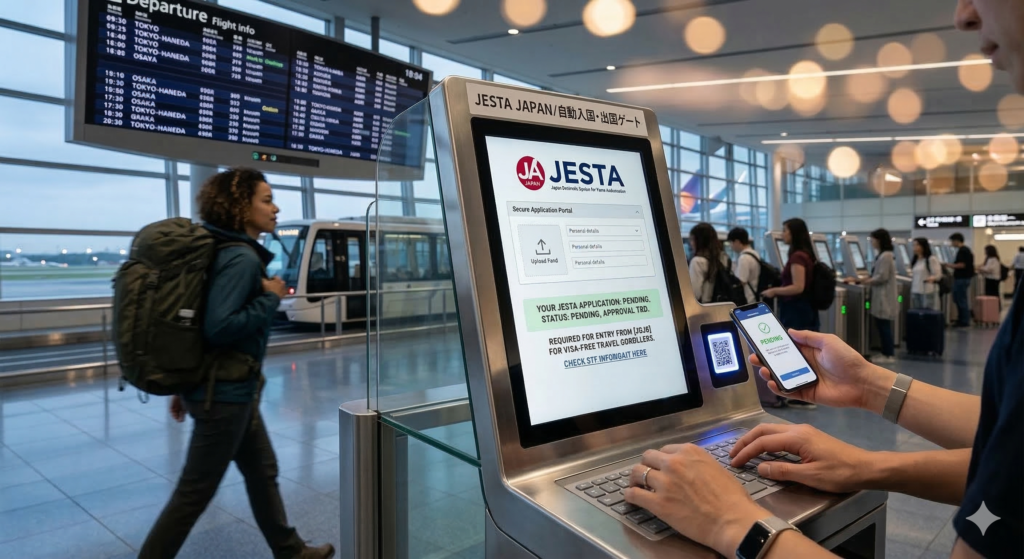
A digital kiosk screen at Japanese border control displaying ‘JESTA Status: Pending, Approval TBD’
Important: The JESTA System (2026 Update)
In March 2026, the Japanese government approved the bill to introduce JESTA (Japan Electronic System for Travel Authorization).
- Current Status: It is not yet required for travel in early 2026. Full implementation is targeted for fiscal year 2028.
- What it means for you: For now, you can still enter visa-free using only the Visit Japan Web portal. However, keep an eye on official news if your trip is planned for late 2026, as pilot programs may begin.
Solo Female Traveler Note
Japan’s immigration officers are professional and courteous. First-time visitors are sometimes surprised by the fingerprinting and photo requirement on arrival — this is standard for all foreign visitors and takes less than a minute. A calm, direct approach works best. The safety section of our main guide covers what to expect in detail.
Seasonal Crowding at Immigration
Arriving during Golden Week (late April–early May), Obon (mid-August), or New Year’s means long immigration queues. If your schedule is flexible, aim for shoulder season arrivals. Landing during off-peak hours also helps significantly.
Thailand
60-day entry with a mandatory digital check-in
| Category | Requirement |
| Visa Status | Visa-Free (Exemption) |
| Allowed Stay | 60 Days (extendable by 30 days) |
| Cost | $0 (Exemption is free) |
| Mandatory Form | Thailand Digital Arrival Card (TDAC) |
Who Gets Visa-Free Entry?
As of 2026, citizens of 93 countries—including the US, UK, EU, Canada, Australia, and New Zealand—can enter Thailand for up to 60 days without a pre-arranged visa. While there is periodic talk of reverting this to 30 days, the 60-day rule remains in effect for most of 2026.
What You Need at Immigration
- Valid Passport: Must have 6 months validity from your date of entry.
- Thailand Digital Arrival Card (TDAC): This is the single most important change. As of May 2025, the paper TM6 form is dead. You must complete the TDAC online via the official portal within 72 hours before your arrival. You will receive a QR code/confirmation email; keep this on your phone or print it.
- Proof of Onward Travel: A ticket out of Thailand within 60 days. Airlines are increasingly strict and will check this before allowing you to board your flight to Thailand.
- Proof of Funds: Technically, you may be asked to show 20,000 THB (approx. $550 USD) in cash or equivalent. While rarely checked for Western tourists, it is an official requirement.
Extending Your Stay
If 60 days isn’t enough, you can visit a local Thai Immigration office (Bangkok and Chiang Mai are the most popular) to apply for a 30-day extension. This costs 1,900 THB (approx. $52) and is typically a half-day process.
The “Border Run” Situation
You may read about travelers doing “border runs” — exiting and re-entering Thailand to reset the visa clock. Thai immigration has tightened scrutiny of multiple re-entries that appear to be visa run tourism. For solo trips of reasonable duration, this shouldn’t be an issue. But if you plan to base yourself in Thailand for 4+ months, look into a proper long-term visa rather than relying on repeated border entries.
Malaysia
The 90-day “Digital Hub” — now requiring a pre-arrival form
| Category | Requirement |
| Visa Status | Visa-Free |
| Allowed Stay | 90 Days |
| Cost | $0 |
| Mandatory Form | Malaysia Digital Arrival Card (MDAC) |
Who Gets Visa-Free Entry?
Malaysia remains one of the most generous countries in the region, offering a 90-day stay to most Western nationalities (US, UK, EU, etc.). However, it is no longer “paperwork-free.”
What You Need at Immigration
- Valid Passport: 6 months validity is strictly enforced.
- Malaysia Digital Arrival Card (MDAC): Mandatory since 2024. You must submit this online form within 3 days before your arrival. Failure to do this can lead to being sent to a separate “holding area” at the airport to complete it on your phone before you can join the immigration queue.
- Proof of Onward Travel: A confirmed ticket out of Malaysia.
- The “Autogate” Perk: As a solo traveler from the US, UK, Australia, or many EU countries, you can now use the Immigration Autogates at KLIA (Kuala Lumpur International Airport) Terminals 1 and 2. To qualify, you must have submitted your MDAC at least 3 days prior. This allows you to skip the manual queues entirely.
Solo Female Traveler Note
Malaysia is incredibly easy to navigate. If you are crossing overland from Thailand (e.g., taking the train from Hat Yai to Padang Besar), you still need to have your MDAC completed. The “Digital Arrival Card” applies to all land, air, and sea borders.
Safety Note on Bag Security
Malaysia’s immigration itself is hassle-free, but Kuala Lumpur’s crowded areas — Petaling Street, Batu Caves on festival days, busy LRT stations — see opportunistic bag theft.
The safety guide for solo female travelers covers crossbody bag strategy and what to watch for in KL specifically. The city is genuinely safe; it just rewards awareness.
Proof of accommodation is sometimes requested at Malaysian immigration. Have your first night booked.
Vietnam
The “Print Only” Destination — Advance planning is non-negotiable
| Category | Requirement |
| Visa Status | e-Visa Required (for most) |
| Allowed Stay | 90 Days (Single or Multiple Entry) |
| Cost | $25 (Single) / $50 (Multiple) |
| Mandatory Form | Official e-Visa Portal |
Do You Need a Visa?
- Exemption: Citizens of the UK, Germany, France, Italy, and Spain currently receive a 45-day visa-free stay. If you are from one of these countries and staying less than 45 days, you do not need an e-visa.
- e-Visa: Citizens of the US, Canada, and Australia (and those staying longer than 45 days) must apply for an e-visa. In 2026, the 90-day e-visa is the standard for all nationalities.
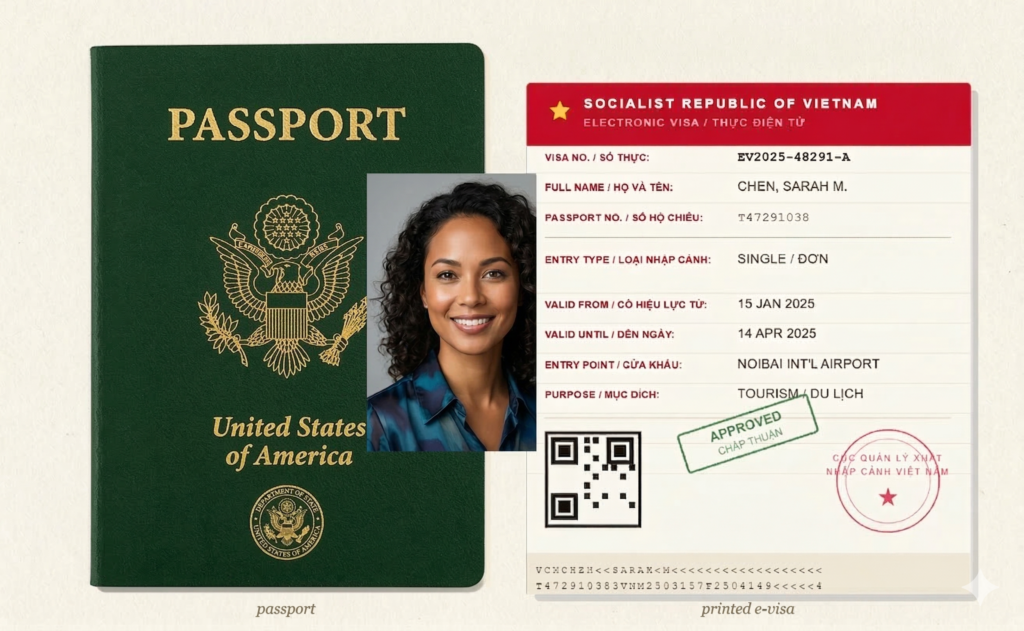
Printed Vietnam e-visa document
How to Apply (The 2026 Standard)
- Use the Official Site: Only use
evisa.gov.vn. Many third-party sites in 2026 look official but charge “service fees” that double the cost. - Wait Times: While the official target is 3 working days, real-world processing in 2026 is taking 5–7 working days due to high volume. Apply at least 2 weeks before your flight.
- Accuracy is Critical: Ensure your name matches your passport’s MRZ (the bottom lines) exactly. In 2026, even a minor typo results in a “Rejected” status, requiring a new application and another fee.
The “Golden Rule” of Vietnam Immigration
You MUST print your e-visa. Despite the digitalization of the rest of Asia, Vietnamese immigration officers in 2026 still require a physical, paper copy of your e-visa to stamp and file.
- Digital copies or PDFs on your phone are not accepted for entry.
- Print two copies: one for immigration and one to keep in your bag as a backup.
Your packing list should include this document alongside your passport copies.
Single vs. Multiple Entry: Which Should You Choose?
| Option | Cost | Choose If |
|---|---|---|
| Single Entry ($25) | $25 | You’re entering Vietnam once and leaving once — a straightforward itinerary from north to south or vice versa |
| Multiple Entry ($50) | $50 | You plan to exit Vietnam and re-enter (e.g., day trip to Cambodia, side trip to Laos, or flying out and back in) |
Apply Well in Advance
Apply at least 1–2 weeks before you need it, not the day before. Processing can take up to 5 business days, and if there’s a problem with your application — wrong photo format, mismatched dates — you’ll need time to fix it. Apply, then check email daily until approval arrives.
Entry Points: Air vs. Land
The Vietnam e-visa specifies your entry point. If you’re flying into Ho Chi Minh City or Hanoi, select the appropriate international airport. If you’re crossing overland from Cambodia or China, select the specific land border crossing you’ll use. You cannot enter through a different point than the one on your visa — this matters if your plans change.
Related Guide: Travel Insurance for Solo Female Travel in Asia
If your plans change, travel insurance covering trip modifications becomes particularly relevant here.
Passport Requirements: What to Check Before You Book
Visa requirements vary by nationality. Everything in this guide describes the experience for most Western passport holders — US, UK, EU, Canada, Australia, New Zealand. If you hold a different passport, the landscape changes significantly. Always verify via each country’s official immigration authority for your specific nationality.
The 6-Month Validity Rule
All five countries in this guide require your passport to be valid for at least 6 months beyond your intended departure date from that country. If you’re visiting all five countries over 12 weeks, your passport needs to be valid until at least 6 months after your final departure date.
Airlines check this at check-in. If your passport falls short, you will be denied boarding — not at immigration, but before you get on the plane. Check this before you book anything else.
Blank Pages
Japan and Vietnam immigration stamp your passport on entry and exit. Malaysia and Thailand also stamp. Singapore may or may not depending on the officer. Over a 12-week multi-country trip, you can accumulate 8–12 stamps. Make sure you have enough blank pages — most countries require at least 2 blank facing pages. If your passport is running low, renew before departure.
Passport Copies: The Offline Backup
Carry two color photocopies of your passport’s photo page, kept in a separate location from your actual passport. If your passport is lost or stolen, these speed up the emergency replacement process significantly at your nearest embassy. The full packing list covers the complete document system used across a 12-week Asia trip.
| Country | 6-Month Rule | Entry Stamp | Blank Pages Required |
|---|---|---|---|
| Singapore | Yes | Sometimes | 1–2 |
| Japan | Duration of stay | Yes | 2 |
| Thailand | Yes | Yes | 2 |
| Malaysia | Yes | Yes | 2 |
| Vietnam | Yes | Yes | 2 |
The one visa mistake that actually ruined someone’s trip was always preventable. Not a complicated rule — just something they forgot to check in advance.
The Most Common Visa Mistakes — and How to Avoid Them
Immigration issues are rarely about having the wrong visa and almost always about missing a digital form or a physical printout. These five mistakes are the most frequent reasons solo travelers are denied boarding or delayed at the border this year.
| Mistake | Where It Happens | How to Avoid It (The 2026 Rule) |
| Missing the 72-Hour Window | Singapore, Malaysia, Thailand | These forms (SGAC, MDAC, TDAC) cannot be submitted more than 3 days before arrival. Set a “72-hour alert” on your phone for the day you leave your previous country. |
| No Vietnam e-Visa Printout | Vietnam Border | Officers will not accept a PDF on your phone. You must have a physical paper copy. Print it at your hotel in your previous city before flying to Vietnam. |
| Ignoring the 6-Month Passport Rule | All 5 Countries | Airlines in 2026 are stricter than ever. If your passport has 5 months and 29 days left on the day you fly, the airline system will likely block your check-in automatically. |
| Mistyping Name on Digital Forms | Japan, Vietnam, Thailand | Digital readers at the “Integrated Kiosks” (Japan) and “Autogates” (Malaysia) will reject you if your form doesn’t match your passport’s MRZ (the bottom lines) exactly. |
| Assuming “Visa-Free” means “Form-Free” | Malaysia & Thailand | Many travelers still arrive in KL or Bangkok expecting zero paperwork. In 2026, the digital arrival card is the paperwork. You must have the QR code ready to show the airline. |
Visa Scams
As of 2026, many “official-looking” websites for JESTA (Japan), TDAC (Thailand), and Vietnam e-Visas have appeared in search results. These are often third-party agencies that charge $50–$100 for a form that is either free or only costs $25.
- Always check that the URL ends in
.gov.vn,.go.jp,.gov.sg, or.imi.gov.my. - If a site asks for a “processing fee” for a Singapore, Malaysia, or Thailand arrival card, it is a scam. Those forms are free.
For Vietnam’s e-visa, third-party sites are common and prominently rank in search results. Go directly to the official government portal. The safety guide for solo female travelers covers how to identify and avoid common tourist scams more broadly.
Note: Completing Thailand’s digital arrival card and Singapore’s SG Arrival Card requires internet access. Having a working SIM before you land makes this easy.
The “Regional Loop”: Crossing Borders by Land in 2026
For many solo travelers, the best part of Southeast Asia is the ease of moving between countries overland—whether it’s the train from Singapore to Kuala Lumpur or the bus from Penang to southern Thailand.
In 2026, the physical borders are just as open as they’ve always been, but the digital borders have moved forward. If you are doing the classic “Singapore $\rightarrow$ Malaysia $\rightarrow$ Thailand” loop, you must treat each land crossing like an airport arrival.
The Overland Digital Checklist
Every time you cross a land border, the 72-hour window resets. You cannot “batch” these forms at the start of your 12-week trip.
Crossing into Malaysia (Bus or Train)
- Arrival Card: Even if you are just taking the 5-minute shuttle train from Singapore’s Woodlands to Johor Bahru, you must have submitted your Malaysia Digital Arrival Card (MDAC) within 3 days.
- The Check: Bus drivers and train conductors at the Singapore departure points are now trained to check for your MDAC confirmation before you board.
- The Perk: Frequent travelers between Singapore and Malaysia can often use the MDAC “Registered Traveler” status to use the autogates at the Johor Bahru (CIQ) land border, saving you hours of waiting in line.
Crossing into Thailand (Train or Van)
- Digital Form: Whether you’re crossing at Padang Besar (train) or Sadao (bus/van), the Thailand Digital Arrival Card (TDAC) is mandatory as of 2025.
- Internet Access: Land borders often have spotty Wi-Fi. Do not wait until you reach the border to fill out your TDAC. Submit it while you still have a stable connection at your hostel in Penang or Langkawi.
- Stamp: Ensure the Thai officer physically stamps your passport with the “60-day” entry. Occasionally at busy land borders, oversight happens—always check your date before leaving the desk!
Crossing into Vietnam (Bus)
- Visa: Most land borders cannot issue a Vietnam e-visa on the spot. You must already have your approved e-visa printed.
- Entry Point Matters: Your Vietnam e-visa specifies a “Port of Entry.” If your visa says “Hanoi Airport” but you try to enter via the Moc Bai land border from Cambodia, you will be turned away. Always match your e-visa entry point to your bus route.
Pro-Tip: The “Offline” Buffer
When traveling overland, your phone’s data might drop as you switch from a Singaporean SIM to a Malaysian one.
The 2026 Rule: Always take a high-resolution screenshot of your MDAC or TDAC QR code. Most border officers in 2026 will scan the code directly from your phone screen, so you don’t need an active internet connection to clear immigration.
The 2026 Solo Traveler’s Document Checklist
In 2026, your “travel documents” are as much about QR codes and digital timestamps as they are about your physical passport. Use this checklist to stay organized across your 12-week trip.
1. The “Physical Essentials” (Keep in a waterproof folder)
- Passport: Valid until at least 6 months after your final flight home.
- Vietnam e-Visa (Printed): Crucial. 2 physical copies (one for the officer, one for your backup).
- Passport Photos: 4 spare physical photos (sometimes required for unexpected visa extensions or lost passport emergencies).
- Physical Backup: 2 color photocopies of your passport photo page.
2. The “Digital Vault” (Saved in a dedicated “Travel 2026” phone album)
- Singapore SGAC QR Code: Submitted within 3 days before arrival.
- Malaysia MDAC Confirmation: Submitted within 3 days before arrival.
- Thailand TDAC QR Code: Submitted within 3 days before arrival.
- Japan Visit Japan Web QR: Ready for the “Integrated Kiosk” at the airport.
- Onward Travel Proof: A PDF/Screenshot of a flight or bus ticket leaving each country.
- Accommodation Confirmation: A screenshot of your first night’s hostel/hotel for each destination.
Organize Your “72-Hour Window”
Since Singapore, Malaysia, and Thailand all require their forms within 3 days of arrival, I recommend using your phone’s calendar to set “Arrival Form Alerts” for each leg of your trip.
| Travel Leg | Submit These | Official Link |
| Singapore | SGAC (Free) | ica.gov.sg |
| Malaysia | MDAC (Free) | imigresen-online.imi.gov.my |
| Thailand | TDAC (Free) | tdac.immigration.go.th |
| Japan | VJW (Free) | vjw-lp.digital.go.jp |
| Vietnam | Check e-Visa Status | evisa.gov.vn |
Final “Solo Traveler” Pro-Tip for 2026
Screenshot Everything. Don’t rely on airport Wi-Fi or your e-SIM working the second you land. If you can’t pull up your QR code at the gate or the kiosk, it can cause unnecessary stress during an arrival. Having a “Visa” album in your phone gallery is your best defense against technical glitches.
Frequently Asked Questions
Do I need travel insurance to enter these countries?
No country in this guide requires travel insurance as a mandatory visa condition for tourist entry. However, not having it is a significant risk. Medical care in Japan and Singapore is excellent but expensive for foreigners. Emergency medical evacuation from a remote area of Vietnam or a Thai island can cost tens of thousands of dollars.
The dedicated travel insurance guide covers exactly what coverage you need for a multi-country Asia trip, how to compare policies, and what “medical evacuation” actually means in practice.
Can I work remotely on a tourist visa in these countries?
Tourist visas across all five countries technically prohibit “work.” In practice, remote work for a foreign employer — using your laptop in a café — is a legal grey area that most countries’ immigration systems are not actively policing for short stays. That said, it is technically a visa condition violation in most cases. For longer-term digital nomad stays, Thailand’s Long-Term Resident visa and Malaysia’s DE Rantau digital nomad visa are legitimate options worth researching.
What if my plans change and I need to leave earlier or later than my visa allows?
Leaving earlier than your visa allows is never a problem — you simply leave before the permitted period expires. Staying longer is where things get complicated. Overstaying a visa in any of these countries results in fines (typically per day), possible detention, and a potential entry ban. If you think you might need more time, extend legally before your current permission expires. Most countries’ immigration offices can help with this process.
What’s the cheapest way to manage money across five different currencies?
Five countries means five currencies: Singapore Dollar, Japanese Yen, Thai Baht, Malaysian Ringgit, and Vietnamese Dong. The most cost-effective approach is a low-fee debit card (Wise or Charles Schwab are popular choices) that converts at the mid-market rate with low or reimbursed ATM fees. Withdraw local currency at ATMs in each country rather than exchanging cash at airport counters.
What happens if I lose my passport while traveling?
Report the loss to local police first (you’ll need the police report). Then contact your country’s nearest embassy or consulate — all five countries have embassies for major Western nations in their capital cities. Emergency travel documents can typically be issued within 1–3 business days. Carrying two color photocopies of your passport (stored separately from the original) and having a scanned digital copy in cloud storage both speed this process up significantly.
Is the visa situation different for solo female travelers specifically?
No — visa requirements are nationality-based, not gender-based. The entry rules are identical for solo female travelers and everyone else. Where solo female travel does require specific consideration is in how you navigate arrivals: late-night airport arrivals, choosing transport, and having your accommodation details ready.
Complete Guide Series
Everything Else You Need for Solo Travel in Asia
This visa guide is part of a complete series covering every aspect of solo female travel across Singapore, Japan, Thailand, Malaysia, and Vietnam.
The 5 Safest Countries for Solo Female Travel: The pillar guide — start here
What to Pack for Solo Travel in Asia: Includes the document checklist
Travel Insurance Guide: What coverage you actually need
