
Scams, Visa Rules & Real Risks
The reality of solo travel in Asia is less about physical danger and more about understanding the systems around you — scams that target tourists in busy districts, visa rules that change faster than many travelers realize, and digital or logistical mistakes that can turn into expensive problems. These risks rarely make dramatic headlines, yet they are the issues that most often disrupt otherwise smooth trips.
This guide is part of my Solo Travel Asia series, where I’ve already explored the five countries that consistently rank as the most accessible for first-time solo travelers: Singapore, Japan, Thailand, Vietnam, and Malaysia. Each destination has its own personality and pace, but they share a common pattern — extremely low violent crime, paired with a handful of predictable tourist traps that are easy to avoid once you know how they work.
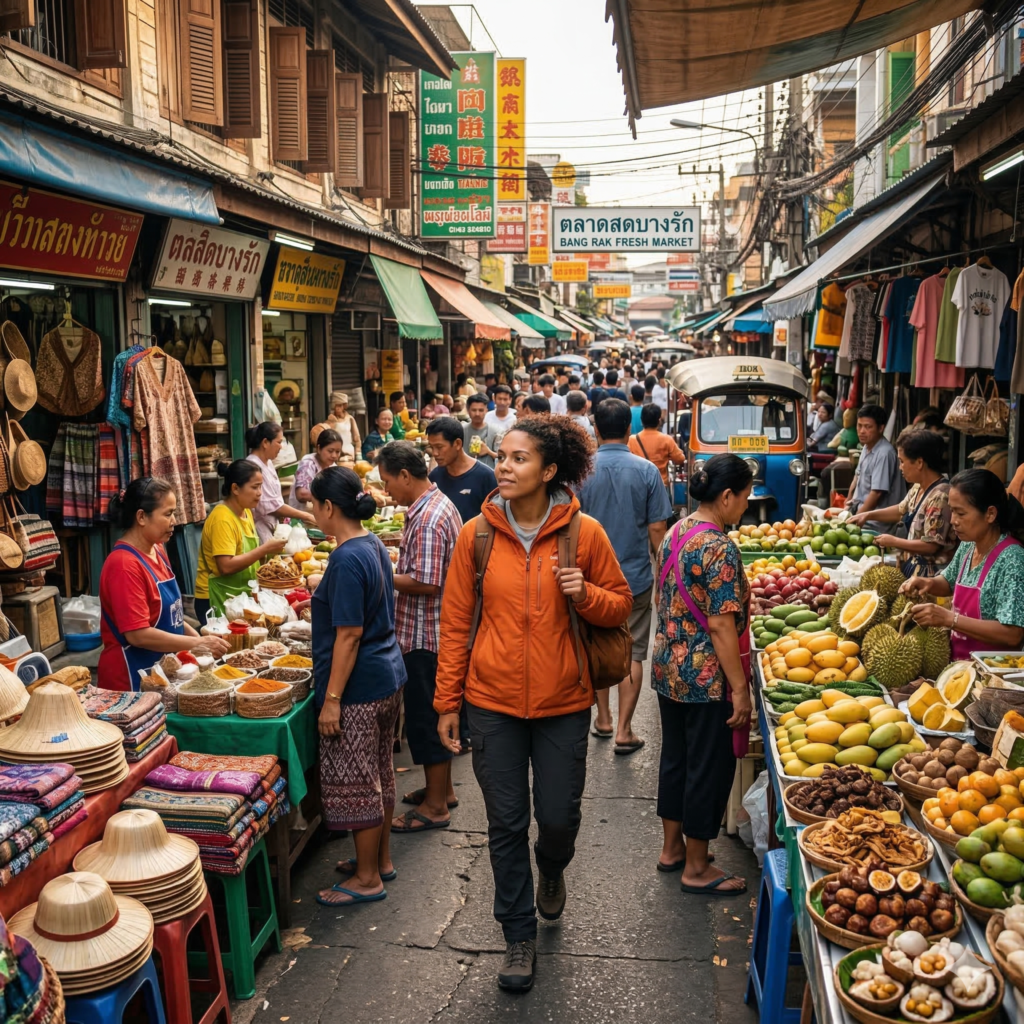
Navigating a busy street market in Thailand with confidence
Think of this article as the operational manual for the region.
It focuses on what actually matters on the ground in 2026: the scams that still catch travelers off guard, the surge in fake visa websites across Southeast Asia, updated visa overstay rules, and the small habits that experienced solo travelers use to move through unfamiliar cities with confidence.
If you understand these patterns before you arrive, you’re already ahead of 95 percent of the tourists around you — and that’s usually all the safety advantage you need.
At a Glance: Safety Vibe by Country
| Country | 2025 GPI Rank | Safety Vibe | Primary Risk | Best App |
|---|---|---|---|---|
| Singapore | #6 | 10/10 — Total Comfort | Overpriced electronics shops | Grab / MRT |
| Japan | #12 | 10/10 — Respectful | Nightlife touts (Shinjuku / Kabukicho) | Google Maps + Walking |
| Thailand | #86 | 8/10 — Friendly / Chaotic | “Closed attraction” scams | Grab / Bolt |
| Malaysia | #13 | 8/10 — Relaxed | Unlicensed taxi overcharges | Grab |
| Vietnam | #38 | 7/10 — High Energy | Motorbike bag snatch & fake visas | Grab |
The Safety Scores listed above are a weighted synthesis of the Global Peace Index (GPI). Scores measure a country’s relative peacefulness for a total of 163 countries.
Note: Thailand’s GPI rank is often skewed by regional border issues; however, the tourist path (Bangkok, Chiang Mai, and the islands) is globally recognized as highly safe for women.
These five countries are genuinely safe — but that’s not the whole story
Singapore consistently ranks among the world’s safest cities for women. Japan’s violent crime rate is so low it barely registers as a statistical category. Thailand and Vietnam host millions of solo female travelers every year, the overwhelming majority of whom return home with nothing worse than sunburn and an overloaded phone camera roll.
Stating that clearly matters, because a lot of solo female travel content overstates danger in ways that make first-timers unnecessarily anxious — or, worse, lead them to make overcautious decisions that actually reduce the quality of their trip.
You don’t need an escort to walk in Bangkok at night. You don’t need a tactical anti-theft bag in Hanoi. The risk profile for solo female travelers in these five countries breaks down like this:
| Risk type | Likelihood | Countries most relevant |
|---|---|---|
| Tourist scams (financial) | Common in tourist areas | Thailand, Vietnam, Malaysia |
| Petty theft / pickpocketing | Moderate in crowded areas | Bangkok, Ho Chi Minh City, KL |
| Visa overstay (legal/financial) | Common due to confusion | All five — penalties vary |
| Fake visa websites / agents | Rising — major 2026 surge | Vietnam, Thailand, all five |
| Street harassment | Low by global standards | Occasional in tourist zones |
| Violent crime against tourists | Rare | Isolated incidents |
| Drink spiking | Real in nightlife areas | Bangkok, Phuket, HCMC bars |
Key insight Financial and administrative risks — scams, overstays, fake visa agents — are the dominant threat for solo female travelers in Asia, not physical safety. A scam won’t hurt you physically. But in the case of a visa overstay or fraudulent visa document, it can cost you entry to a country for years.
Scams by country: named, explained, defused
The scams reported most consistently by solo travelers across forums, embassies, and traveler communities throughout 2024–2026. The best defense against a scam is recognizing it before it starts.
Thailand — Is it safe for solo female travelers in 2026?
Yes — with specific scam awareness baked in. Thailand is one of the most popular solo female travel destinations in the world for good reason. The scams here are financial, not physical, and every single one is avoidable once you know the script.
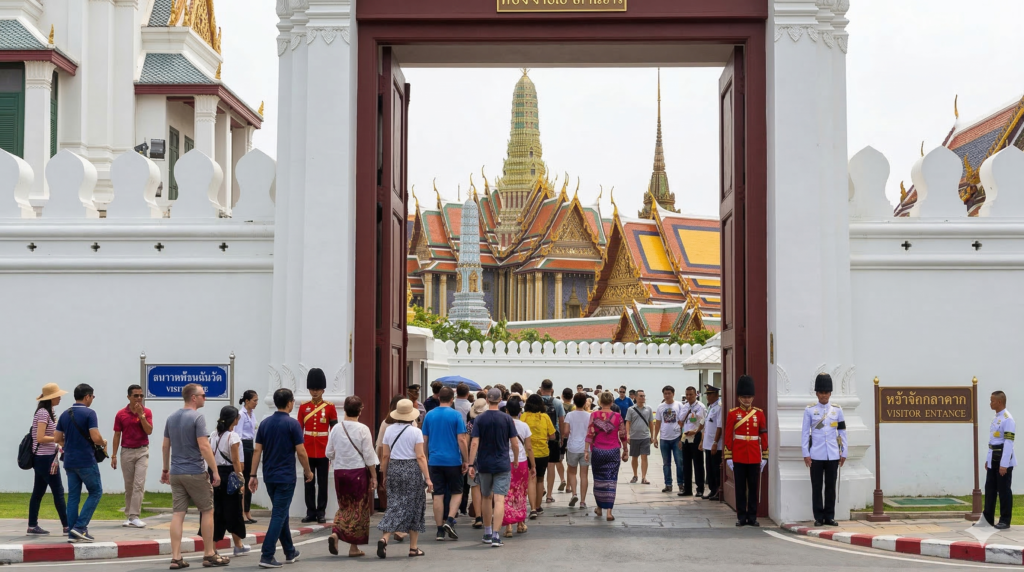
The Grand Palace entrance in Bangkok, Thailand. It’s always open to visitors.
Bangkok: The “Grand Palace is Closed Today” scam
Near major attractions — the Grand Palace, Wat Pho, Wat Arun — a well-dressed, friendly local explains that today is a special Buddhist holiday and the palace won’t open until the afternoon. They offer to show you “lesser-known temples” in the meantime. A tuk-tuk is conveniently waiting. The temples are real. The final destination — a gem shop or tailor — is where the scam lives.
How to stop it
The Grand Palace is open almost every day of the year. Walk directly to the entrance and check for yourself. Any stranger who tells you otherwise is running this scam, regardless of how persuasive they seem.
I’ve been approached by this scam three times in two visits to Bangkok. The script barely changes: “Very bad luck today — royal ceremony.” The tuk-tuk is already there. The tell is that they know the timing of your plans before you’ve told them.
Islands & Cities: The jet ski / scooter damage claim
You rent a jet ski or scooter, return it in the same condition you received it, and the rental company claims you caused damage that was already there before you took it. They demand hundreds of dollars in repairs, hold your passport as collateral, or threaten police involvement.
Stop it by
Photographing and taking videos in every centimetre of any rented vehicle before leaving the shop. Never hand over your actual passport — offer a photocopy. If a scam is in motion, go directly to the tourist police.
Everywhere: The tuk-tuk commission circuit
A tuk-tuk driver offers an impossibly cheap city tour. The catch: the tour includes mandatory stops at shops where the driver earns commission. Use Grab for any journey where you want to go directly somewhere. Short tuk-tuk rides for atmosphere are fine — negotiate the fare upfront and say “no stops.”
Vietnam — Is it safe for solo female travelers in 2026?
Vietnam is safe— and it’s one of the most rewarding solo female destinations in Asia. The risks are specific: bag snatching on motorbikes and financial scams in tourist areas. Both are avoidable with the right habits.
Ho Chi Minh City: The friendly stranger card game
A friendly stranger strikes up conversation outside a landmark — often posing as someone from your home country. Over a card game at their “uncle’s birthday,” you win a few rounds easily — then lose a larger amount. The family is all in on it, operating with a rotating gang of 20–50 people playing coordinated roles.
In District 1, I was approached three times in two days using a near-identical script: “I’m from [your country]! I am visiting my uncle — today is his birthday. You must come, just for tea.” The giveaway: the “stranger” already knows which country you’re from before you say anything. They’ve watched you.
Never accept an invitation to a stranger’s home or private location, regardless of how genuine the connection seems. Any card game with money involved — with people you don’t know — is a scam.
Hanoi / Old Quarter: Motorbike bag snatch
A passenger on a slow-moving motorbike grabs a bag, phone, or camera from a pedestrian. Old Quarter Hanoi, HCMC’s District 1, and Da Nang’s beachside promenades see the highest frequency.
Wear your crossbody bag on the side away from traffic — or diagonally across the front in busy areas. Don’t hold your phone loosely near roads. A short, tight strap worn close to the body is significantly harder to grab.
Malaysia — Is it safe for solo female travelers in 2026?
Malaysia is very safe and one of the most underrated solo female destinations in Southeast Asia — safer in feel than Thailand and Vietnam, more culturally layered than Singapore. The primary tourist-facing risk is transport overcharging.
Kuala Lumpur & Penang: The unlicensed taxi overcharge
Unlicensed taxis at airports and train stations quote flat fares — often 3–5 times the metered rate. In KL, airport taxi touts aggressively direct you away from the Grab or official taxi queue.
Open Grab before you leave the arrivals hall and book while connected to airport WiFi. Never negotiate with anyone approaching you in arrivals. The Grab pickup point at KLIA and KL Sentral is clearly marked.
Singapore — Is it safe for solo female travelers in 2026?
Singapore is the safest city in this guide — and arguably one of the safest cities for solo female travelers anywhere in the world. The primary tourist-facing risk is financial, not physical.
Tourist areas: Electronics bait-and-switch
Shops in tourist-facing electronics markets advertise cameras and phones at attractive prices. After the purchase is agreed, a high-pressure add-on sale begins — cases, warranties, accessories — bringing the total far above the initial price. Buy electronics from authorised brand stores only. Singapore has strong consumer protection law.
Japan — Is it safe for solo female travelers in 2026?
Japan is the safest country in this guide by almost every measurable metric. Violent crime against tourists is extremely rare. Public transport is safe at all hours. The main risk is concentrated in one very specific context.
Nightlife areas (Kabukicho, Shinjuku): Hostess bar overcharge
Touts outside bars invite tourists in with promises of free drinks or low cover charges. Bills at the end are many times the agreed amount, with “table charges” and “service fees” never mentioned upfront.
Never enter a bar based on a street invitation. Look for places with a visible drinks menu displayed outside. Tourist police in major Japanese cities take overcharging complaints seriously.
The pattern behind every scam Every scam on this list shares the same structure: an unexpected approach, a plausible reason to redirect your attention, and a decision that must be made quickly. The pressure of time is always artificial. “Today only” is never true. Ask yourself: would I have done this if I’d planned it myself? If the answer is no, the answer is no.
Fake visa agents: the risk nobody talks about
How to identify a fraudulent visa website in 30 seconds — every time
In 2025–26, fake visa websites and fraudulent third-party visa agents became one of the most significant emerging risks for tourists visiting Southeast Asia. Vietnam, Thailand, and Singapore’s government authorities all issued specific warnings. The fraud works because Google results return a mix of official government portals and convincing copycat sites — often with the official site buried below sponsored ads.
1 — Sites that overcharge but deliver
These sites charge $50–150 for a visa that costs $25 directly from the government. You get a real visa, pay too much, and hand your passport number to an unknown third party.
2 — Sites that deliver nothing (or forgeries)
Outright fraud. You pay, receive nothing or a convincingly formatted fake, and discover this at the boarding gate or at immigration. The real cost: missing a flight, being denied entry, or triggering an immigration record that affects future applications.
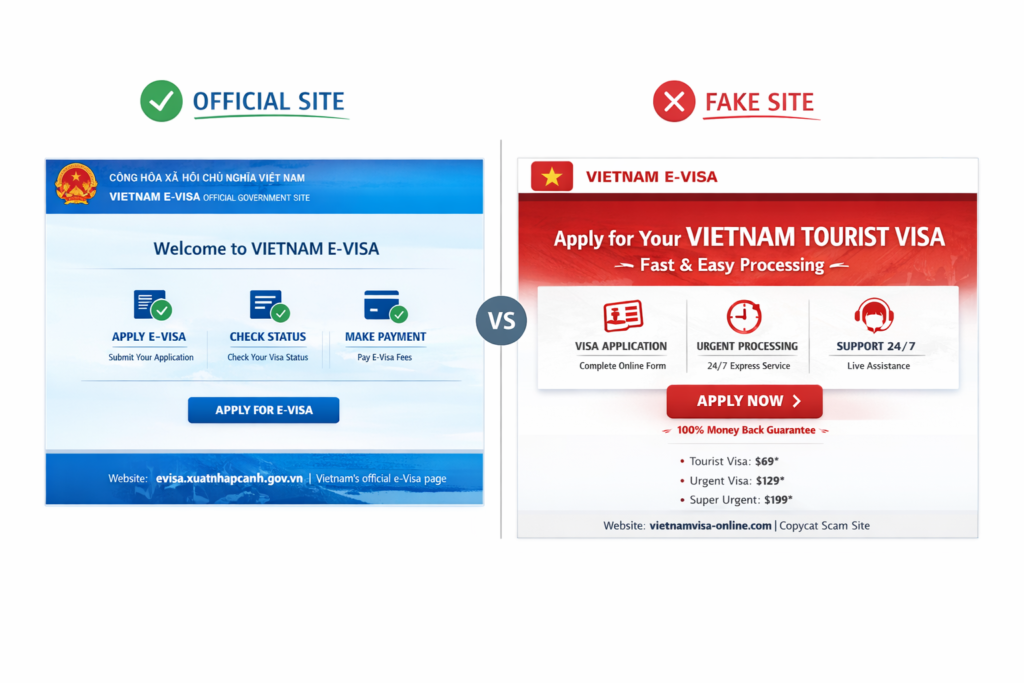
Side-by-side comparison of Vietnam’s official government e-visa website and a copycat scam site
The Vietnam e-visa problem is specifically acute
Vietnam’s official e-visa system is at evisa.xuatnhapcanh.gov.vn. Dozens of sites with names like “vietnam-evisa.com” appear in paid ads. Only trust the .gov.vn domain. Critical: the Vietnam e-visa must be printed — a valid visa on your phone will not be accepted at immigration.
Official government domains — the only URLs to trust
| Country | Official URL ✅ | Copycat example ❌ |
|---|---|---|
| 🇻🇳 Vietnam | evisa.xuatnhapcanh.gov.vn | vietnam-evisa.com |
| 🇹🇭 Thailand | thaievisa.go.th | thailand-evisa.net |
| 🇸🇬 Singapore | ica.gov.sg | — |
| 🇲🇾 Malaysia | eservices.imi.gov.my | — |
| 🇯🇵 Japan | mofa.go.jp | — |
The 30-second check
Before entering any information into a visa site, look at the URL bar. Does it contain an official government domain (.gov.vn, .go.th, .gov.sg, .gov.my)? If not: close the tab. This one habit eliminates nearly all fake visa site risk.
What happens if you overstay your visa in Asia?
2026 rules — what changed in late 2025 and what it means for your trip
Visa overstays are one of the most common — and most underestimated — administrative risks for solo travelers doing multi-week trips in Asia. The cause is almost never intentional: a miscounted entry date, a rescheduled flight, a stay that felt within the visa period but wasn’t. The consequences became substantially more serious in late 2025.
Late 2025 CRITICAL IMMIGRATION ALERT
Major enforcement changes in Thailand and Vietnam have significantly increased the risk for solo travelers. Read this before you book.
Thailand: The end of the “Visa run”
As of November 2025/January 2026
- 2-Entry Limit: You are now limited to two visa-exempt entries per calendar year (by land or air).
- The “Pattern” Crackdown: Even if you have “entries” left, immigration officers now have explicit authority to deny entry if they believe your history suggests you are living in Thailand long-term rather than visiting.
- The TDAC Requirement: All travelers must complete the Thailand Digital Arrival Card (TDAC) online at least 72 hours before arrival. This replaces the old paper forms and is cross-referenced with your travel history instantly.
- DTV Scrutiny: The popular Destination Thailand Visa (DTV) now requires consistent proof of 500,000 THB (~$14,500) held for at least 3 months prior to application. Lump-sum deposits right before applying are being rejected.
Vietnam: Decree 282/2025 enforcement
Effective December 15, 2025
- Steep Fine Hikes: Overstay fines have doubled. A 16–30 day overstay now triggers a fine up to VND 10 million (~$380)—up from VND 3-5 million.
- Automatic Deportation: Decree 282 explicitly grants authorities the power to deport any foreigner who overstays by 16 days or more.
- ASEAN Data Sharing: Vietnam has begun sharing immigration violation data with Thailand, Malaysia, and Singapore. An overstay in Hanoi can now result in a secondary-room questioning when you land in Bangkok or Kuala Lumpur.
- The 12-Hour Rule: Accommodation providers must register your stay within 12 hours of arrival (urban areas). If your hostel is “casual” about paperwork, they are putting your legal status at risk.
Jetgurl Pro-Tip
“In 2026, ‘I didn’t know’ is not a legal defense. These systems are now fully digitized. If you plan to spend more than 60 days in either country, stop relying on exemptions. Secure a proper Tourist Visa or DTV before you fly to avoid a permanent ‘Undesirable’ stamp in your passport.”
| Country | Daily / Initial Fine | Maximum Fine | Entry Ban | Key Consequences |
| Thailand | 500 THB (~$14) | 20,000 THB (~$570) | 1–10 years (if overstay > 90 days) | Passport stamped “undesirable alien” for repeat violations. Voluntary surrender leads to shorter bans. |
| Vietnam | ~$19/day (Tiered for 1–5 days) | ~$1,520 (VND 40M) | 1–3 years | Deportation authority at 16+ days. Overstays are shared via ASEAN data systems, affecting regional visas. |
| Singapore | N/A (Criminal Offense) | SGD 4,000 (~$3,000) | Permanent blacklisting | Zero tolerance policy; may include up to 6 months imprisonment. |
| Malaysia | RM 1,000 (~$210) | RM 10,000 (~$2,100) | Permanent blacklisting | Possible 5-year imprisonment. Overstayers are held at their own expense until deportation. |
| Japan | None | None | 3 years (up to 1 year overstay) | 10-year ban for overstays exceeding 1 year. Long-term impact on all future Japanese visa eligibility. |
How to avoid an accidental visa overstay
- Photograph your entry stamp the moment immigration returns your passport. If it looks wrong, raise it immediately.
- Set a phone alarm 7 days before your visa expires — that’s your “deal with this now” alert.
- Extensions in most countries require 5–10 working days to process. Don’t wait.
- If you’ve already overstayed: self-report. Going proactively results in lighter penalties than being caught at departure.
- Visa runs are increasingly scrutinised. Thailand now explicitly limits this to twice per year.
Destination Thailand Visa (DTV) vs Tourist Visa — which is right for you?
| Feature | Tourist Visa / Visa Exemption | Destination Thailand Visa (DTV) |
|---|---|---|
| Who it’s for | Short-term visitors (under 90 days) | Remote workers, long-stay travelers |
| Length of stay | Up to 60 days (exemption) / 90 days (visa) | Up to 180 days per entry |
| Entries | Max 2 visa-exempt entries/year (2025 rule) | Multiple entry for 5 years |
| Cost | Free (exemption) or ~$35–50 | 10,000 THB (~$280) |
| Extension | 30 days first, 7 days second | Additional 180 days in-country |
| Best for | Normal holidays up to 60 days | Long-term stays; avoids visa run issues |
Arrival safety: the hours that matter most
From airport to first accommodation — the decisions that set the tone for your trip
The arrival window is when most safety incidents for solo female travelers happen. You’re tired, disoriented, carrying everything you own, and operating in an unfamiliar system. This is exactly when scammers operate.
Do these four things before you leave the arrivals hall
- Get a local SIM card — Every airport in these five countries has a SIM desk in arrivals. You need data before you need anything else: navigation, Grab, your hostel address.
- Book your Grab from inside the terminal on WiFi. Don’t negotiate with anyone who approaches you in arrivals. They are not the cheaper option.
- Identify your accommodation address offline. Screenshot it. Put it in your photos. Losing internet at the wrong moment is more common than it should be.
- If arriving late at night: message your accommodation with your ETA from inside the airport. Budget guesthouses in Bangkok and Hanoi have notoriously inconsistent reception after midnight.
Transport from the airport — by country
| Country | Best option | Watch out for |
|---|---|---|
| Singapore | MRT or Grab | Touts outside arrivals — Changi’s MRT is fast, cheap, drops you near most hotels |
| Japan | Airport bus or train | Unlicensed “fixed price” taxi offers; Japan’s official airport transport is excellent |
| Thailand (BKK) | Grab or Airport Rail Link | Metered taxi queue is legitimate; avoid flat-rate touts before the queue |
| Malaysia (KUL) | Grab from KLIA or KL Sentral | Taxi touts at arrivals quoting flat fares — 3–5x the Grab price |
| Vietnam | Grab or official Mai Linh taxi | Fake “Mai Linh” taxis with tampered meters; check the door logo matches exactly |
On tiredness and decision-making
Jetlag and decision fatigue are not separate problems from safety. When you’re exhausted, your ability to read a situation accurately drops significantly. Arrange your airport transport, first night accommodation, and SIM before you land. These three decisions don’t need to be made tired.
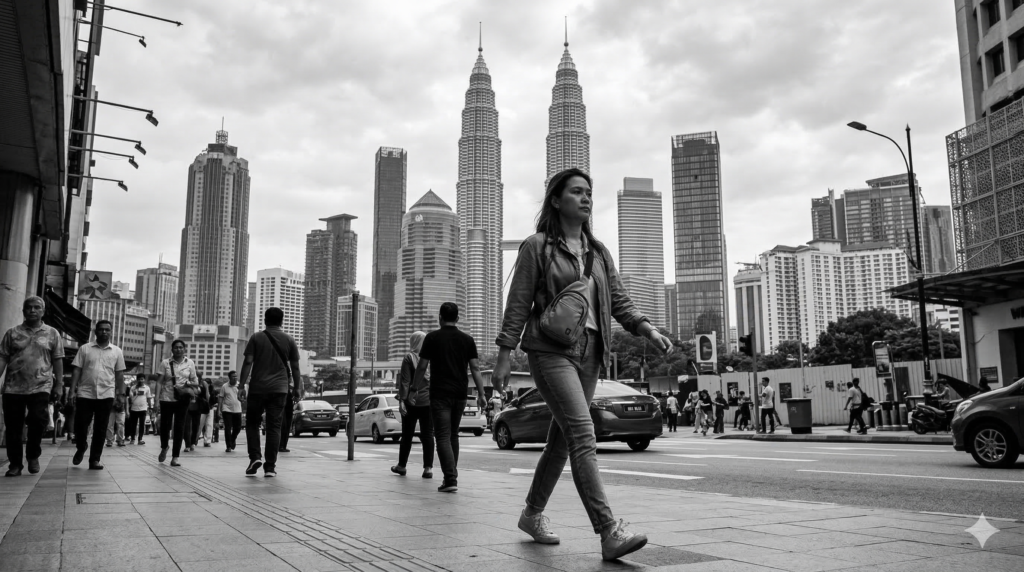
A woman wearing a crossbody bag across her chest while walking in Kuala Lumpur
The habits that actually keep you safe
Most safety content focuses on items to pack. Items are passive. Habits are active.
- 01 Always use Grab for transport: In Singapore, Thailand, Malaysia, and Vietnam, Grab provides a tracked, priced, accountable ride. Every trip has a record. Fundamentally different from hailing a taxi in a tourist area.
- 02 Keep daily cash separate: Pull small amounts — enough for a day’s street food and transport — into a separate coin purse. Your main cards and larger cash never come out at a market stall.
- 03 Know the scam before you arrive: The psychology of scam prevention is simple: foreknowledge short-circuits the social engineering. You can’t be surprised by a script you’ve already read.
- 04 Choose social hostels deliberately: A well-reviewed social hostel gives you an instant community, reliable front desk for local advice, and an environment where other travelers notice if something seems off.
- 05 Assess nightlife honestly: Drink spiking is a real risk in specific Bangkok, Phuket, and Ho Chi Minh City bar districts. Keep your drink in your hand. Going out with hostel-mates significantly reduces this risk.
- 06 Walk with conviction: In every city in this guide, the travelers who experience the most harassment are those who look lost. Check your map in a café, not while standing still on a street corner.
- 07 Track your visa dates actively: Put your visa expiry date in your phone calendar the day you arrive. Set an alert 7 days out. This takes 90 seconds and eliminates the entire category of accidental overstay.
- 08 Trust the local infrastructure: Hotel front desks, hostel staff, and tourist police in all five countries are reliable resources for directions and taxi recommendations.
On trusting your instincts
Your gut responds to cues your conscious mind hasn’t yet processed. If something feels wrong — a person is too insistent, a situation is moving too fast — that feeling is data. You’re allowed to leave, to say you changed your mind, to get out of a tuk-tuk and walk. Politeness is not a safety requirement.
Protecting your data across five countries
Losing your phone in 2026 means losing navigation, banking, bookings, photos, and communication simultaneously
Before you leave home — the non-negotiable setup
- Enable cloud photo backup (Google Photos or iCloud) set to back up on WiFi automatically. If your phone is snatched, you keep your photos.
- Set a strong passcode and enable remote wipe (Find My iPhone / Google Find My Device). If a thief can’t get in, the data is safe.
- Save offline maps for every city you’re visiting. Google Maps lets you download city maps for offline use.
- Screenshot or PDF your accommodation bookings and visa documents. Store them in a photos folder by country. You will need these at immigration and check-in.
- Share your itinerary with one person at home — a Google Doc with accommodation names, dates, and booking references.
Using public WiFi safely
Use a VPN for any connection that isn’t your own mobile data. ExpressVPN and NordVPN both work reliably across all five countries, including Vietnam where some international sites are restricted without one.
Never leave your phone unattended
In Vietnam’s café culture and Thailand’s beach bars, leaving a phone face-down on a table while you swim is common — and the most reliable way to lose one. Lock it to your bag, keep it in a zipped pocket, or take it with you.
Connectivity as a Lifeline: Why an eSIM is Your #1 Safety Tool
For a solo female traveler, the most vulnerable moments of a trip aren’t usually in the middle of a dark alley—they are the “transition beats.” It’s the 15 minutes after you land in a new country, the moment you step out of a train station into a crowded plaza, or the seconds after you realize your Grab driver has taken a “shortcut” that doesn’t look like a shortcut.
An eSIM ensures you are never “offline” during these critical windows.
The “Why”: Eliminating the Arrival Vulnerability
The traditional scramble for a local SIM card creates a specific kind of “tourist target” behavior.
- The Wi-Fi Trap: Searching for a public Wi-Fi signal often tethers you to a specific spot (like an airport cafe) with your head down in your phone, making you easy to spot and approach.
- The Kiosk Chaos: Fumbling with cash, local ID requirements, and physical SIM tools at a busy airport kiosk while managing your luggage is a high-stress moment where bags are easily snatched or scams are initiated.
The 2026 Move: By installing an eSIM before you leave home, your phone connects to the local 5G network the second your plane touches the tarmac. You can book your ride, check your hostel’s address, and message home before you’ve even unbuckled your seatbelt.
Grab’s 2026 Safety Suite: AudioProtect & Live Sharing
Ride-hailing apps like Grab (the standard in Singapore, Thailand, and Malaysia) have introduced advanced safety features that require a stable data connection to function.
- AudioProtect (New for 2026): This feature allows the app to record encrypted audio of your ride on both your device and the driver’s. It acts as a digital witness. For late-night rides (10 PM – 6 AM), this feature is often enabled by default and cannot be turned off. Without a working data connection, the app cannot reliably sync or verify this protection.
- Live Location Sharing: 2026’s GPS tech is more precise than ever. You should always use the “Share My Ride” feature with a trusted contact. If you lose data, your “live” location freezes, which can cause unnecessary panic for your emergency contact at home.
The “Crisis” Angle: Immediate Digital Independence
If a situation feels sketchy—a street feels too quiet, a group is following you, or a “friendly” local is getting too pushy—your data is your exit strategy.
- Discreet Emergency SOS: Most 2026 smartphones (like the iPhone 17 or Samsung S26) have integrated emergency SOS features that can send a silent “Help” alert with your GPS coordinates to local authorities or your “Circle” of contacts.
- Instant Verification: Scammers rely on your confusion. If someone tells you “the temple is closed” or “the train is canceled,” having instant data allows you to verify that claim in 5 seconds without having to depend on a stranger for information.
- Digital Escort: If you have to walk home alone at night, being on a “Live” video call or using a safety app like Noonlight (which dispatches help if you release a button) provides a layer of protection that simply doesn’t exist offline.
SIM cards and connectivity by country
| Country | Best SIM option | Cost (30 days) | eSIM available? |
|---|---|---|---|
| Singapore | Singtel Tourist SIM | SGD 15–25 (~$11–18) | Yes — Airalo, Holafly |
| Japan | IIJmio or Softbank Tourist | ¥2,000–4,000 (~$13–26) | Yes — widely available |
| Thailand | AIS, DTAC, or TrueMove | 200–400 THB (~$6–12) | Yes — all major carriers |
| Malaysia | Maxis, Celcom, or Digi | RM 30–50 (~$6–11) | Yes — Airalo works well |
| Vietnam | Viettel or Vinaphone | 100k–200k VND (~$4–8) | Yes — local SIM often faster |
I consider a working eSIM my #1 safety item—even more than a door alarm. Landing with immediate data means you can book a tracked Grab and share your live location the moment you touch down. See my [2026 Packing List] for the step-by-step setup and which providers have the best 5G coverage in Vietnam and Japan
FAQs
Is solo female travel in Southeast Asia safe for first-timers?
Yes — with appropriate context. These five countries host millions of solo female travelers annually without incident. First-timers do particularly well by starting in Singapore or Japan — both extremely safe, English-friendly, and easy to navigate — before moving into Thailand and Vietnam where the scam landscape is more active.
What’s the actual risk of going out alone at night in Bangkok?
Lower than most solo female travel content implies. Sukhumvit, Silom, and the Old Town areas are busy, well-lit, and have tourist police presence. Walking back from a restaurant or bar at midnight is a normal part of solo travel in Bangkok for millions of women every year. The risks worth taking seriously are drink spiking in specific bar districts and taking transport with strangers rather than using Grab. None of these require avoiding nightlife — they require specific habits within it.
What should I do if I’ve already overstayed my visa?
Don’t hide it. Immigration systems in all five countries will flag an overstay when you check out. Self-reporting before your departure date results in significantly lighter penalties. In Thailand, minor overstays under 90 days paid at the airport usually result only in the fine (500 THB/day, max 20,000 THB) with no re-entry ban. In Vietnam, Decree 282/2025 means even 1–2 days creates a passport record. Medical documentation for a health-related overstay is often accepted as a mitigating factor.
Is it safe to travel solo as a woman in Japan?
Japan is, by most measurable metrics, the safest country in this guide for solo female travelers. Violent crime against tourists is extremely rare. Public transport is safe at all hours. Women-only train carriages exist on many lines during rush hours. The main considerations are practical: language barriers (Google Translate with camera mode is essential) and awareness of the hostess bar overcharge scam in Kabukicho, Shinjuku.
How do I know if a visa website is legitimate?
Check the domain. Official government visa portals use country-specific government domains: evisa.xuatnhapcanh.gov.vn (Vietnam), thaievisa.go.th (Thailand), and similar .gov.XX patterns. If the URL ends in .com, .net, .online, or any non-government suffix, you’re on a third-party site. For all five countries in this guide, you can apply directly on the official government portal yourself — no agent needed.
What’s the most effective safety item to pack?
A fully charged phone with Grab installed, cloud backup enabled, and your accommodation address saved offline. This outperforms every piece of tactical gear in real-world solo travel situations. For physical items: a door wedge alarm for budget guesthouses (~$8), a crossbody bag worn with the zip facing inward, and a personal alarm.
Do I need to dress differently in different countries?
Yes, though the variation is less dramatic than many guides suggest. The consistent rule across all five countries is temple modesty — covered shoulders and knees at religious sites. Beyond temples, Bangkok and Ho Chi Minh City are genuinely relaxed about clothing. Modest dress in rural areas and conservative Muslim areas of Malaysia is genuine cultural respect. A lightweight sarong handles most situations across all five countries.
