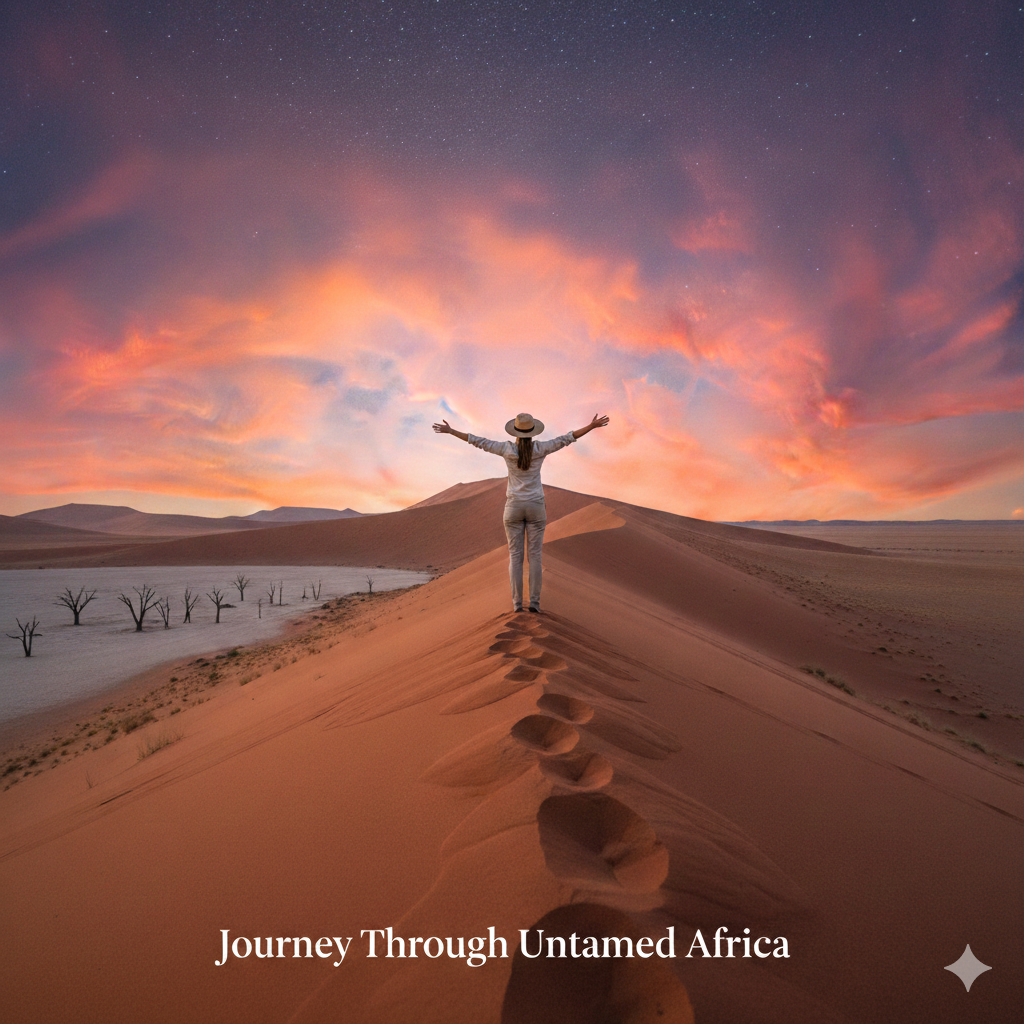

Planning solo female travel in Southern Africa? Two of Africa’s safest, most spectacular countries for women traveling alone are Botswana and Namibia. After spending nearly a month exploring these destinations solo, from the Okavango Delta’s waterways to Namibia’s otherworldly deserts, I’m sharing everything you need: safari budgets, safety tips, accommodation recommendations, and the moments that made this journey unforgettable.
Southern Africa offers a unique blend of wilderness adventure and modern infrastructure that makes it ideal for first-time solo travelers to the continent. Whether you’re seeking close encounters with elephants in Chobe, sunrise over towering sand dunes, or the freedom of a desert road trip, this guide will help you plan the Southern African adventure of a lifetime.
Related to this guide is my safari travel through two incredible East African countries, Kenya and Tanzania.
Why Botswana & Namibia for Solo Female Travelers?
The first time I mentioned solo travel in Africa, the reaction wasn’t dramatic—it was quiet. A pause. Then a careful, “Are you sure?”
That pause is familiar to many women who travel alone. Not because we doubt ourselves, but because Africa is still spoken about as one story, when in reality it’s thousands. Some loud, some chaotic, some gentle, some deeply grounding.
Botswana and Namibia consistently rank among Africa’s safest countries for solo female travelers. Here’s why:
Botswana
- Politically stable and progressive (one of Africa’s strongest democracies)
- Low crime rates, especially in tourist areas
- Well-organized safari infrastructure
- English widely spoken
- Respectful, welcoming culture
- Fewer crowds
Namibia
- Excellent road infrastructure for self-drive safaris
- German colonial influence = European-style efficiency
- One of Africa’s lowest crime rates
- English widely spoken
- Solo female travelers common and respected
- Safe for camping and road trips
Traveling solo in Southern Africa has never been about being fearless for me. It’s about choosing places that feel steady, cultures that value respect, and destinations where moving through the day alone feels natural rather than brave.
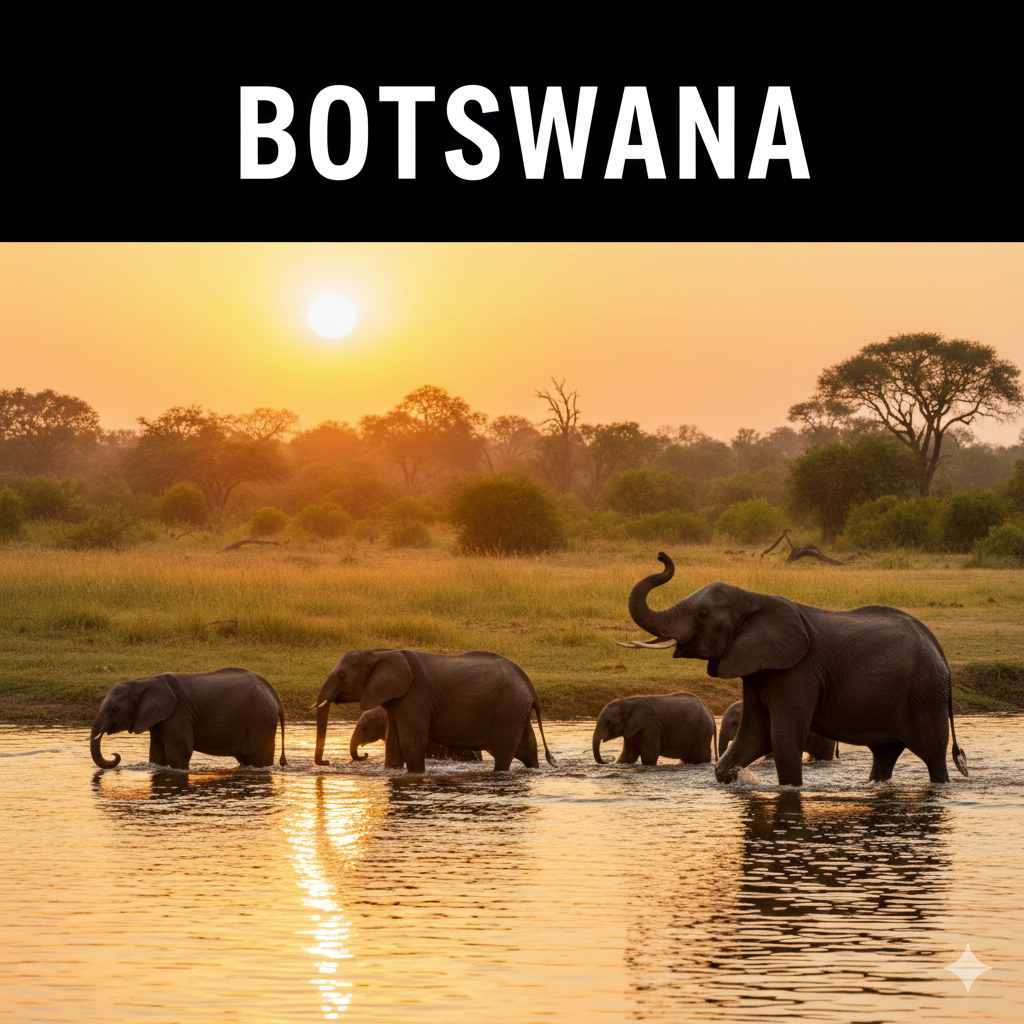
Elephant herds in Botswana
Botswana: Untamed Wilderness & Elephant Paradise
Botswana is Best for: Luxury safari seekers, Okavango Delta explorers, elephant lovers, off-the-beaten-path adventurers, authentic wilderness experiences.
Perfect Time to Visit:
- Okavango Delta: May-September (high water season, best for mokoro safaris)
- Chobe National Park: May-October (dry season, incredible game viewing)
- Green Season (Nov-April): Lower prices, fewer tourists, lush landscapes, but some camps close
Visa: Visa-free for most nationalities (US, UK, EU, Australia, Canada) for up to 90 days
Currency: Botswana Pula (BWP) – approximately 1 USD = 13-14 BWP
The Botswana Solo Travel Experience
Botswana is Africa’s best-kept secret for safari purists. The government prioritizes “low volume, high value” tourism, meaning fewer tourists, pristine wilderness, and higher prices. But oh, the rewards.
This country has the highest concentration of elephants in Africa (over 130,000), the magical Okavango Delta (a massive inland delta that floods the Kalahari Desert annually), and some of the continent’s most exclusive safari camps. It’s also one of Africa’s most stable, safest, and politically progressive countries.
As a solo female traveler, Botswana felt incredibly safe and welcoming. Safari guides are professional and respectful, accommodations cater well to solo travelers (many offering single supplements or easy group joining), and the tourist infrastructure is reliable.
My Botswana Journey: 10 Days Solo
I spent 10 days in Botswana, split between the Okavango Delta and Chobe National Park. Flying from Johannesburg to Maun, Botswana’s safari gateway, marked the beginning of an unforgettable adventure.
Maun: Gateway to the Delta
Maun is Best for: Safari launching point, budget travelers seeking affordable Okavango access, local markets, mokoro trips, connecting flights to luxury lodges
Population: ~65,000
Vibe: Frontier town meets safari hub—dusty streets, donkeys wandering, safari vehicles everywhere
Where I Stayed: The Old Bridge Backpackers—a riverside hostel with camping, female-only dorms, pool, bar, and safari booking services. Budget-friendly ($15-20 USD/night) and incredibly social—perfect for solo travelers wanting to join group safaris.
Solo Traveler Tip: Maun hostels are excellent for meeting other travelers to split safari costs. Many people arrive solo and leave with a safari crew.
Arriving in Maun
I arrived in Maun late afternoon after a connection through Johannesburg. The small airport is efficient and welcoming. A taxi to town costs about 50-70 BWP ($4-5 USD).
Checking into Old Bridge, I immediately felt the community vibe—travelers swapping safari stories around the pool, staff helping coordinate group trips. I wandered Maun’s dusty streets, visiting local markets selling baskets, crafts, and fresh produce. Safari Land Cruisers rumbled past constantly.
That evening, over drinks at the hostel bar, I met other solo travelers and backpackers. Together with the hostel, we booked a 3-day/2-night Okavango Delta mobile camping safari ($450 USD all-inclusive). Mobile camping safaris are Botswana’s budget option—you camp in the bush, cook over fires, sleep in tents, and experience the delta authentically without the $1,000+/night luxury lodge price tag.
Maun Essentials:
- Where to Eat: Hilary’s Coffee Shop (breakfast), Ostrich Farm Restaurant (dinner), local markets (cheap meals)
- What to Do: Book safaris, visit craft markets, crocodile farm tours, relax before delta adventures
- Safari Booking: Book through hostels for best group rates, or pre-book with operators like Okavango Expeditions, Audi Camp Safaris
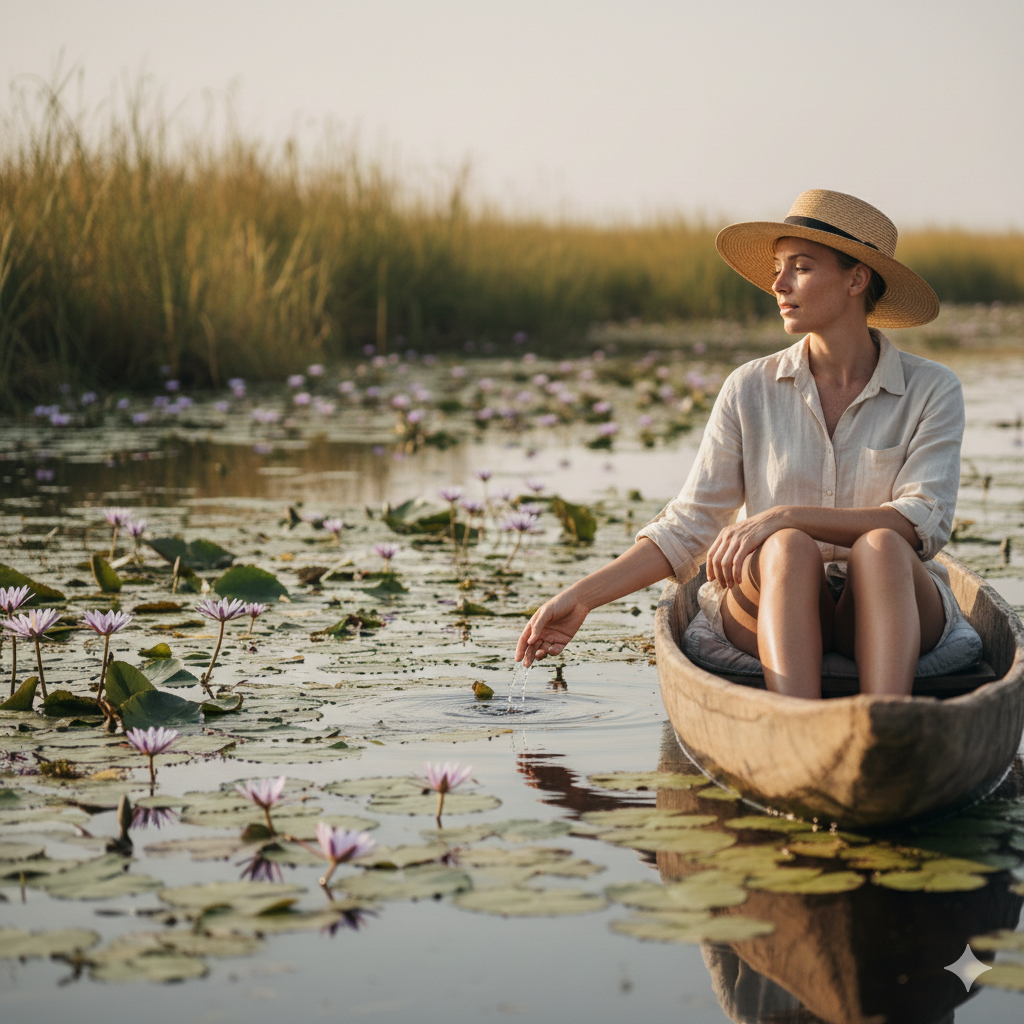
Sitting in a traditional wooden mokoro canoe on the lily-covered waterways of the Okavango Delta, Botswana.
Okavango Delta: Paradise Found
Okavango Delta is Best for: Mokoro (dugout canoe) safaris, birdwatching (400+ species), walking safaris, water-based game viewing, pure wilderness magic, romantic luxury (if you splurge)
UNESCO World Heritage Site | One of the Seven Natural Wonders of Africa
The Okavango Delta is one of the world’s largest inland deltas, a miraculous oasis where the Okavango River floods into the Kalahari Desert annually, creating a lush, wildlife-filled wetland. It’s unlike any place on Earth.
Visiting the delta is non-negotiable for any Botswana trip. You have two options:
Budget Option: Mobile camping safaris ($400-600 for 3 days)
Luxury Option: Fly-in lodge stays ($500-2,000+ per night)
I chose mobile camping. Best decision ever.
Day 1—Into the Delta
At 7 AM, we departed Maun in open-top safari vehicles. Our group: six solo travelers and backpackers from around the world, plus our guide Kgosi and camp assistant Mpho. The diversity of the group—ages 23 to 58, from five countries—reminded me that solo travel has no age limit.
We drove 2 hours through scrubland to the delta’s edge, then transferred to mokoros—traditional dugout canoes poled by local guides (called “polers”).
Gliding silently through the delta’s waterways—reeds towering on either side, lily pads floating, kingfishers darting overhead—was pure serenity. Hippos grunted nearby. Our guide whispered, “Pole quietly. We are in their home.”
Drifting through the Okavango in a mokoro, surrounded by silence broken only by birdsong and water lapping, I felt like I’d entered another world.
We reached our island camp—a clearing with dome tents, a campfire, and a long-drop toilet (aka a hole in the ground). No fences. No barriers between us and the wild. Our poler explained: “Elephants may visit at night. Stay in your tent and they’ll pass peacefully.”
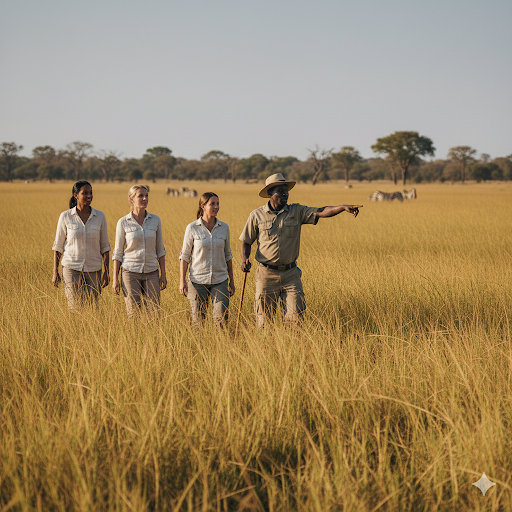
Guided walking safari in Botswana’s Okavango Delta wilderness
Walking Safari
After a lunch of sandwiches and fruit, we set off on a walking safari. Kgosi taught us to track animals by footprints, droppings, and broken branches. Walking in single file, adrenaline pumping, we remained hyper-aware that predators could be anywhere.
We spotted giraffes browsing acacia trees, zebras grazing, impalas leaping through grass, and elephant dung so fresh it was still steaming—meaning a herd passed minutes before.
Solo Travel Insight: Walking safaris are incredible equalizers. Solo, couple, group—everyone walks together, and the shared adrenaline creates instant bonds.
That evening, we sat around the campfire eating stew and rice, swapping stories under a sky so full of stars I couldn’t comprehend it. The Milky Way stretched like a river of light. Lions roared in the distance—far enough to feel safe, close enough to feel the thrill. I slept fitfully but exhilarated.
Day 2—Deep in the Wild
We woke at 5:30 AM for another walking safari. Dawn in the delta was magical—soft light, cool air, animals active. We tracked a herd of elephants for over an hour, getting close enough to hear them ripping grass, rumbling softly to their calves.
Kgosi stopped us suddenly, pointing ahead. A lone male lion, massive and golden, lay in the shade 50 meters away. Frozen, my heart hammered in my chest. After what felt like an eternity, the lion yawned, stretched languidly, and sauntered off into the bush.
Standing meters from a wild lion, no vehicle between us, just trust in our guide—that’s the rawest, most humbling moment of my life.
We returned to camp for breakfast, then took mokoros deeper into the delta, spotting crocodiles sunning on banks and a fish eagle swooping to catch its prey. The silence, broken only by paddle dips and bird calls, felt meditative.
Afternoon was free time. I journaled under a tree, swam carefully in hippo-free channels (always ask your guide first!), and watched elephants cross the water to our island—trunk raised, babies following.
Hippos grazed outside our tents that night. I could hear them munching grass, grunting in conversation, occasionally bumping into tent guy-ropes. Terrifying and thrilling in equal measure.
Safety Note: Hippos are extremely dangerous. Never leave your tent at night during mobile camping. Use the buddy system if you absolutely must, and always inform your guide.
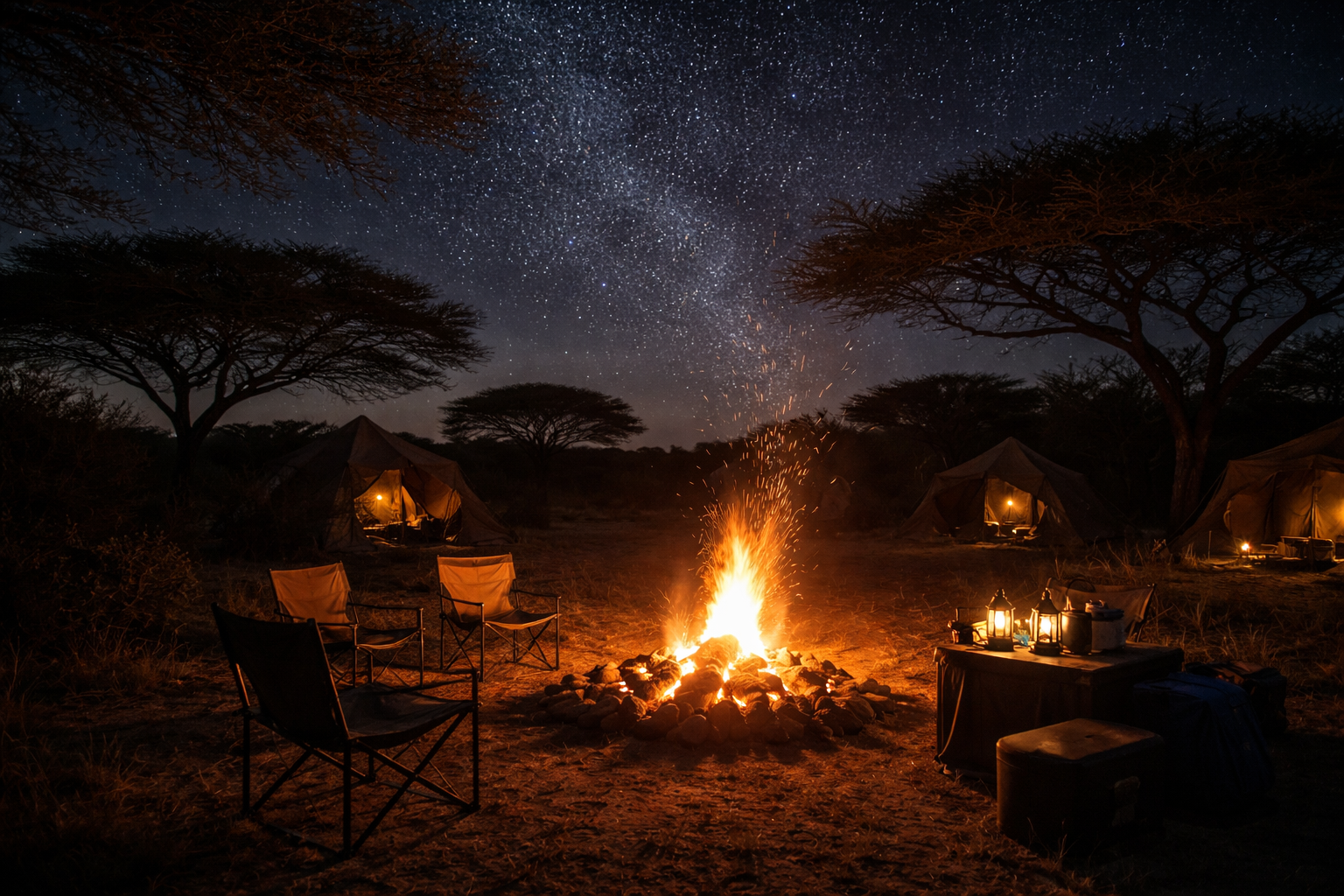
Mobile camping safari in Botswana with a campfire under an African night sky
Day 3—Farewell to Paradise
Our last morning, we walked to a viewpoint overlooking the delta’s endless floodplains. The beauty was overwhelming—water, reeds, islands, wildlife, sky merging at the horizon.
We mokoro’d back to the vehicles, drove to Maun, dusty and content. I’d learned to track animals, identify bird calls, sleep with lions nearby, and trust in the wild.
Okavango Delta Quick Hits:
Must-Do Experiences:
- Mokoro safari through waterways (quintessential delta experience)
- Walking safari with armed guide (adrenaline rush)
- Mobile camping for authentic wilderness immersion
- Birdwatching—over 400 species (bring binoculars)
- Stargazing (minimal light pollution)
- Luxury lodge splurge if budget allows (incredible but expensive)
Budget Breakdown:
- Mobile camping safaris: $400-600 for 3 days all-inclusive
- Mid-range lodges: $200-400 per night
- Luxury lodges: $500-2,000+ per night
- Mokoro day trips from Maun: $80-120
What to Pack:
- Neutral safari colors (khaki, olive, beige—avoid bright colors and black)
- Sturdy walking boots (broken in!)
- Sun protection (hat, SPF 50+, sunglasses)
- Insect repellent with DEET
- Headlamp with extra batteries
- Lightweight rain jacket
- Warm layers (nights get cold, even in summer)
- Binoculars for wildlife viewing
- Waterproof bag for electronics during mokoro rides
Pro Tips for Solo Travelers:
- Book mobile camping through hostels in Maun for easiest group joining
- Dry season (May-October) offers best game viewing but higher prices
- Green season (November-April) is cheaper with fewer tourists but some camps close
- No fences in mobile camps—always listen to guides
- Bring earplugs if you’re a light sleeper (hippos are LOUD)
- Photography: Early morning and late afternoon offer best light
- Travel insurance is mandatory—ensure it covers safari activities
Chobe National Park: Elephant Capital of the World
Chobe is Best for: Elephant herds (100,000+ elephants), river safaris, combining Botswana with Zimbabwe/Namibia, budget-friendly game viewing, self-drive safaris
Park Size: 11,700 km² (4,517 sq mi)
Known For: Having the highest concentration of elephants in Africa
I traveled overland from Maun to Kasane (gateway to Chobe) via overnight bus ($30 USD, 10 hours). The bus was basic but safe—locals and tourists mixed, bumpy roads, stunning landscapes rolling past. Adventurous and authentic.
Alternative: Domestic flights Maun to Kasane (40 minutes, $120-180 USD) if time is limited.
Where I Stayed: Chobe Safari Lodge—a mid-range lodge on the Chobe River with balconies overlooking the water, pool, restaurant, and safari packages. Solo-friendly with group activities and easy to meet other travelers. ($60-90 USD/night)
Budget Alternative: Chobe Safari Lodge Campsite or Thebe River Safaris Lodge (both $20-40/night)
Day 1—River Safari Sunset
I arrived in Kasane around noon, checked in, showered off the bus dust, and immediately booked a sunset river safari ($50 USD). At 3 PM, we boarded a boat with about 15 other travelers—couples, families, a few solo adventurers like me.
Within minutes, we encountered hundreds of elephants drinking, bathing, and playing along the riverbanks. Baby elephants splashed joyfully, rolling in mud, while matriarchs watched protectively. Teenagers play-fought, tumbling over each other. I’ve never seen so many elephants in one place.
Watching an elephant family—babies tumbling, mothers guiding—reminded me that we’re all just trying to take care of the ones we love.
We also saw:
- Hippos yawning (displaying massive teeth—intimidation displays)
- Nile crocodiles lurking in shallows
- Cape buffalo herds drinking
- A leopard slinking through riverside reeds at sunset (rare daytime sighting!)
- Countless birds: African fish eagles, kingfishers, herons
The golden-hour light on the river, elephants silhouetted against the sun, reflections shimmering—I cried. Not ashamed. Pure overwhelm at nature’s beauty.
River Safari Tips:
- Book the 3 PM sunset cruise (best light and animal activity)
- Bring a telephoto lens or good zoom camera
- Sunset gets cool—bring a light jacket
- Sit on the upper deck for best views
- Most lodges offer these—shop around for best price
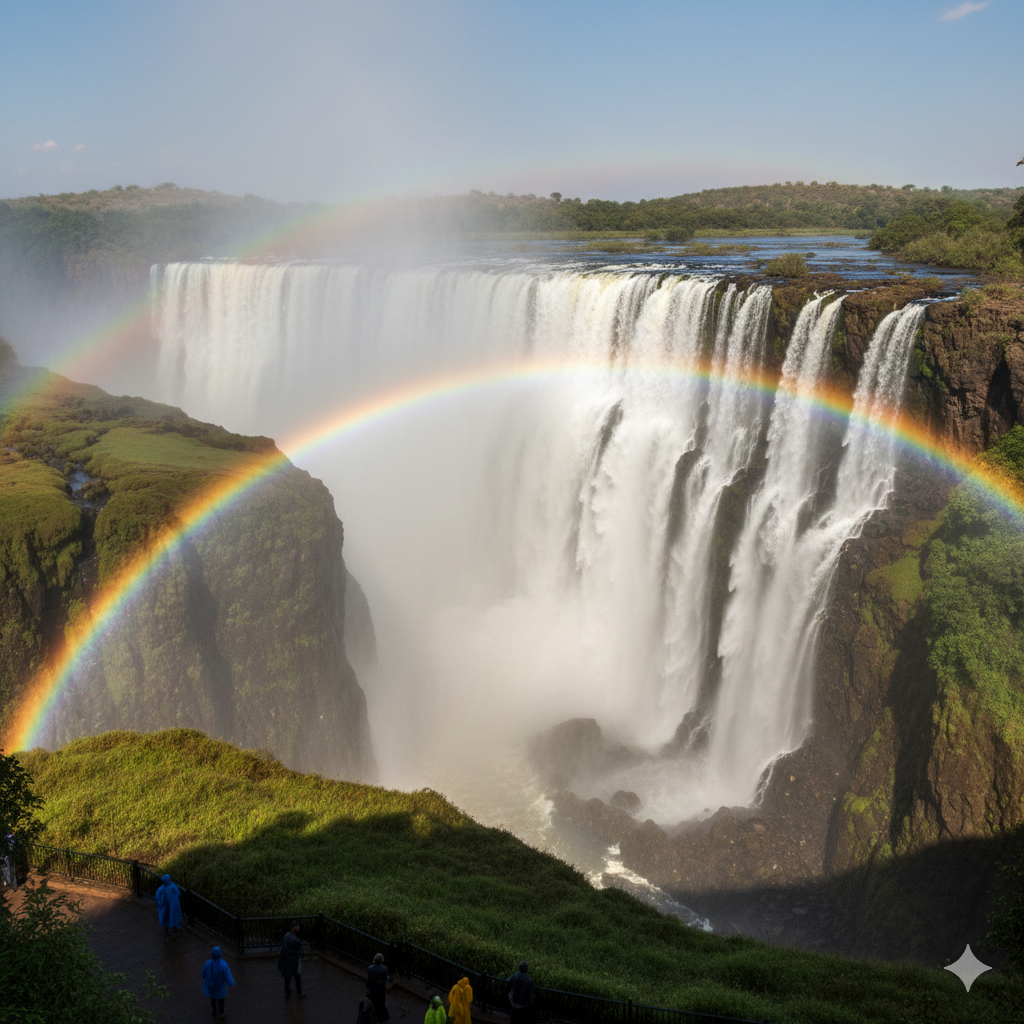
Victoria Falls Zimbabwe viewed on a day trip from Botswana
Day 2—Game Drive and Zimbabwe Day Trip
Early morning game drive in Chobe National Park (6 AM-10 AM). Our open-sided safari vehicle navigated dusty roads, stopping frequently for sightings:
- Lions (a pride of seven lounging under a tree)
- More elephants (never gets old!)
- Giraffes browsing impossibly tall trees
- Zebras in massive herds
- Rare puku antelopes (unique to this region)
- Warthogs scurrying comically
Chobe has the highest concentration of elephants in Africa—over 120,000. During dry season, herds of 50-100 elephants are common sights.
In the afternoon, I joined a day trip to Victoria Falls in Zimbabwe (30-minute drive from Kasane). US passport—check requirements for your nationality.
The falls—massive, thundering, rainbows dancing in the mist—were breathtaking. Walking the trails on the Zimbabwean side, getting completely drenched by spray, I felt the raw power of nature. One of the Seven Natural Wonders of the World, and absolutely deserving of that title.
Back in Kasane that evening, I reflected on how accessible African borders are for travelers. Botswana to Zimbabwe took 30 minutes, making multi-country trips incredibly doable.
Chobe & Border Crossing Quick Hits:
Must-Do Experiences:
- Sunset river safari (elephants galore, stunning photography)
- Morning game drive in Chobe National Park
- Day trip to Victoria Falls, Zimbabwe (30 min drive)
- Day trip to Namibia’s Caprivi Strip (if time allows)
- Self-drive safari if you have your own vehicle
Kasane Border Town Advantage:
- Four countries meet here: Botswana, Zimbabwe, Namibia, Zambia
- Easy day trips across borders
- Budget safaris widely available ($40-60 per activity)
- Safe, well-organized tourist infrastructure
Budget Breakdown:
- River safari: $45-60
- Game drive: $50-70
- Victoria Falls entry (Zimbabwe): $30 + $30 visa
- Accommodation: $20 (camping) to $150 (luxury lodge)
Pro Tips:
- Combine Chobe with Victoria Falls for an epic 3-4 day itinerary
- Book game drives through your accommodation for best rates
- Border crossings are straightforward—bring passport and cash for visas
- Kasane has ATMs, supermarkets, restaurants—stock up here
- Self-drive is possible in Chobe if you have 4×4
Botswana Budget Breakdown (10 Days Solo)
| Category | Budget Range | My Spending |
|---|---|---|
| Accommodation (hostels/camping) | $20-60/night | $350 |
| Okavango mobile safari (3 days) | All-inclusive | $450 |
| Chobe safaris (river + game drive) | Per activity | $120 |
| Transport (Maun-Kasane bus) | One-way | $30 |
| Victoria Falls day trip | Entry + visa | $60 |
| Food (self-catering + local meals) | $15-25/day | $180 |
| Miscellaneous (SIM card, tips, snacks) | $80 | |
| TOTAL | $1,270 |
Budget Traveler Total: $980-1,200
Mid-Range Traveler Total: $1,500-2,000
Luxury Traveler Total: $5,000+ (with fly-in camps)
Money-Saving Tips:
- Stay in hostels/camp (save 50%+ on accommodation)
- Join group safaris instead of private (significantly cheaper)
- Self-cater breakfast and lunch, eat out for dinner
- Book safaris through hostels for group discounts
- Travel in shoulder season (April-May, November) for lower prices
- Use overland buses instead of flights
Splurge-Worthy:
- At least one luxury lodge night in the Okavango (if budget allows—truly unforgettable)
- Helicopter flight over the delta ($200-400)
- Multi-day mobile safari with upgrades
Namibia: Desert Dreams, Road Trip Freedom & Starry Skies
Namibia is Best for: Road trippers, desert lovers, photographers, adventure seekers, solitude, self-drive safaris, adrenaline junkies, solo female travelers wanting freedom
The budget is affordable compared to Botswana. Mid-range by African standards
Perfect Time to Visit:
- May-October: Dry season, cooler temperatures (10-25°C/50-77°F), best for wildlife
- November-April: Hot season (can reach 40°C/104°F), but dramatic thunderstorms, lush landscapes, fewer tourists
Visa: Visa-free for most nationalities (US, UK, EU, Australia, Canada) for up to 90 days
Currency: Namibian Dollar (NAD) – pegged 1:1 with South African Rand (ZAR). Both accepted.
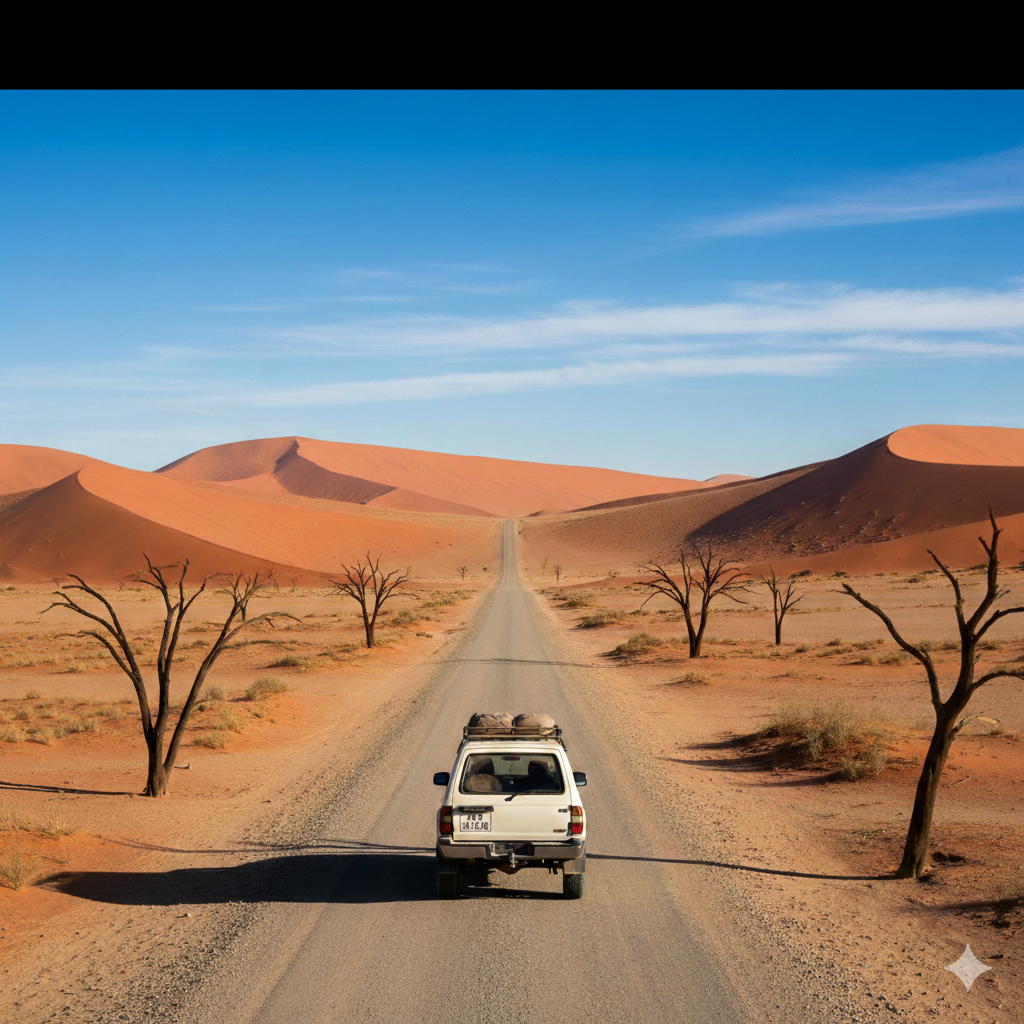
Desert road in Namibia stretching into the horizon with a 4×4.
The Namibia Solo Travel Experience
Namibia is otherworldly. Imagine rust-red sand dunes that ripple to the horizon, ghost towns swallowed by the desert, shipwrecks along the Skeleton Coast, and night skies so clear you can see the Milky Way like a river of light.
Vast, empty, and hauntingly beautiful—Namibia offers all of this. It’s also one of Africa’s safest countries with excellent infrastructure, making it ideal for solo travelers—especially those brave enough to rent a 4×4 and road trip.
Why Namibia is Perfect for Solo Female Road Trippers:
- Excellent road conditions (even gravel roads are well-maintained)
- Low crime rates, especially outside cities
- Easy navigation (roads are well-marked)
- Solo female travelers are common and respected
- Safe camping culture
- English widely spoken
- German influence means European-style efficiency
- Cell service in most areas
- Sparse population = solitude when you want it, company when you need it
My Namibia Journey: 2 Weeks Solo Road Trip
I spent two weeks in Namibia, road-tripping from Windhoek to Sossusvlei, Swakopmund, Etosha National Park, and back. Renting a 4×4 (necessary for gravel roads and some desert driving), I camped and stayed in budget lodges throughout my journey.
Total Distance Driven: ~2,500 km (1,550 miles)
Windhoek: The Gateway City
Windhoek is Best for: Starting point for Namibia adventures, African-European fusion culture, craft markets, German beer halls, organizing your road trip
Population: ~430,000
Vibe: Surprisingly modern and clean capital city with German colonial architecture mixed with African markets
Where I Stayed: Chameleon Backpackers—a lively hostel with female-only dorms, pool, bar, and campsite. Met fellow road-trippers here, including others looking to share 4×4 rental costs. ($15-20 USD/night dorm)
I arrived in Windhoek from Kasane, Botswana (via Johannesburg, $150 USD flight). The small airport is efficient. Taxis to the city center cost 150-200 NAD ($8-11 USD).
Small, clean, and surprisingly modern, Windhoek carries a legacy of German colonial influence (Namibia was German Southwest Africa until 1915). You’ll see this in architecture, language (some older Namibians speak German), and the ubiquitous German restaurants and breweries.
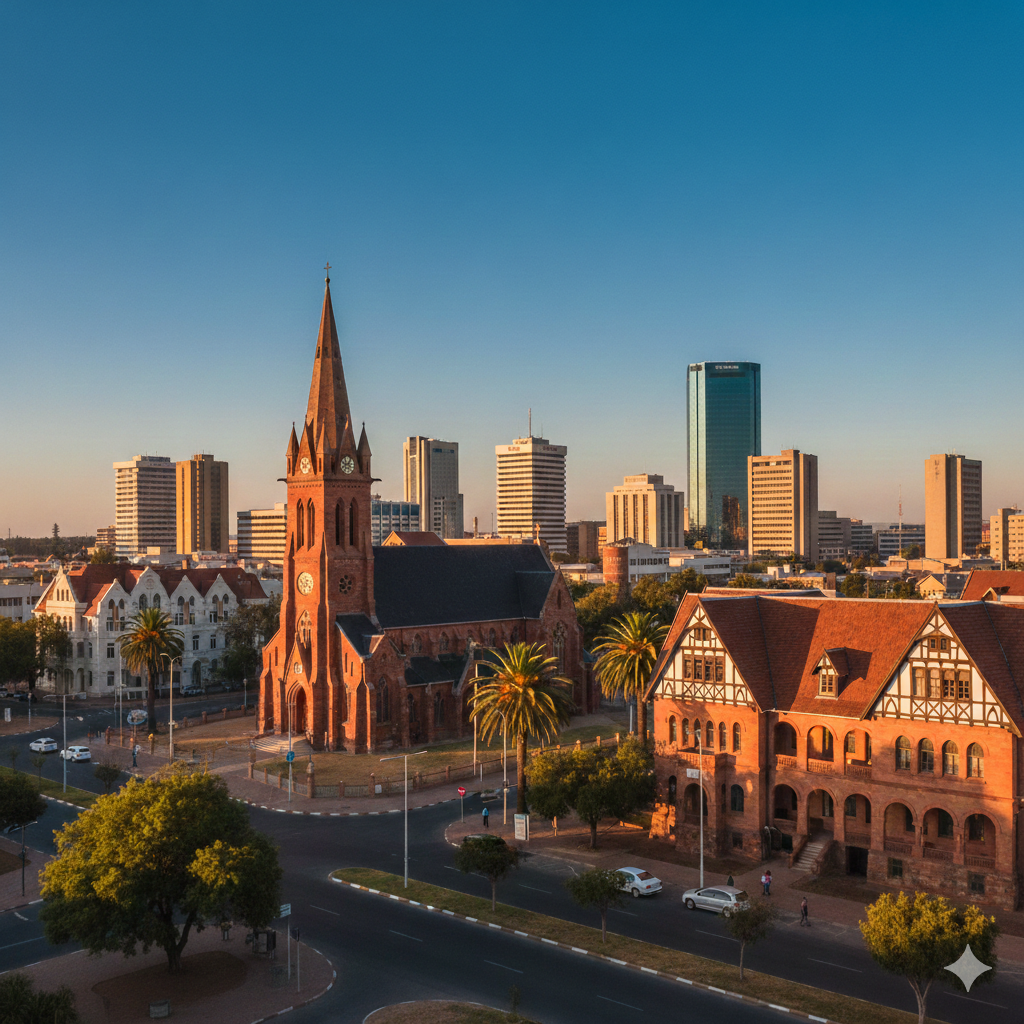
Namibia’s city center, Windhoek
Exploring Windhoek
I spent a day exploring before starting my road trip:
Independence Avenue: Main shopping street with cafes, bookstores, outdoor gear shops (great for last-minute safari supplies)
National Museum of Namibia: Small but informative, covering independence history and indigenous cultures (free entry)
Craft markets: Namibian crafts—wood carvings, jewelry, textiles. Practice bargaining skills here.
Joe’s Beerhouse: Windhoek institution. Massive outdoor beer garden serving traditional braai (BBQ)—kudu steaks, oryx, impala, ostrich. I had a springbok steak with pap (maize porridge) and gravy. Delicious and very Namibian. ($10-15 USD for a meal)
Solo Traveler Tip: Windhoek hostels often have notice boards where travelers seek road trip companions to split rental costs. I met two other solo travelers at Chameleon, but chose to drive alone for complete freedom.
Picking Up Your 4×4 Rental
The next morning, I collected my rented 4×4 from a local company recommended by the hostel ($50 USD/day for a basic 4×4 with camping gear—tent, sleeping bags, cooking equipment).
4×4 Rental Tips:
- Book in advance during high season (June-October)
- Ensure insurance includes gravel road coverage (essential!)
- Most rentals come with camping gear (cheaper than lodges)
- Check tire condition and spare tire thoroughly before leaving
- Get emergency numbers and understand breakdown procedures
- Fill up in cities—fuel stations are sparse in rural areas
- Budget $200-300 for fuel over 2 weeks
Do you need a 4×4? Yes, for:
- Sossusvlei last 5km: Yes (deep sand)
- most gravel roads: No (but highly recommended for safety/comfort)
- Etosha: No (2WD fine)
- and, freedom and peace of mind: Yes
I loaded supplies—water (essential!), snacks, canned food, firewood—and hit the road, heart racing with excitement.
Sossusvlei & Namib Desert: Mars on Earth
Sossusvlei is Best for: Dune climbing, surreal landscapes, photography, solitude, desert silence, sunrise/sunset magic, camping under stars
Distance from Windhoek: 350 km (217 miles), ~5 hours drive
Entry Fee: 80 NAD per person + 10 NAD per vehicle (~$5 USD total)
Sossusvlei is home to some of the world’s tallest sand dunes (over 300 meters/985 feet), including the famous Dune 45 and Big Daddy. The landscape is so alien that NASA has tested Mars rovers here.
These aren’t just sand dunes—they’re mountains of sand in shades of orange, red, and pink, sculpted by wind over millions of years. Stark, beautiful, humbling.
Day 1—Driving to the Desert
I left Windhoek early (7 AM) and drove 5 hours southeast toward Sossusvlei. Roads were mostly paved (C19 and C27), then turned to gravel—bumpy but manageable at 80 km/h. The landscape shifted dramatically: from highland savannah to scrubland to endless red desert.
Safety stops: Solitaire (small settlement with a famous bakery—apple pie is mandatory) for fuel and snacks.
I stayed at Sesriem Campsite inside Namib-Naukluft National Park ($15 USD per night per person). Basic but perfectly located—you’re inside the park, meaning early gate access for sunrise at dunes.
Pitching my tent under a camel thorn tree as the sun set, I watched the dunes transform—painted shades of orange, pink, purple, and gold. The silence was profound.
The silence of the Namib Desert is so complete, you can hear your heartbeat. It’s humbling and peaceful all at once.
That night, I cooked canned stew over a campfire, watched stars emerge in impossible numbers, and felt utterly, beautifully alone—but not lonely.
Camping Solo in Namibia
Namibia has a strong, safe camping culture. Campsites are secure, well-maintained, and frequented by locals and tourists alike. As a solo female camper, I always felt safe. Most campsites have:
- Ablution blocks (showers/toilets)
- Cooking areas with sinks
- Braai (BBQ) stands
- Security or locked gates at night
- Other campers nearby
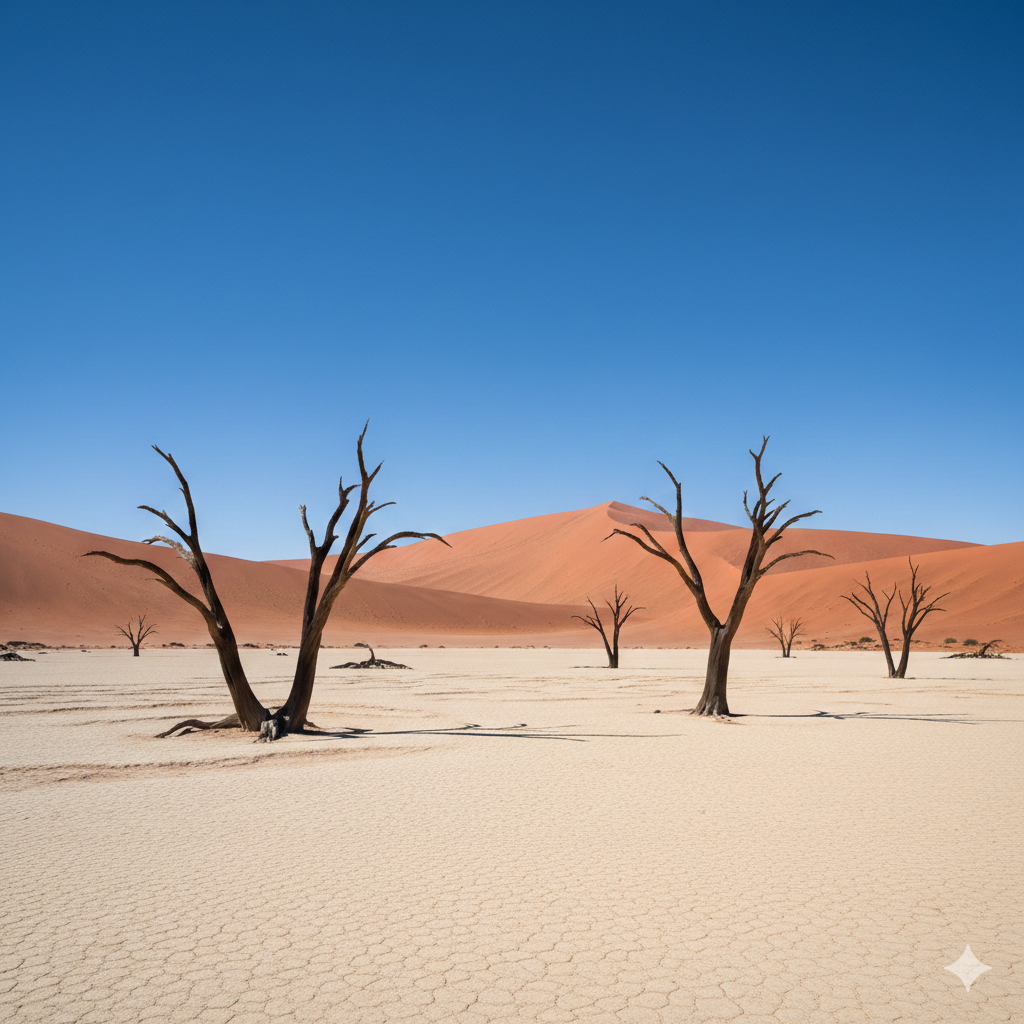
Deadvlei Namibia dead trees and white clay pan surrounded by red dunes
Day 2—Sunrise at Dune 45 & Deadvlei
Waking at 4:30 AM (brutal, but worth it), I drove to Dune 45 (60 km from Sesriem) to catch sunrise. Park gates open one hour before sunrise—being camped inside the park means you’re first in line.
Climbing the dune in pre-dawn darkness, headlamp bobbing, was surreal. The sand shifts beneath your feet—two steps forward, one slide back. At the top, I sat with a handful of other early risers as the sun rose, turning the dunes from purple to crimson to blazing orange.
Watching the Namib Desert wake up—colors shifting, shadows dancing, silence broken only by the wind—I felt like I was watching the earth breathe.
Photography tip: Sunrise is ideal for dramatic shadows on dunes. Golden hour light makes the sand glow.
Next, I drove deeper into the park (final 5 km requires 4×4 due to deep sand) to Deadvlei, a white clay pan dotted with ancient, blackened dead trees (600-700 years old). The stark contrast—white pan, black trees, red dunes, blue sky—looked like a surrealist painting.
Walking among these skeletal trees, I felt transported to another planet. The trees died when the river changed course, leaving them to desiccate in the desert. Haunting and beautiful.
I hiked to the top of Big Daddy, the tallest dune in the area (~325 meters). The climb took 40 minutes—exhausting in the sand and heat, but the view from the top was worth every gasping breath. Then I ran/tumbled down the slip face like a kid, laughing and covered in sand. Pure, unfiltered joy.
The Milky Way
By midday, the heat was unbearable (40°C+/104°F+). Returning to Sesriem, I napped in the shade, drank liters of water, then drove to Sesriem Canyon, a small but beautiful rock canyon carved by the Tsauchab River. Cooler and shaded—a nice reprieve from desert heat. You can walk down into the canyon, touching rock walls millions of years old.
That evening, I watched the sunset from my campsite, grilling boerewors (South African sausages) over a campfire and marveling at the stars. The Milky Way was so bright I could see by its light.
Solo Reflection: Traveling alone in the desert forces you to be present. No distractions, no conversation to fill silence. Just you and nature in its rawest form. I journaled for hours that night—something I rarely make time for in daily life.
Day 3—Onward to Swakopmund
Packing up camp, I drove 4 hours northwest to Swakopmund, Namibia’s quirky coastal town. The drive through desert transitioning to coast is spectacular—moon landscapes, rocky outcrops, and eventually the fog-shrouded Atlantic Ocean appearing suddenly at road’s end.
Sossusvlei & Namib Desert Quick Hits:
Must-Do Experiences:
- Sunrise at Dune 45 (set alarm—worth the early wake)
- Deadvlei dead tree forest (otherworldly)
- Climb Big Daddy dune (tallest in the area, epic views)
- Sesriem Canyon (cool refuge from desert heat)
- Stargazing (some of the world’s darkest skies)
- Photography at golden hour (sunrise/sunset)
Practical Information:
- Park entry: 80 NAD + 10 NAD per vehicle
- Camp at Sesriem inside the park for best access
- Park gates open 1 hour before sunrise, close at sunset
- No fuel inside park—fill up at Sesriem or Solitaire
- Cell service: None inside park
What to Pack:
- Tons of water (minimum 3L per person per day)
- Sun protection (hat, SPF 50+, sunglasses, long sleeves)
- Warm layers (desert nights are COLD—near freezing in winter)
- Headlamp for pre-dawn starts
- Sturdy shoes (sand gets hot, dunes are steep)
- Snacks and meals (no restaurants in park)
- Camera with extra batteries (cold drains batteries fast)
Budget:
- Camping: $15/night
- Park entry: ~$5
- Fuel: ~$30
- Food (self-catering): $10/day
- Total for 2 days: ~$60
Pro Tips:
- Wake up EARLY for sunrise (gates open 1 hour before)
- Bring plenty of water (dehydration is real and dangerous)
- 4×4 not required for paved roads, but needed for last 5km to Deadvlei
- Camp inside the park to avoid long pre-dawn drives
- Don’t climb dunes midday (scorching sand can burn feet)
- Solitaire bakery apple pie is legendary—stop on your way
Swakopmund: Adventure Capital & Coastal Charm
Swakopmund is Best for: Adrenaline junkies, seafood lovers, German architecture enthusiasts, sandboarding, skydiving, quad biking, relaxing after the desert
Population: ~44,000
Vibe: Surreal German colonial town meets African coast—Bavarian architecture, palm trees, Atlantic Ocean, adventure sports hub
Distance from Sossusvlei: ~350 km (217 miles), 4-5 hours
Swakopmund is Namibia’s coastal playground. Think German colonial buildings painted in pastels, palm-lined streets, Atlantic fog rolling in, and adventure sports everywhere. It’s bizarre—like a Bavarian village teleported to the African coast—but utterly charming.
Where I Stayed: Desert Sky Backpackers—a cozy hostel with female dorms, communal kitchen, and chill courtyard. Met adrenaline junkies from around the world planning quad biking, sandboarding, and skydiving. ($18 USD/night)
Mid-Range Option: Beach Lodge ($60-80/night)
Budget Alternative: Alte Brucke Resort campsite ($10/night)
Day 1—Sandboarding and Quad Biking
After the desert’s solitude, Swakopmund’s energy was jarring but fun. I booked a sandboarding and quad biking combo tour ($70 USD, half day) through the hostel.
At 8 AM, we drove to massive sand dunes just outside Swakopmund. Our guide showed us lie-down sandboarding—you strap onto a board, lie face-first, and speed down towering dunes headfirst. Terrifying and exhilarating. Wind in your face, sand spraying, screaming with equal parts terror and joy—I’ve never felt more alive.
Some dunes were 50+ meters high. Speeds reached 80 km/h (50 mph). I fell once, tumbling into sand, laughing hysterically.
Racing across the dunes, sand spraying, heart pounding, I felt completely alive.
Next: quad biking. Straddling a powerful ATV, we tore through the dunes—flying over ridges, catching air, navigating valleys of sand. Pure adrenaline. By the end, I was covered head-to-toe in sand and grinning like a maniac.
Solo Female Perspective: These adventure tours are extremely solo-friendly. Groups mix ages and genders, guides are professional and safety-focused, and the shared adrenaline creates instant camaraderie.
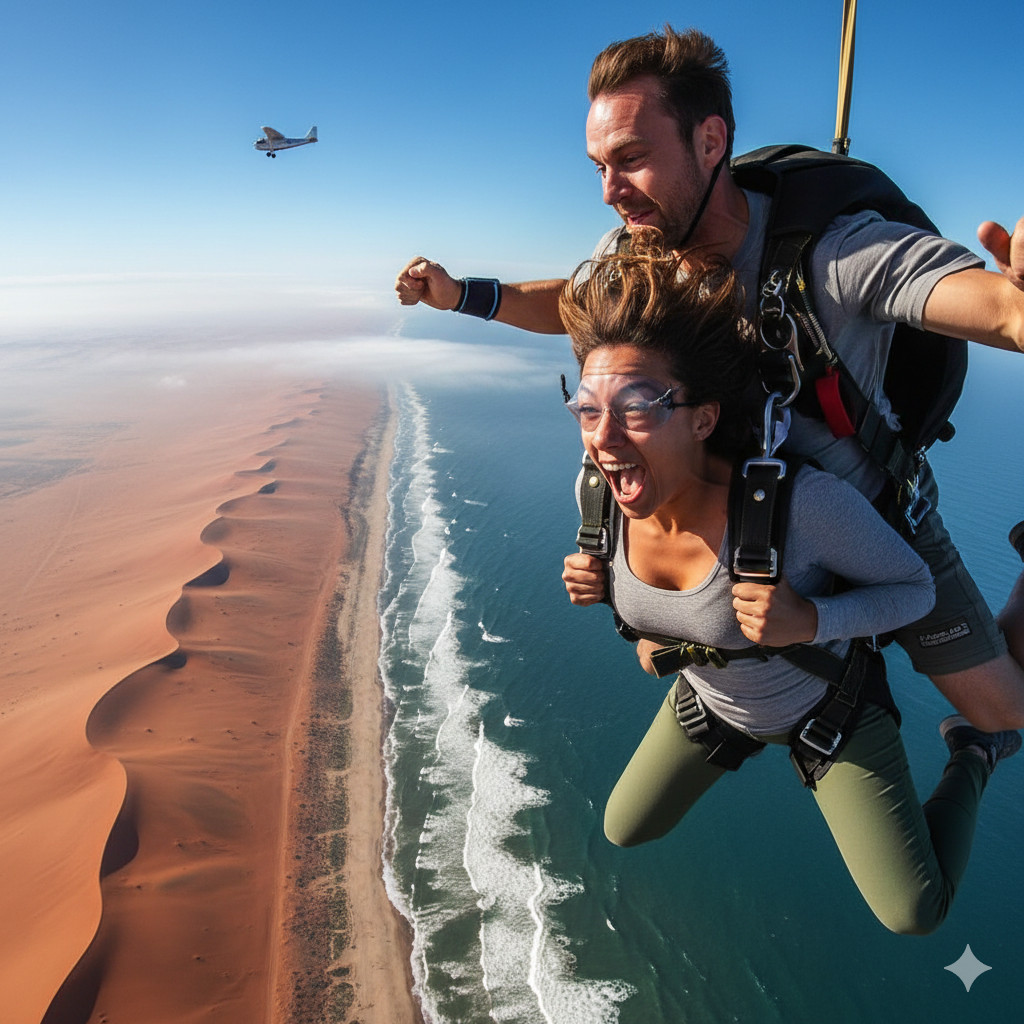
Day 2—Skydiving Over the Namib
I splurged on tandem skydiving ($250 USD)—the most expensive single activity of my entire Africa trip, but also the most spectacular.
We flew over the Namib Desert and the Atlantic coastline in a small plane. At 10,000 feet, my tandem instructor and I shuffled to the open door. My brain screamed, “Don’t jump!” My heart answered, “JUMP!”
Free-fall over red dunes meeting turquoise ocean—60 seconds of pure, screaming, life-affirming terror. When the parachute deployed, silence. Floating above the edge where desert meets ocean, I understood how small and infinite the world is.
Floating above the Namib, looking down at the edge where desert meets ocean, I understood how small and infinite the world is.
Landing on the beach, I cried happy tears. Some experiences change you—that was one.
Swakopmund Adventure Tip: Book activities 1-2 days in advance during high season. Most operators offer hotel pickup. Weather can affect schedules (fog delays), so build flexibility into your itinerary.
That evening, still buzzing with adrenaline, I ate fresh seafood at The Tug Restaurant, built inside an old tugboat on the beach. Oysters, grilled kingklip (local fish), ocean views—perfection. ($15-25 USD for a meal)
Day 3—Walvis Bay Flamingos and Cape Cross Seal Colony
Walvis Bay is 30 minutes south of Swakopmund—a working port town with an incredible lagoon. I drove there to see flamingos feeding in the shallow waters. Thousands of pink birds against blue water and golden sand—utterly stunning. Bring binoculars for best viewing.
Cape Cross Seal Reserve is 120 km north of Swakopmund—home to 80,000-210,000 Cape fur seals (depending on season). The smell hit me before I even parked—overwhelming ammonia and fish. But watching the seals was hilarious: barking constantly, fighting over space, mothers calling to pups, bulls lumbering around, babies nursing. Chaotic, loud, and oddly endearing.
Entry: 80 NAD (~$4.50 USD)
Photography tip: Visit early morning for best light and less wind. Bring a telephoto lens—you can’t get super close.
Swakopmund Quick Hits:
Must-Do Experiences:
- Sandboarding (lie-down or stand-up options)
- Quad biking through dunes
- Skydiving over the Namib (splurge-worthy!)
- Walvis Bay flamingos
- Cape Cross Seal Reserve
- Fresh seafood at The Tug or Jetty 1905
- Explore German colonial architecture
Where to Eat:
- The Tug (seafood, ocean views)
- Jetty 1905 (upscale seafood)
- Village Café (breakfast, coffee)
- Anchor Point (casual, affordable)
Budget Breakdown:
- Accommodation: $15-25/night (hostels)
- Sandboarding + quad biking: $70
- Skydiving: $250 (optional splurge)
- Meals: $10-20/day
- Cape Cross entry: $4.50
- Fuel (exploring): $20
- Total for 3 days (without skydiving): ~$180
- Total with skydiving: ~$430
Pro Tips:
- Book adventure activities in advance (popular, especially June-Sept)
- Swakopmund is cold and foggy (coastal desert)—pack layers, even in summer
- Budget-friendly compared to Botswana
- Combine with Walvis Bay for full day of exploration
- ATMs and supermarkets widely available—stock up here before Etosha
Etosha National Park: Self-Drive Safari Paradise
Etosha is Best for: Self-drive safaris, waterhole game viewing, budget safaris, photography, rhino sightings, solo travelers wanting safari freedom
Size: 22,270 km² (8,600 sq mi)—about the size of New Jersey
Known For: Massive salt pan (Etosha Pan), excellent self-drive roads, abundant wildlife, rhino conservation
Distance from Swakopmund: ~530 km (329 miles), 6 hours drive
Etosha is one of Africa’s premier safari parks—a massive salt pan surrounded by savannah teeming with wildlife. Unlike parks in East Africa, you can self-drive in your own 2WD or 4×4 vehicle (no guide required), making it incredibly budget-friendly.
The park strategy is genius: animals come to waterholes to drink, so you park your car at a waterhole, turn off the engine, and wait. Wildlife comes to you.
I drove from Swakopmund to Etosha—long (6 hours) but scenic. Roads are paved until Outjo, then gravel. Fill up with fuel before entering the park.
Where I Stayed: Okaukuejo Rest Camp—government-run camp inside Etosha with basic chalets, camping, restaurant, swimming pool, shop, and a famous floodlit waterhole. Budget-friendly and perfectly located. ($25 USD/night camping, $60 USD/night chalet)
Other Options: Halali Camp (central), Namutoni Camp (east, historic fort), private lodges outside park (expensive)
Solo Traveler Perspective: Etosha rest camps are incredibly solo-friendly. Solo travelers are common, and the communal camping/self-catering setup means you naturally meet others. I shared sunset waterhole viewing with couples, families, and other solo adventurers—all united by wildlife love.
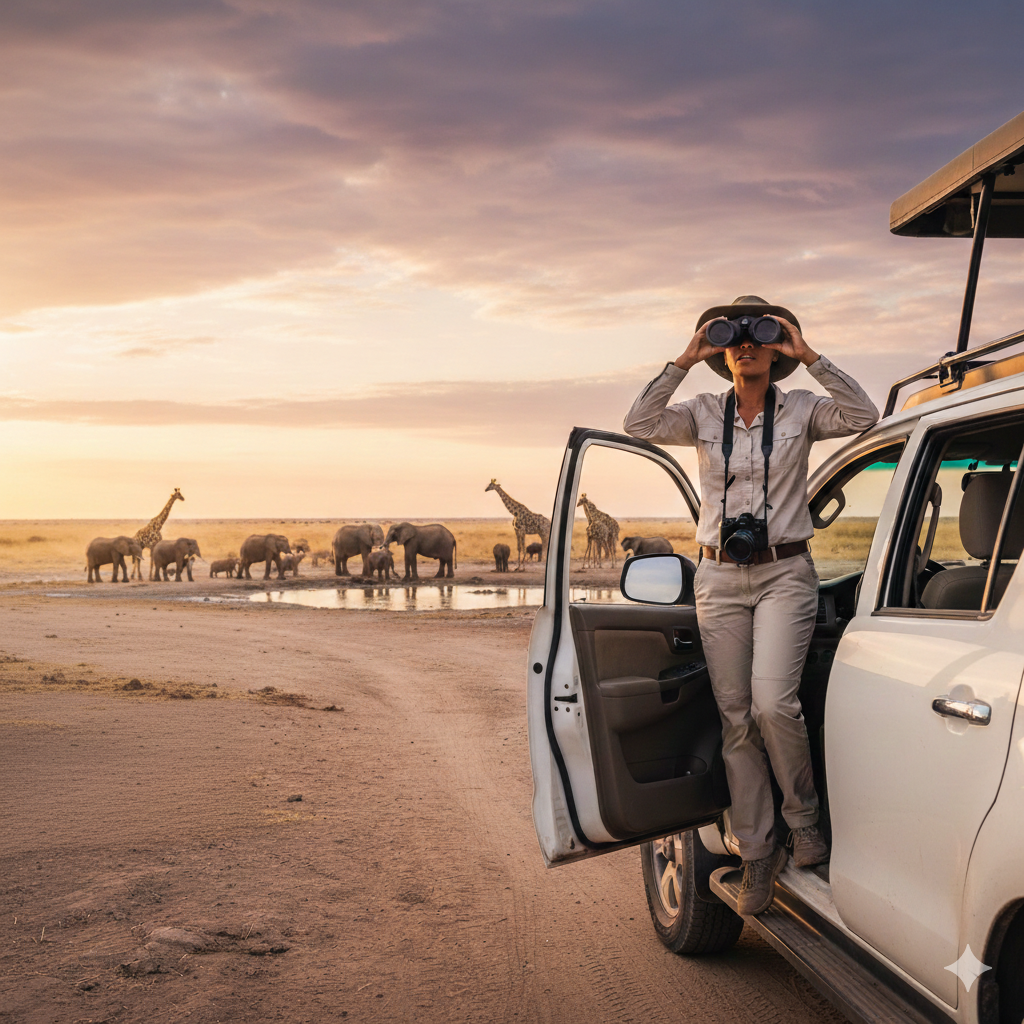
Day 1—Self-Drive Safari & Okaukuejo Waterhole
I entered Etosha through the southern Anderson Gate (entry: 80 NAD per person + 10 NAD per vehicle) and spent the day driving between waterholes.
How self-drive safari works:
- Drive slowly on park roads (max 60 km/h—strictly enforced)
- Stop at waterholes (marked on maps)
- Turn off engine, sit quietly, watch
- Animals come to drink—you’re guaranteed sightings
- Never exit your vehicle except at designated rest areas
My first day sightings:
Okaukuejo Waterhole: Elephants, black rhinos, zebras, springboks, giraffes, oryx—all drinking together. Like a wildlife cocktail party. The interaction between species—rhinos giving elephants space, zebras nervously approaching—was fascinating to observe.
Rietfontein Waterhole: A pride of seven lions lounging under a tree, too lazy to move despite midday heat. Massive male with a dark mane, females, juveniles. I sat watching for 45 minutes, mesmerized.
Salvadora Waterhole: Giraffe herd moving in slow motion—their drinking posture (legs spread wide) is hilariously awkward.
Watching a black rhino approach a waterhole, cautious and powerful, I held my breath. These creatures are survivors, and every sighting feels like a gift.
That evening, I sat at the floodlit waterhole at Okaukuejo camp. This is Etosha’s secret weapon: a waterhole illuminated at night, visible from the camp fence. As darkness fell, animals emerged from the blackness:
- Black rhinos (multiple sightings)
- Elephants bathing under the stars
- Hyenas slinking in to drink
- Jackals nervously approaching
- Lions (twice!) coming to drink
I stayed until midnight, mesmerized. Other travelers came and went, sharing whispered excitement at each new arrival.
Solo Camping Safety: I slept in my rooftop tent (part of 4×4 rental), parked near other campers. Etosha camps are fenced, so large animals can’t enter. Safe and well-organized.
Day 2—Northern Etosha and Wildlife Bonanza
I drove to the northern part of Etosha, stopping at waterholes along the way.
Highlights:
- Goas Waterhole: A herd of 40+ elephants bathing—calves playing, adults drinking, dust clouds rising
- Chudob Waterhole: Giraffes moving in slow motion (they’re fascinatingly graceful for such large animals)
- Namutoni area: A honey badger (rare sighting!—aggressive little creatures), warthogs scurrying
- Halali area: A leopard slinking through bush at dusk (incredibly lucky—leopards are shy)
Etosha Pan: I drove to viewing points overlooking the massive salt pan—a shimmering white expanse stretching to the horizon. During rains (Nov-April), it partially floods and attracts flamingos. In dry season, it’s a surreal, Mars-like landscape. Mirages shimmer constantly.
Etosha’s vastness and emptiness—the white salt pan, the endless savannah, the solitude—felt almost meditative. Driving solo meant I could stop whenever I wanted, sit at waterholes for hours, and move at my own pace. Absolute freedom.
Wildlife Photography Tips:
- Early morning (6-9 AM) and late afternoon (4-7 PM) offer best light
- Animals most active at dawn and dusk
- Bring a telephoto lens (300mm minimum, 400-600mm ideal)
- Beanbag or window mount for camera stability
- Patience pays off—spend 30+ minutes at waterholes
Leaving Etosha
After two full days, I exited through Anderson Gate and drove back to Windhoek (5-6 hours). The return to civilization—paved roads, fuel stations, restaurants—felt surreal after days of wilderness.
Etosha National Park Quick Hits:
Must-Do Experiences:
- Self-drive safari (ultimate freedom and budget option)
- Waterhole game viewing (especially floodlit waterholes at camps)
- Spot rhinos, elephants, lions, leopards (Big 4—no buffalo in Etosha)
- Stay at rest camps inside the park (Okaukuejo, Halali, Namutoni)
- Drive to Etosha Pan lookout points
- Night viewing at floodlit waterholes
Practical Information:
- Entry fee: 80 NAD per person + 10 NAD per vehicle (~$5 USD)
- Gates open: Sunrise to sunset (strictly enforced)
- Speed limit: 60 km/h on gravel, 40 km/h on paved
- No exiting vehicle except at designated areas
- Three rest camps inside park with fuel, shops, restaurants
What to Pack:
- Binoculars (essential for distant sightings)
- Camera with telephoto lens
- Cooler with food/drinks (save money self-catering)
- Patience (wildlife viewing requires waiting)
- Etosha map (sold at gates and camps)
- Full fuel tank (fuel available at camps but expensive)
Budget Breakdown:
- Camping: $25/night
- Park entry (2 days): ~$10
- Fuel (driving ~300 km in park): $30
- Food (self-catering): $15/day = $30
- Total for 2 days: ~$95
Pro Tips for Solo Travelers:
- Book rest camps in advance (May-October is high season—fills up)
- Bring your own food and cook at camps (huge savings)
- Best game viewing: early morning (6-9 AM) and late afternoon (4-7 PM)
- Speed limit strictly enforced—rangers give tickets
- Stay at least 2 full days (one day isn’t enough)
- Waterhole strategy: arrive, wait patiently—animals will come
- 2WD cars are fine (good gravel roads)
- Solo camping in rest camps is safe and communal
Namibia Budget Breakdown (2 Weeks Solo)
| Category | Budget Range | My Spending |
|---|---|---|
| 4×4 rental (14 days @ $50/day) | Including camping gear | $700 |
| Fuel (2,500 km @ ~12L/100km) | Namibia fuel ~$1.20/L | $250 |
| Accommodation (camping/hostels) | $15-30/night | $280 |
| Camping fees (Sossusvlei, Etosha) | Park camping | $50 |
| Park entry fees (Sossusvlei, Etosha) | Total | $15 |
| Activities (sandboarding, skydiving, etc.) | Optional adventures | $450 |
| Food (self-catering + eating out) | $10-15/day | $175 |
| Miscellaneous (SIM card, tips, snacks) | $80 | |
| TOTAL | $2,000 |
Budget Traveler Total (no skydiving): $1,550-1,700
Mid-Range Traveler Total: $2,000-2,500
Comfort Traveler Total: $3,000+ (lodges instead of camping)
Money-Saving Tips:
- Camp instead of staying in lodges (save $50-100/night)
- Self-cater most meals (supermarkets in Windhoek, Swakopmund)
- Skip expensive activities (skydiving is amazing but optional)
- Travel in shoulder season (April-May, November) for lower prices
- Share 4×4 rental costs with other travelers (common practice)
- Fill up fuel in cities (cheaper than remote stations)
Safety, Health & Practical Tips
Safety for Solo Female Travelers in Southern Africa
Overall Assessment: Botswana and Namibia are among Africa’s safest countries. I felt safe throughout my journey.
General Safety Tips:
- Both countries have low violent crime rates
- Tourist areas (Maun, Kasane, Swakopmund, Windhoek) are very safe
- Avoid walking alone after dark in cities (use taxis—cheap and safe)
- Keep valuables hidden and secure (but don’t be paranoid)
- Trust your instincts always
- Stay in reputable accommodations with good reviews
- Use registered taxis or Uber (available in Windhoek)
Solo Female Specific:
- I experienced zero harassment in either country
- Camping alone felt safe (stay at official campsites)
- Safari guides are professional and respectful
- Dress modestly in cities (shoulders/knees covered)
- Safari attire: no restrictions—shorts and tanks are fine
- Locals are friendly and helpful, not pushy
Road Trip Safety (Namibia):
- Roads are well-maintained, even gravel roads
- Always carry extra water (5+ liters per person)
- Tell someone your route and expected arrival times
- Cell service in most areas, but carry emergency numbers
- Wildlife on roads (especially kudu)—drive carefully at dawn/dusk
- Carry spare tire and jack (usually included in rentals)
- Never drive at night in rural areas (animals on roads)
Emergency Numbers:
- Botswana: 999 (police), 911 (ambulance)
- Namibia: 10111 (police), 211111 (ambulance)
Solo Travel Community: Solo travelers are extremely common in both countries. Expect to meet many others—hostels, safaris, and campsites are social.
Health & Vaccinations
Required Vaccinations:
- Yellow Fever: Required if arriving from yellow fever endemic countries. Not required from US/Europe directly, but carry your certificate anyway
- Hepatitis A & B: Recommended
- Typhoid: Recommended
- Tetanus: Ensure up to date
- Rabies: Optional (recommended if camping/safari)
Malaria Risk:
- Botswana: Malaria risk in Okavango Delta and Chobe (especially Nov-May)
- Namibia: Malaria risk in northern regions including Etosha (Nov-May). None in Windhoek, Swakopmund, Sossusvlei
Malaria Prevention:
- Take antimalarial medication (consult travel doctor—Malarone, Doxycycline)
- Use insect repellent with DEET (30%+ at dawn/dusk)
- Sleep under mosquito nets (provided at camps)
- Wear long sleeves/pants at dawn and dusk
- Avoid dark colors (mosquitoes attracted to dark)
Water & Food Safety:
- Tap water is safe in Namibia (Windhoek, Swakopmund)
- Tap water questionable in Botswana—drink bottled or filter
- Carry a filtered water bottle (LifeStraw, Grayl)
- Avoid raw foods unless washed in safe water
- Peel fruits yourself
- Eat at busy local spots (high turnover = fresh food)
- Street food in cities generally safe
Sun Protection:
- African sun is INTENSE—SPF 50+ sunscreen essential
- Reapply every 2 hours
- Wear wide-brimmed hat, sunglasses
- Lips burn—use SPF lip balm
- Dehydration risk is real—drink 3+ liters water daily in desert
Travel Insurance:
- Mandatory—don’t skip this, I booked with World Nomads
- Must cover medical evacuation (remote safari areas)
- Must cover safari activities, camping, and 4×4 rental (if driving)
- Recommended: World Nomads, SafetyWing
First Aid Kit Essentials:
- Anti-diarrheal medication (Imodium)
- Pain relievers (ibuprofen, acetaminophen)
- Antihistamines (allergic reactions, insect bites)
- Antibacterial ointment
- Band-aids, blister treatment
- Prescription medications (bring extras)
- Antimalarial medication
- Electrolyte powder (dehydration prevention)
Money & Budgeting
Currency:
- Botswana: Botswana Pula (BWP) – ~13-14 BWP = 1 USD
- Namibia: Namibian Dollar (NAD) – ~18-19 NAD = 1 USD (pegged 1:1 with South African Rand)
ATMs & Cards:
- ATMs widely available in cities (Maun, Kasane, Windhoek, Swakopmund)
- Visa/Mastercard accepted at most lodges, restaurants, safari operators
- Carry cash for markets, street food, rural areas, small vendors
- US dollars accepted at some places but poor exchange rates
Cash Recommendations:
- Withdraw in cities before heading to remote areas
- Carry 200-300 USD equivalent in local currency for emergencies
- Safari operators often prefer cash for group bookings
Banking Tips:
- Inform your bank before traveling (avoid card blocks)
- Carry two different cards (backup if one fails)
- Note emergency card cancellation numbers
Tipping Guidelines:
- Safari guides/camp staff: $10-15 USD per day (split among group)
- Restaurant servers: 10% if no service charge included
- Taxis: Round up fare
- Mokoro polers: 50-100 BWP per day
- Camping staff: 20-50 NAD per day
Budget Expectations:
- Budget Traveler: $50-80/day (camping, self-catering, group safaris)
- Mid-Range Traveler: $100-150/day (lodges, some restaurants, activities)
- Comfort Traveler: $200+/day (luxury lodges, all activities)
Transport in Southern Africa
Between Countries:
- Flights: Ethiopian Airlines, Fastjet (Windhoek-Johannesburg-Maun)
- Overland buses: Intercape, cross-border buses (cheaper, slower)
- Self-drive: Possible to rent 4×4 in one country, cross borders (requires paperwork)
Within Botswana:
- Maun to Kasane: Overnight bus (~$30, 10 hours)
- Domestic flights: Charters available but expensive ($150-300)
- Safari vehicles: Included in safari packages
- Taxis: Available in cities (negotiate fare beforehand)
Within Namibia:
- 4×4 rental: Best option for flexibility ($40-70/day)
- Intercity buses: Limited but available (Intercape)
- Domestic flights: Air Namibia (limited schedules)
- Taxis/Uber: Available in Windhoek
Driving in Namibia:
- License: International Driving Permit recommended (but many rent with just passport country license)
- Side of road: Left (same as South Africa, UK)
- Road conditions: Excellent paved roads, well-maintained gravel
- Speed limits: 120 km/h paved, 80-100 km/h gravel
- Fuel: Available in towns (carry extra jerry can for remote areas)
- Tolls: None
- Wildlife on roads: Common at dawn/dusk—drive carefully
Communication & Connectivity
Language:
- English: Widely spoken in both countries (official language)
- Local languages: Setswana (Botswana), Afrikaans/Oshiwambo/German (Namibia)
- No language barrier: English is sufficient everywhere
SIM Cards & Data:
- Botswana: Mascom, Orange, beMobile (buy at airports, shops)
- Namibia: MTC, TN Mobile (buy at airports, shops)
- Cost: $5-10 USD for SIM + data package
- Data: 1-2 GB sufficient for 2 weeks (maps, communication)
Coverage:
- Cities and towns: Excellent 3G/4G
- Remote areas (Okavango, Sossusvlei, Etosha): Limited or none
- Download offline maps before arriving (Maps.me, Google Maps)
Apps to Download:
- Maps.me: Offline maps (essential for Namibia road trip)
- Google Translate: Offline mode for emergencies
- WhatsApp: Communication with lodges, guides
- XE Currency: Exchange rates
Cultural Etiquette
General Behavior:
- Locals are friendly, welcoming, and respectful
- Greet people before asking questions (“Hello, how are you?”)
- Patience is valued—don’t rush interactions
- Handshakes common (right hand)
Dress Code:
- Cities: Casual, modest (cover shoulders/knees for respect)
- Safari: Comfortable, practical (shorts, tanks fine)
- Neutral colors on safari (khaki, olive, beige—avoid bright colors and black)
- Swakopmund/Windhoek: European-style dress acceptable
Photography:
- Always ask before photographing people (“May I take your photo?”)
- Market vendors may expect small payment for photos
- Wildlife: No restrictions (shoot away!)
- Military/government buildings: Don’t photograph
Dining:
- Tipping 10% expected if no service charge
- Eating with hands acceptable for traditional dishes
- Try local specialties (braai, game meats)
Bargaining:
- Expected at markets (start 50% of asking price)
- Not expected at restaurants, fixed-price shops
- Bargain with a smile—it’s a friendly interaction
Packing List for Southern Africa (Botswana & Namibia)
Clothing:
- 3-4 neutral safari shirts (khaki, olive, beige—avoid white/gets filthy)
- 2 pairs safari pants (zip-off legs ideal—convert to shorts)
- 1 pair shorts
- 1 pair long pants for evenings
- Swimwear (lodges have pools)
- Warm fleece or down jacket (desert nights freezing, even in summer!)
- Rain jacket (lightweight, packable)
- 3-4 casual t-shirts
- Underwear and socks (quick-dry fabric)
- Sturdy hiking boots (broken in!)
- Sandals or flip-flops (camp showers)
- Wide-brimmed sun hat
- Buff or scarf (dust protection)
Gear Essentials:
- Daypack (20-30L for day trips)
- Headlamp with extra batteries (essential for camping)
- Reusable water bottle with filter (LifeStraw, Grayl)
- Sunscreen SPF 50+ (African sun is brutal)
- Insect repellent with DEET 30%+
- Sunglasses (polarized for glare)
- Quick-dry towel
- Power bank (20,000mAh—for long drives)
- Universal adapter (Type M for Namibia/Botswana—three round pins)
- Ziplock bags (protect electronics from dust/sand)
Camera/Photography:
- Camera with telephoto lens (wildlife—300mm minimum, 400-600mm ideal)
- Extra batteries (cold drains batteries fast)
- Memory cards (32-64 GB minimum)
- Lens cleaning kit (dust everywhere)
- Beanbag or window mount for car safari photography
- Phone with offline maps
Health/Toiletries:
- Antimalarial medication (consult doctor)
- First aid kit (see Health section above)
- Prescription medications (bring extras)
- Hand sanitizer
- Wet wipes (showers limited in camping)
- Toilet paper (not always available)
- Feminine hygiene products
- Lip balm with SPF
- Mosquito net (if not provided by accommodation)
Documents:
- Passport (valid 6+ months beyond travel)
- Visa documents (if required)
- Yellow fever vaccination certificate
- Travel insurance details (printed + digital)
- Copies of important documents (digital + physical)
- Emergency contact info
- International Driving Permit (for Namibia)
- Safari booking confirmations
Optional but Recommended:
- Binoculars (game viewing)
- Book or Kindle (downtime at camps)
- Journal (solo travel reflection)
- Waterproof phone case
- Portable speaker (campfire music)
- Kindle or book for downtime
My Southern Africa Solo Lessons
Southern Africa—Botswana and Namibia—shattered every expectation I had. These countries challenged me, humbled me, filled me with joy, and showed me beauty I didn’t know existed.
From gliding silently through the Okavango Delta at sunrise to standing meters from wild lions, from watching elephant families bathe in the Chobe River to climbing towering sand dunes in the Namib Desert, every moment felt like a gift.
Southern Africa taught me that solo travel isn’t about being alone—it’s about being open. Open to new places, new experiences, new versions of yourself.
Yes, these destinations require preparation. You’ll need vaccinations, some planning, street smarts, and either a budget for safaris or the courage to road trip. The desert is hot, the nights are cold, and elephants occasionally bump your tent.
But the magic—oh, the magic—makes it all worth it.
As a solo female traveler, I felt safe (with basic precautions), empowered, and endlessly inspired. Safari guides and camp staff were professional and respectful. Fellow travelers—solo and otherwise—became fast friends. Locals offered warmth and help freely.
My advice for solo female travelers to Southern Africa:
✅ Do your research but stay flexible—plans change, and that’s okay
✅ Trust your instincts—they’re usually right
✅ Join group safaris—meet people, split costs, share experiences
✅ Rent a 4×4 and road trip Namibia—ultimate freedom
✅ Camp at least once—you’ll save money and sleep under ridiculous stars
✅ Wake up early for sunrises—worth every lost hour of sleep
✅ Talk to other travelers—hostels and camps are goldmines for tips
✅ Give yourself time at waterholes—patience pays off
✅ Go with an open heart—Africa will fill it
Southern Africa is waiting for you. Botswana’s elephants are waiting. Namibia’s dunes are waiting. The Okavango’s silence is waiting.
Pack your bags, book that flight, trust that you’re ready, and go.
You won’t regret it.
Frequently Asked Questions
Is Southern Africa safe for solo female travelers?
Yes. Botswana and Namibia are among Africa’s safest countries with low crime rates, stable governments, and well-developed tourist infrastructure. I felt safe throughout my journey. Basic precautions apply: don’t walk alone at night in cities, use registered taxis, and stay in reputable accommodations.
How much does solo travel in Botswana and Namibia cost?
Budget travelers: $50-80/day (camping, self-catering, group safaris). Mid-range: $100-150/day (lodges, some activities). Botswana is more expensive than Namibia due to low-volume tourism policy. Total for 3-4 weeks: $2,700-4,200.
Do I need a 4×4 to road trip Namibia?
Not strictly necessary for main roads, but highly recommended. Required for: Sossusvlei’s last 5km (deep sand), off-road desert exploration, peace of mind on gravel roads. Many travelers successfully use 2WD, but 4×4 offers flexibility and safety.
Can I do a safari alone in Southern Africa?
Absolutely! Join group mobile camping safaris (budget option, great for meeting people) or book private safaris (expensive). Self-drive safaris in Etosha National Park, Namibia, are perfect for solo travelers. I did both—loved the freedom.
When is the best time to visit Botswana and Namibia?
May-October is ideal: dry season, best game viewing, cooler temperatures. Peak season (July-September) means higher prices and more tourists. November-April is green season: cheaper, fewer tourists, but hotter and some camps close.
Is the Okavango Delta worth the price?
Yes. It’s expensive, but unforgettable. Budget option: mobile camping safaris ($400-600 for 3 days). Luxury option: fly-in lodges ($500-2,000/night). Even one night in the delta is worth it—there’s nowhere else like it on Earth.
Can I camp alone as a solo female traveler?
Yes, and it’s safe! Namibia has excellent, secure campsites. Botswana’s mobile camping safaris are group-based. I camped throughout my trip and always felt safe. Official campsites have security, ablution blocks, and other campers nearby.
Book your flight, pack your bags, and go discover Southern Africa. The wilderness is calling.
About the Author
I’ve traveled solo through 47 countries across Europe, Asia, the Americas, and Africa, often for weeks at a time. My adventure focuses on cultural immersion, safety tips, accommodation, solo dining, and independent travel for women. Everything in this guide comes from personal experience—navigating cities alone, asking questions, making mistakes, and learning what truly works for women traveling solo.