
What to actually pack — and what to leave behind — for 4 to 12 weeks across five countries in Asia (Singapore, Japan, Thailand, Malaysia & Vietnam)
Three months and five countries later, I came home with half the clothes I left with, two extra sarongs, a wok I definitely didn’t need, and a very clear picture of what actually earns its place in a backpack.
I built this guide from that experience — twelve weeks across Singapore, Japan, Thailand, Malaysia, and Vietnam — combined with the packing wisdom of every traveler I met along the way. It covers every category: clothing, safety, tech, toiletries, health, and documents. Each section explains why items earn their place (or don’t), so you can build a list that suits your trip length and travel style.
Before you pack
The One Rule That Changes Everything
If you can’t carry your bag comfortably for 20 minutes at a brisk walk, it’s too heavy. That’s the whole rule.
Asia has world-class laundry infrastructure at every price point. You can have clothes washed, dried, and folded for less than the cost of a coffee in most Southeast Asian cities. Japan’s coin laundromats are clean, efficient, and open 24 hours. This means you need far fewer clothes than your instincts are telling you to pack.
The standard backpacker wisdom — pack for one week, wash weekly — holds for trips of any length. Add a buffer of two days if you’re visiting Japan in winter or trekking in northern Thailand where drying takes longer.
The real goal The best souvenir you can bring home from Asia is empty space in your bag — space you earned by leaving behind everything that didn’t earn its weight.
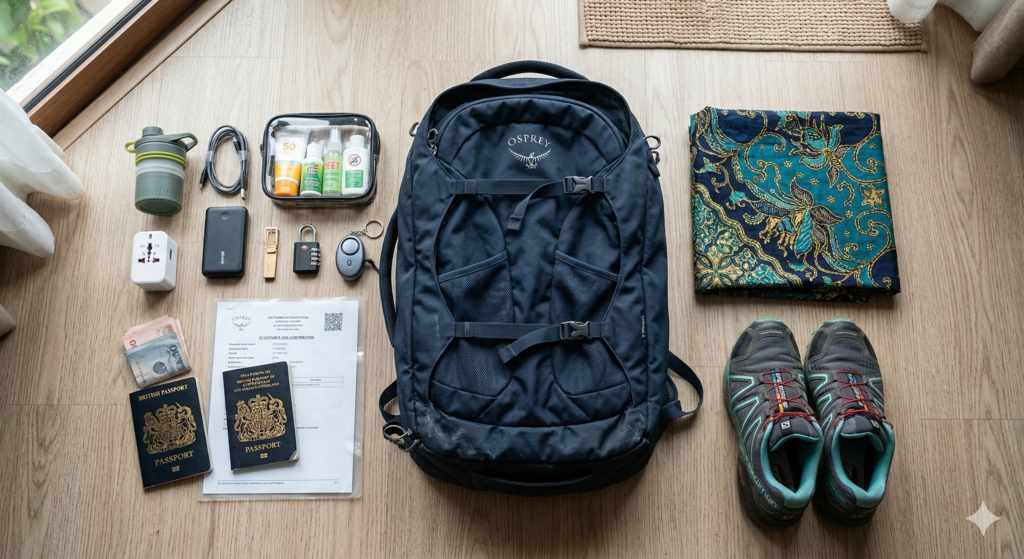
40L backpack and essential travel gear
Carry-on vs. Checked Luggage
For multi-country trips within Asia, carry-on only is strongly recommended. Budget airlines dominate regional routes (AirAsia, Scoot, VietJet), and checked bag fees can easily double your fare if you didn’t book with luggage included. More importantly, carry-on means no waiting at baggage claim, no lost luggage risk, and the ability to hop on a last-minute flight without stress.
The sweet spot for most 4–8 week trips: a 40-liter backpack as your main bag, plus a small 10–15 liter daypack that collapses into it during transit.
| Comparison at a Glance: What Changes? |
| Feature | Southeast Asia (SEA) | Japan (Mainland) |
| Main Enemy | Humidity & Sweat | Wind & Temperature Swings |
| The “Uniform” | Linen trousers + Sandals | Jeans/Chinos + Sneakers |
| Temple Etiquette | Cover shoulders/knees (Sarong) | Formal/Modest (No specific “cover-up” usually needed) |
| Footwear Priority | Breathability & Easy-off | Arch support for 20k+ steps |
| Laundry Frequency | Every 2-3 days (High sweat) | Every 5-7 days (Dry air) |
Clothing
What to Wear Across Five Very Different Climates
There is no single ‘Asian climate.’ You are packing for the 95% humidity of a Singapore afternoon, the biting winds of a Kyoto November, and the monsoon rains of Northern Vietnam. If you pack a single ‘tropical’ wardrobe, you will be shivering in Japan and sweltering in Malaysia. The secret isn’t more clothes—it’s a modular system that stacks..
The solution is layering with lightweight, quick-dry fabrics — and accepting that you’ll look like a traveler, not a fashion influencer, for most of your trip. The good news: nobody cares. Everyone is too busy eating street food.
The Core Clothing Formula
For a 4–8 week trip covering multiple countries, this is what actually works:
3-4 Merino or linen-blend tops are the secret — Breathable and modest enough to wear at temples. Quick-dry fabric is non-negotiable in humid climates.
1 pair lightweight trousers + 1 shorts or skirt — Trousers double as temple wear. That’s genuinely enough.
1–2 dresses — A loose, lightweight dress is the most versatile item you’ll pack. Casual enough for beach days, presentable enough for nicer dinners.
1 thin cardigan or zip-up — Does triple duty: temple modesty, air-conditioned restaurants, and cool nights in the highlands.
Swimwear — One piece or bikini depending on preference. A rash guard is worth adding if you’re doing reef snorkeling.
5–7 pairs quick-dry underwear — Merino wool socks for Japan — comfortable, odor-resistant, warm enough in winter.
Footwear: The One Area Where Weight Is Worth It
Three pairs covers almost every situation:
Trail runners or walking shoes — Your primary footwear for cities, day trips, and hiking. Comfort over looks — you will walk more than you expect.
Sandals (Birkenstock-style or equivalent) — For beach days, hostel common areas, and casual evenings. Doubles as shower shoes in budget guesthouses.
One pair of slip-on flats or loafers (optional) — Worth it if you’re spending significant time in Singapore or Tokyo where slightly smarter footwear is appreciated.
Temple tip
Temples across Thailand, Vietnam, Malaysia, and Japan require removing shoes at the entrance. Shoes with many laces are a daily frustration. Slip-ons and sandals with easy closures will save you minutes and minor embarrassment every single day.
Dressing Modestly Without Packing Heavily
Modest dress is expected at temples and religious sites across all five countries: covered shoulders, covered knees. Many major sites (especially in Thailand) have sarongs available to borrow at the entrance. However, carrying a lightweight sarong or scarf from the start gives you instant temple access anywhere, doubles as a beach cover-up, and takes up almost no space.
Local buy tip
Buy cheap, beautiful sarongs once you arrive in Thailand or Malaysia rather than packing one from home. They cost almost nothing, and picking the fabric you love becomes a small travel ritual in itself.
The Japan Exception: Layering for a Four-Season Country
Everything above works seamlessly for Singapore, Thailand, Malaysia, and Vietnam. Japan is the outlier: Tokyo in March sits around 10°C at night, and Kyoto in November is coat weather. If you’re packing for a combined Japan-and-Southeast-Asia trip — one of the most-searched itinerary types — your tropical lightweight clothing will fail you the moment you land at Narita in any month outside June through September.
The solution is Uniqlo Heattech, bought on arrival in Japan — not packed from home. Uniqlo stores are everywhere: multiple locations in every major city, airport branches, reasonable prices. A Heattech base layer top and leggings pack to almost nothing, add genuine warmth under a light jacket, and transform your existing wardrobe into a functional cold-weather kit without adding bulk in the countries where you don’t need it.
Japan itinerary strategy If your itinerary runs Singapore → Thailand → Japan (or ends in Japan in spring or autumn): pack for Southeast Asia and buy layering in Japan. If Japan comes first: pack one lightweight packable down jacket from home. Wear it in Japan, then compress it for the rest of the trip where it becomes your “overly air-conditioned restaurant” layer. Don’t pack a heavy wool coat. It won’t survive the transition, and you’ll resent every gram of it in Hanoi’s August humidity.
The One “Nice” Item Worth Packing
This article said you won’t need clothes for nice dinners, and that’s mostly true. But Singapore rooftop bars and Tokyo’s quieter cocktail spots have a way of making “mostly true” feel like “you wish you’d packed differently.” One item changes this: a dark, wrinkle-resistant dress or a simple black jumpsuit. It weighs almost nothing, folds flat, and takes you from a Bangkok street market to a Marina Bay Sands view without feeling like you’re wearing your hiking kit. You don’t need a capsule wardrobe. You need one thing that isn’t obviously travel clothing.
Safety
The Items That Actually Keep You Safer
Safety gear for solo female travel gets overcomplicated online. Let’s be direct: these five countries are genuinely safe. Singapore and Japan consistently rank among the safest places on earth. Thailand, Malaysia, and Vietnam are not dangerous destinations for solo female travelers — millions of women travel them every year without incident. The items below aren’t here because Asia is threatening. They’re here because smart habits and a few lightweight tools reduce daily friction, build confidence, and matter most in the specific situations where they’re needed.
The more valuable safety investment isn’t gear at all — it’s knowing the scams before you encounter them. Bangkok’s “Grand Palace is closed today” approach is more likely to cost you an afternoon and some baht than any physical threat. Vietnam’s motorbike bag grab. Overpriced taxis with a mysteriously broken meter. None of these are stopped by hardware. They’re stopped by knowing they exist. The solo female travel safety guide covers country-specific scams in detail.
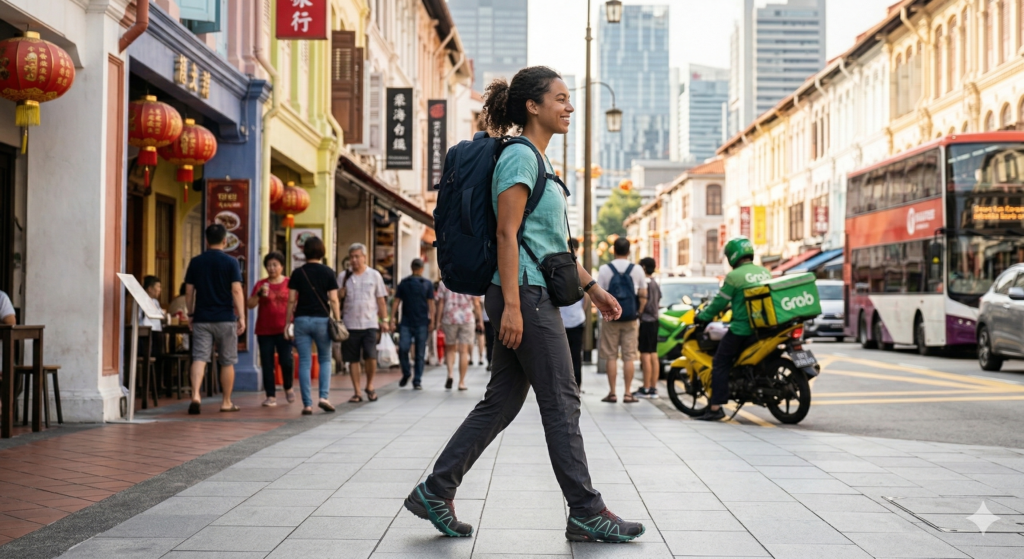
Walking with a 40L carry-on backpack in Singapore
Safety Items Worth Carrying
Crossbody bag — Your daily carry. Worn across the body, zipper facing inward. Anti-theft features (hidden zippers, slash-proof straps) are a bonus but not essential in these five countries.
Small coin purse / decoy wallet — A cheap coin purse for daily spending — street food, markets, tuk-tuks. Pull this out at stalls, not your main wallet with all your cards.
Padlock (combination) — For hostel lockers. Many hostels provide locks but not all. TSA-approved combination lock preferred — no key to lose.
Money belt — For transit days and crowded markets — not for everyday use. Wearing it constantly is uncomfortable and makes you more conspicuous.
Document copies — Printed copies of your passport, visa, insurance policy, and travel itinerary. Kept separately from your actual documents.
Personal alarm (130dB+) — Small, cheap, and genuinely useful. Pull the pin and it draws immediate attention.
Door wedge alarm — Costs under $10 and provides real peace of mind in budget guesthouses where door locks feel questionable.
On the Door Wedge and Personal Alarm
A content strategist reviewing this article called the door wedge and personal alarm “security theater” for countries this safe. They’re not wrong that physical threat risk is low. But they’re answering the wrong question. A first-time solo traveler sleeping alone in a budget guesthouse in an unfamiliar country at 2 AM isn’t lying awake calculating crime statistics — they’re managing a feeling. The door wedge doesn’t cost more than a coffee, weighs next to nothing, and converts an unsettled night into a settled one. That has value. Keep it.
What You Actually Don’t Need
Skip the elaborate anti-theft backpacks with 15 hidden pockets and the neck wallets if they make you uncomfortable. Also, skip personal GPS trackers unless you’re planning serious solo trekking in remote areas. These five countries require sensible habits, not tactical gear.
The most important safety tool
Download Grab before you arrive in any Southeast Asian country. Having a tracked, app-based ride replaces the need to negotiate with taxi drivers, avoids overcharging, and creates a record of every trip. It won’t fit in your bag, but it’ll do more for your safety than any physical item on this list. Japan is the exception — use metered taxis there, bookable via the JapanTaxi app or any taxi rank.
Tech & Navigation
The Tech That Earns Its Weight
Technology has genuinely transformed solo travel. Apps replaced guidebooks. Grab replaced taxi negotiations. Google Translate replaced years of language study. But every tech item in your bag adds weight, and most electronics are available to buy or replace affordably across Asia.
Absolute Essentials
| Item | Why It Matters | Notes |
| Smartphone (unlocked) | Navigation, translation, rides, communication, payments | The single most important item you’ll carry. Ensure it’s unlocked before you leave home. |
| Power bank (20,000mAh) | All-day battery backup for heavy navigation and photo days | Must go in carry-on luggage (airline rules). Check limits before packing. |
| Universal travel adapter | Singapore, Malaysia, Japan, and Thailand/Vietnam use different plug types | A multi-country adapter handles all five with no need to carry multiples. |
| Mini power strip (“squid”) | Hostels frequently have one plug per bed. One power strip charges phone, power bank, and earbuds simultaneously. | Get a compact 3-socket flat-plug version. Pairs with your adapter. |
| Headphones | Long bus rides, overnight trains, airport waits | Noise-cancelling earbuds are worth the investment for overnight trains in Vietnam and Japan. |
Digital Hygiene: The Things Nobody Packs But Everyone Needs
Losing your phone in Vietnam with no cloud backup is a specific kind of misery — months of photos, gone. Before you leave: turn on automatic photo backup (Google Photos or iCloud), enable Find My Device, and save scanned copies of your passport and visa to cloud storage. Takes 15 minutes and takes the catastrophe out of “I dropped my phone in the river.”
A VPN is worth having for two reasons: accessing home streaming services from abroad, and using public WiFi in airports and hostels without exposing your data. ExpressVPN and NordVPN both work reliably across all five countries, including Vietnam where some sites are restricted.
SIM Cards vs. eSIM: What to Use
For multi-country trips, a regional eSIM is the most convenient option — no swapping physical SIMs between countries, no risk of losing tiny cards, and coverage across all five countries on one plan. Airalo’s “Discover” regional plan covers Southeast Asia broadly; for Japan specifically, Airalo Japan or Ubigi tend to have the most reliable coverage. Data is typically 10–15GB for $25–40, enough for standard navigation, messaging, and occasional streaming.
If your phone doesn’t support eSIM, buy local SIMs at each airport. They’re sold at dedicated counters immediately after immigration, take 5 minutes to set up, and cost $8–15 for adequate data.
eSIM Setup & Logistics (2026)
Many flagship phones like the iPhone 17 and Samsung S26 (specifically US models) have removed the physical SIM tray entirely. Even if your phone still has a slot, the days of hunting for a paperclip to swap tiny plastic cards at a kiosk are over.
Here is the 2026 step-by-step for getting your data ready before you leave the house.
Step 1: The 2-Second Compatibility Check
Before buying a plan, you must confirm your phone is eSIM-capable and carrier-unlocked.
- The Universal Shortcut: Open your phone’s keypad and dial
*#06#. If an EID number (Embedded Identity Document) appears on the screen, your phone has the hardware for an eSIM. - Manual Check (iPhone): Settings > General > About. Scroll down to “Available SIM” or “Digital SIM.”
- Manual Check (Android): Settings > Connections > SIM Manager. Look for the “Add eSIM” option.
Note: If your phone was purchased on a monthly contract, it may still be “locked” to your home provider. You must call them and request an unlock before a travel eSIM will work.
Step 2: Choosing Your 2026 Asia Plan
For a 12-week trip covering Singapore, Japan, Thailand, Malaysia, and Vietnam, you have two choices: a single “Regional” plan or individual “Local” plans.
| Provider | Best For | 2026 Perk |
| Airalo (Asialink) | The Multi-Country Loop | Reliable 5G in most of Asia; easy in-app top-ups. |
| Ubigi | The Japan Specialist | Hands-down the best 5G speeds in Japan; very affordable. |
| Saily | Security First | Built by the NordVPN team; includes extra privacy features. |
| Jetpac | The Budget Soloist | Offers “Emergency Data” for Grab/Maps even after your plan hits zero. |
| Holafly | Unlimited Data | Best if you plan to stream movies or work remotely (no data caps). |
Step 3: The “Pre-Flight” Installation
Do not wait until you land to install the eSIM. You need a stable Wi-Fi connection to download the digital profile.
- Purchase your plan 24 hours before departure.
- Scan the QR code (or use the “One-Click” install in the provider’s app).
- Label your lines: Name your home SIM “Primary” and the new eSIM “Asia Data.”
- Keep your Primary SIM on for emergency texts (like bank 2FA), but turn off “Data Roaming” on that line to avoid massive fees from your home provider.
Step 4: Landing & Activation
When the plane touches down:
- Go to Settings > Cellular/Connections.
- Switch “Cellular Data” to your Asia eSIM.
- Ensure “Data Roaming” is toggled ON for the eSIM (this is required for regional plans to hop between networks).
- Restart your phone if it doesn’t pick up a signal within 2 minutes.
Before you land
Download Google Maps offline maps for every city you’re visiting — do this on WiFi before you arrive. Offline maps mean you can navigate confidently even when you’re on a local SIM with poor signal, or in Japan’s rural areas where data can be inconsistent.
The “Old School” Backup
Even in an eSIM-only world, I still pack a physical SIM tool (or a sturdy earring) in my tech kit. Why? Because if your phone glitches and you need to access your physical home SIM to receive a verification code from your bank, you don’t want to be hunting for a paperclip in a Vietnamese coffee shop.
Don’t wait until you land to figure out your data. Setting up your eSIM while still on your home Wi-Fi is a logistical must. Beyond just maps, this is a major security move—check out my [Solo Female Safety Guide] for how to use your data to stay safe during late-night arrivals.
What to Leave Behind
Laptops are heavy and risky in hostels unless you need to work remotely
A tablet is a reasonable middle ground.
Dedicated cameras are worthwhile if photography is central to your trip, but modern smartphones photograph better than most budget mirrorless cameras.
E-readers are wonderful for long trips; the Kindle Paperwhite’s battery lasts weeks and weighs 200 grams.
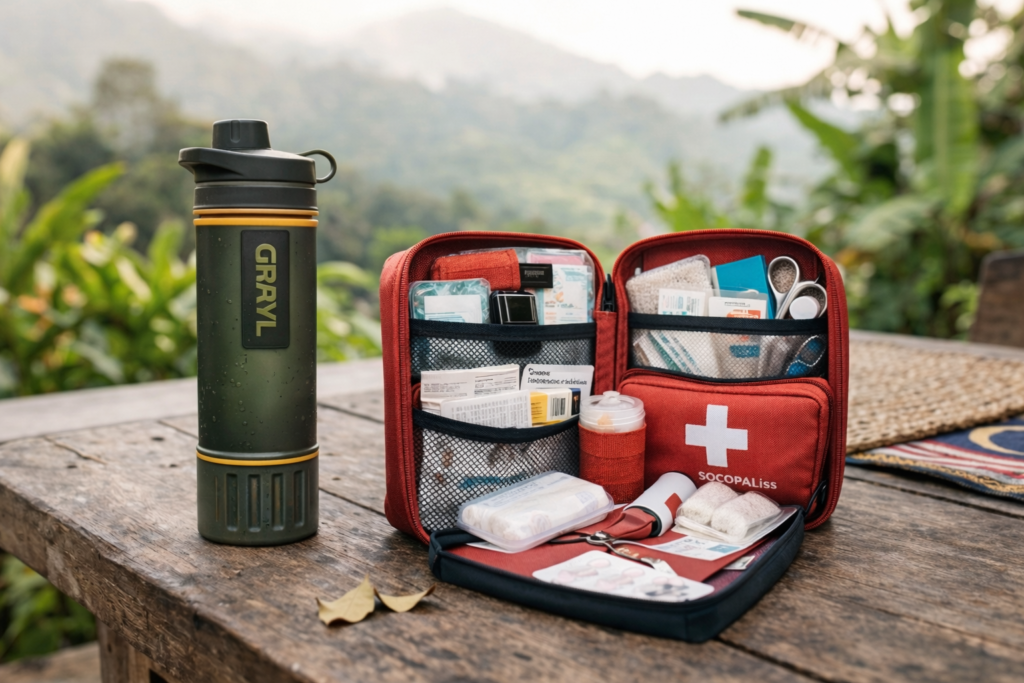
Filtered water bottle and travel first aid kit for backpacking through Vietnam and Malaysia
Toileties & Health
Buy Most of It When You Arrive
This is the category where most people dramatically overpack. Pharmacies, 7-Elevens, and convenience stores across Asia stock every major toiletry brand alongside excellent local alternatives, usually at lower prices than back home. There is no need to pack six weeks of shampoo.
Worth Packing From Home
Sunscreen (SPF 50+) — Expensive in Singapore and Japan, reasonably priced elsewhere but not always in high SPF. Pack enough for your first week; restock locally.
DEET-based insect repellent — For jungle areas and rural Thailand and Vietnam. Available locally but DEET formulas vary in strength.
Basic first aid kit — Blister plasters, antihistamine, antiseptic wipes, rehydration sachets, and paracetamol. Basic, but you’ll use all of it.
Prescription medications — Bring your full supply plus extra. Carry in original packaging with a copy of the prescription. Don’t rely on finding exact equivalents abroad.
Stomach medication — Loperamide (Imodium) and oral rehydration salts. Available locally but you’ll want them before you need them.
Earplugs — Non-negotiable for hostels. Dorm rooms at 11pm are never as quiet as you’d like.
Filtered water bottle (Grayl or Lifestraw) — Tap water is not safe to drink in Thailand, Vietnam, or Malaysia. A filter bottle pays for itself quickly and eliminates the guilt of buying single-use plastic every day for weeks.
Buy When You Arrive
Shampoo, conditioner, body wash, toothpaste, deodorant, razors, and sanitary products are all available everywhere at reasonable prices. Pharmacies in Singapore, Japan, and Malaysia are particularly well-stocked. In Vietnam and Thailand, every 7-Eleven stocks the basics.
Carry-on only tip Solid toiletries (shampoo bars, solid deodorant, solid sunscreen) are worth considering if you’re doing carry-on only — no liquid limits, no leaks, and they last longer per gram than liquid equivalents. Lush shampoo bars have a strong following among long-term backpackers
Menstrual Health
Tampons are less widely available than pads in parts of Southeast Asia, particularly rural areas and smaller towns. If you prefer tampons, pack a sufficient supply or stock up in Singapore, Japan, or major cities. Menstrual cups and discs are increasingly available in health stores in major cities. Period underwear is excellent for long travel days and transit.
Documents & Money
The Category Where Organisation Pays Off
Losing your passport in Asia is not the catastrophe it once was — every country in this guide has a competent embassy system and a process for emergency travel documents. That said, it’s still a multi-day headache you want to avoid. A simple document system prevents most of the problems.
What to Carry
| Document | Physical Copy | Digital Copy |
| Passport | Original + 2 color photocopies kept separately | Scanned PDF in Google Drive or iCloud |
| Visa confirmations | Print Vietnam e-visa — required at immigration | All visas saved as PDFs |
| Travel insurance | Policy number and emergency contact on a card in your wallet | Full policy document saved offline |
| Flight bookings | Not required but useful | In email + saved PDFs |
| Accommodation | First night’s address in the local language | Confirmation emails |
| Emergency contacts | Written on paper, separate from phone | In phone and shared with someone at home |
Managing Money Across Five Countries
Each country uses a different currency: Singapore Dollar, Japanese Yen, Thai Baht, Malaysian Ringgit, Vietnamese Dong. Managing five currencies sounds complicated; it’s not. The system that works best: a low-fee debit card (Wise or Charles Schwab in the US both reimburse ATM fees) plus a backup credit card with no foreign transaction fees.
Withdraw cash in each country on arrival from airport ATMs — they’re reliable, though fees vary. Keep small bills for street food vendors, tuk-tuks, and markets. Carry larger amounts less frequently to minimize transaction fees.
Before you leave
Tell your bank you’re traveling before you go. Fraud alerts triggered by overseas transactions can freeze your card at the worst possible moment. Most banks let you set a travel notice online or via their app in under two minutes.
The Right Bag
Choosing Your Main Bag
The bag conversation gets religious among long-term travelers. Here’s the practical breakdown:
| Bag Type | Best For | Honest Downsides |
| 40–45L backpack | Multi-country backpacking, hostel stays, overland travel | Back and shoulder strain on long transit days; less professional appearance |
| Rolling carry-on (21″) | City-focused trips, mixing hotels and hostels, business-adjacent travel | Cobblestone streets in Penang and Hoi An are brutal on wheels; can’t carry on some budget flights |
| Hybrid travel backpack | The middle ground — carries like a backpack, opens like a suitcase | More expensive; heavier than a basic backpack |
For trips that include significant island hopping, overland bus routes (Bangkok–Chiang Mai, HCMC–Hoi An), and budget airlines, a 40–45 liter backpack wins on practicality. If your trip is primarily city-based with direct flights and hotel accommodation, a rolling carry-on is perfectly functional.
The daypack rule
Bring a foldable daypack that packs into itself. You’ll use it daily for sightseeing while your main bag stays at the hostel. It also means you can check your main bag on a flight and still have everything you need for a layover.
Country-specific additions
What to Pack for Each Destination
Your standard packing list works across all five countries. These additions are for specific contexts within each destination.
| Country | Add | Why |
| Singapore | Light cardigan | Air conditioning is aggressive in malls, restaurants, and MRT. You’ll want a layer indoors even when it’s 32°C outside. |
| Japan | IC card (Suica / Pasmo) | Get one immediately on arrival — works on trains, buses, and convenience store purchases nationwide. Technically not packing, but don’t skip it. |
| Japan (spring / autumn) | Buy Heattech base layer on arrival | March–May and September–November in Tokyo and Kyoto can be genuinely cold. Buy at any Uniqlo on arrival — cheaper there, and you won’t carry warm layers through Southeast Asian heat. |
| Japan (winter) | Packable down jacket from home + Heattech on arrival | December–February requires real warmth. One lightweight packable down jacket; layer Heattech underneath. Skip the heavy wool coat. |
| Thailand (islands) | Rash guard, reef-safe sunscreen | Reef-safe sunscreen is required at some marine parks. Rash guards prevent sunburn and jellyfish issues during peak season. |
| Vietnam (north, winter) | Light down jacket | Hanoi in December is surprisingly cold by Southeast Asia standards. Your beach clothes won’t be enough. |
| Malaysia (highlands) | Light fleece | Cameron Highlands mornings are genuinely chilly. Pack one layer you wouldn’t need in KL. |
What To Leave Behind
The Honest Leave-Behind List
Every veteran solo traveler I met in Asia had a version of this list. The details vary but the categories are always the same.
| Item | Why You Don’t Need It |
| More than 4 tops | Laundry is everywhere, cheap, and fast. You are not packing for an expedition. |
| Hair dryer | Available at hostels and guesthouses. Heavy and takes up disproportionate space. |
| Physical guidebooks | Heavy, outdated the moment they’re printed, and your phone does the job better. |
| Excessive toiletries | Buy locally. The sunscreen is cheaper in Tokyo than you think. |
| Laptop (unless working remotely) | A smartphone handles 95% of travel tasks. Add a tablet if you need a larger screen. |
| Jewelry you’d be devastated to lose | Leave it at home. Buy beautiful, inexpensive pieces at markets and leave them there when you go. |
| More than two pairs of shoes | You’ll buy sandals in Bangkok within the first week anyway. |
| Full-size toiletry bottles | Decant into small containers for the first week; restock locally in full sizes if needed. |
| Heavy winter coat for Japan | Pack a lightweight packable down jacket instead. A full wool coat is dead weight across four other countries. |
The one exception I left home with clothes I’d save for nice dinners. I never once went to a nice enough dinner that my travel clothes weren’t fine — except that one rooftop bar in Singapore where I wished I’d packed the black jumpsuit.
Master Checklist
Your Complete Packing Checklist
Use this before you pack. Every item is listed without tags or qualifiers — refer to the relevant section above for context on each one.
Clothing
- 3–4 lightweight quick-dry tops
- 1 pair lightweight trousers
- 1 pair shorts or skirt
- 1–2 dresses (one dark, wrinkle-resistant for evenings)
- 1 thin cardigan or zip-up layer
- Swimwear + rash guard (if snorkeling)
- 5–7 pairs quick-dry underwear
- Merino wool socks (especially for Japan)
- Trail runners or walking shoes
- Sandals
- Slip-on flats or loafers (optional, for cities)
- Sarong or lightweight scarf (or buy on arrival in Thailand/Malaysia)
Safety Items
- Crossbody bag (main daily carry)
- Small coin purse / decoy wallet
- Padlock — combination, TSA-approved
- Money belt (for transit days)
- Document copies — passport, visa, insurance, itinerary
- Personal alarm (130dB+)
- Door wedge alarm
Tech & Navigation
- Smartphone (confirm it’s unlocked before travel)
- Power bank (20,000mAh) — carry-on only
- Universal travel adapter
- Mini power strip / “squid” (3-socket, flat plug)
- Headphones — noise-cancelling earbuds preferred
- Airalo regional eSIM (or buy local SIMs at each airport)
- Cloud photo backup enabled (Google Photos or iCloud)
- VPN installed (ExpressVPN or NordVPN)
- Google Maps offline maps downloaded per city
- Grab app installed (JapanTaxi app for Japan)
Toiletries & Health
- Sunscreen SPF 50+ (enough for first week; restock locally)
- DEET insect repellent
- Basic first aid kit — blister plasters, antihistamine, antiseptic wipes, rehydration sachets, paracetamol
- Prescription medications (full supply + extra, original packaging)
- Stomach medication — Imodium and oral rehydration salts
- Earplugs
- Filtered water bottle (Grayl GeoPress or Lifestraw)
- Menstrual supplies (tampons if preferred — less available in rural areas)
Documents & Money
- Passport (valid 6+ months beyond final departure date)
- 2 color photocopies of passport (kept separately)
- Vietnam e-visa printed — required at immigration
- Travel insurance details — policy number and emergency phone number on a card
- Low-fee debit card (Wise or Schwab for US travelers)
- Backup credit card (no foreign transaction fees)
- Bank notified of travel dates
- Emergency contacts written on paper, separate from phone
Asia is loud, vibrant, and unpredictable. Your luggage shouldn’t be.
By sticking to a carry-on and a modular wardrobe, you’re giving yourself the gift of mobility. You can buy the sarong in Bali. You can grab the Heattech in Osaka. But you can’t buy back the time you spent stressing over a heavy bag.
Go. Eat the street food. Get lost in the shrines. You’ve got this.
What’s the one thing you never travel without? Let me know in the comments below—I’m always looking to refine the master list!
