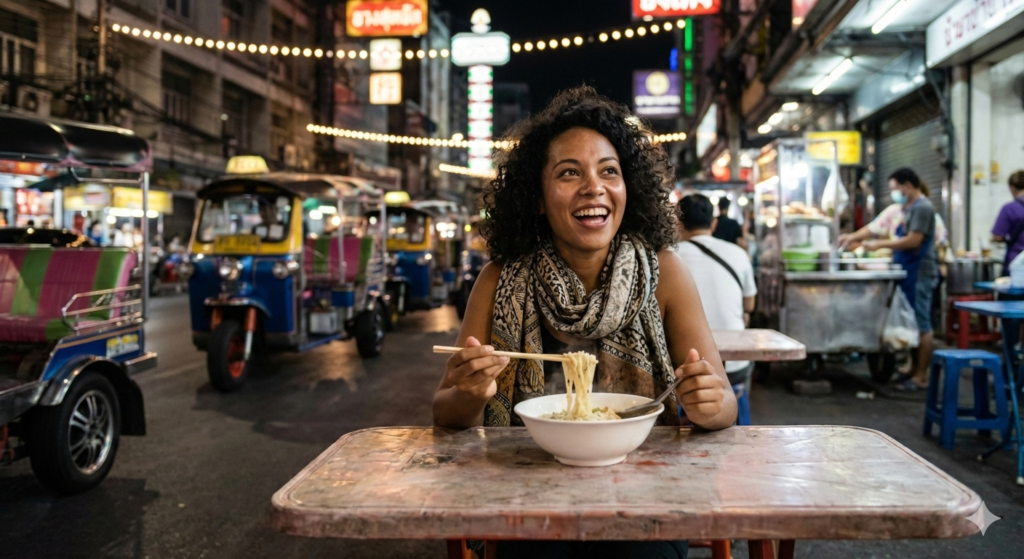

I stayed for 3 months in Thailand and tasted over 120 street food meals across Bangkok, Chiang Mai, and the islands. So, I’ve created this guide specifically for women traveling alone. Eating solo in Thailand isn’t just safe, it’s one of the best parts of the journey. But knowing how to navigate street stalls, avoid common mistakes, and stay safe makes all the difference.
This Thailand food guide will show you exactly how to eat confidently as a solo female traveler—from ordering your first pad thai to finding hidden cafés where you can linger for hours.
My First Night in Bangkok
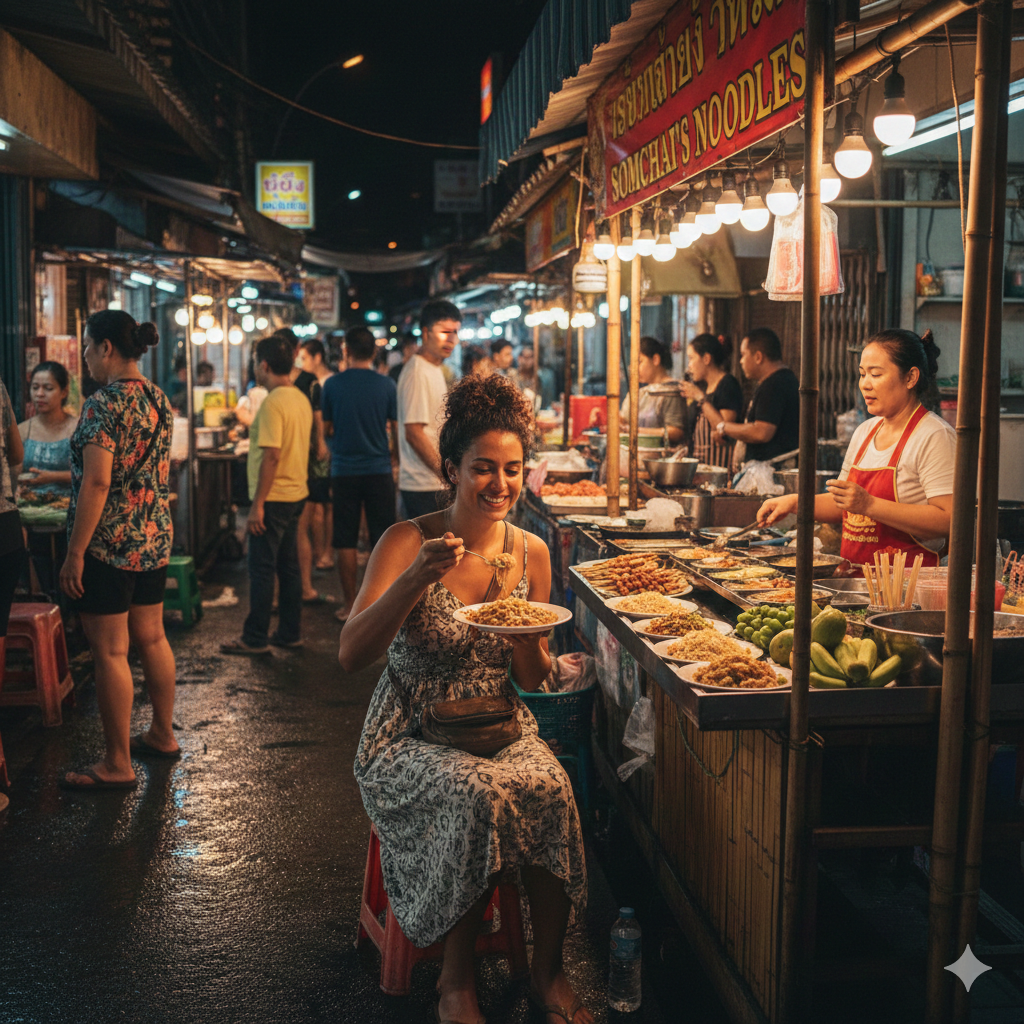
I’d just arrived in Bangkok at 10 PM, sweaty and exhausted, staring at a street stall where a woman with quick hands was frying something in a cloud of garlic and chili. Cars honked behind me, and locals ate like this was the most normal thing in the world.
I didn’t know what anything was. I didn’t know how to order. And I definitely didn’t know the spice levels.
But when the cook looked up and smiled, I pointed at a bowl someone else was eating and hoped for the best.
That first bite changed everything. The noise faded. The jet lag disappeared. All I could think was: “This is the best thing I’ve ever eaten.”
Here’s what makes eating in Thailand different as a solo female traveler: you’re doing it alone, in unfamiliar territory, where you might not speak the language, and the food is everywhere. Street stalls at midnight. Markets at dawn. Vendors calling out to you. The abundance is thrilling and overwhelming.
Your culinary journey in Thailand shouldn’t feel intimidating. It should feel safe, delicious, and entirely yours to explore.
Why Thailand’s Food Culture Is Perfect for Solo Travelers
Thailand consistently ranks as having the world’s best food on global travel surveys. But beyond the rankings, Thai food culture is uniquely welcoming to solo travelers, especially women.
What makes Thai cuisine unforgettable:
Quick, casual interactions: You order, you eat, you leave. No pressure to linger if you don’t want to. Perfect for solo travelers who want flexibility.
Communal seating is normal: Shared tables at street stalls mean you’re surrounded by others but never obligated to interact. It takes the awkwardness out of dining alone.
Fearless balance of flavors: Sweet, sour, salty, and spicy coexist in perfect harmony, creating dishes that feel bold yet comforting in the same bite.
Fresh ingredients everywhere: Herbs, chilies, lime, coconut, fish sauce—they’re not garnish, they’re essential. You can taste the difference immediately.
Regional diversity that matters: Southern food is fiery and intense, northern dishes are gentler and earthy, Isan cuisine is sharp and punchy. Traveling through Thailand means eating entirely different identities, not just variations.
World-class dining without pretension: Bangkok’s top restaurants show how refined Thai cuisine can be while still honoring tradition over trends.
Affordable beyond belief: Some of the most memorable meals cost less than a coffee back home.
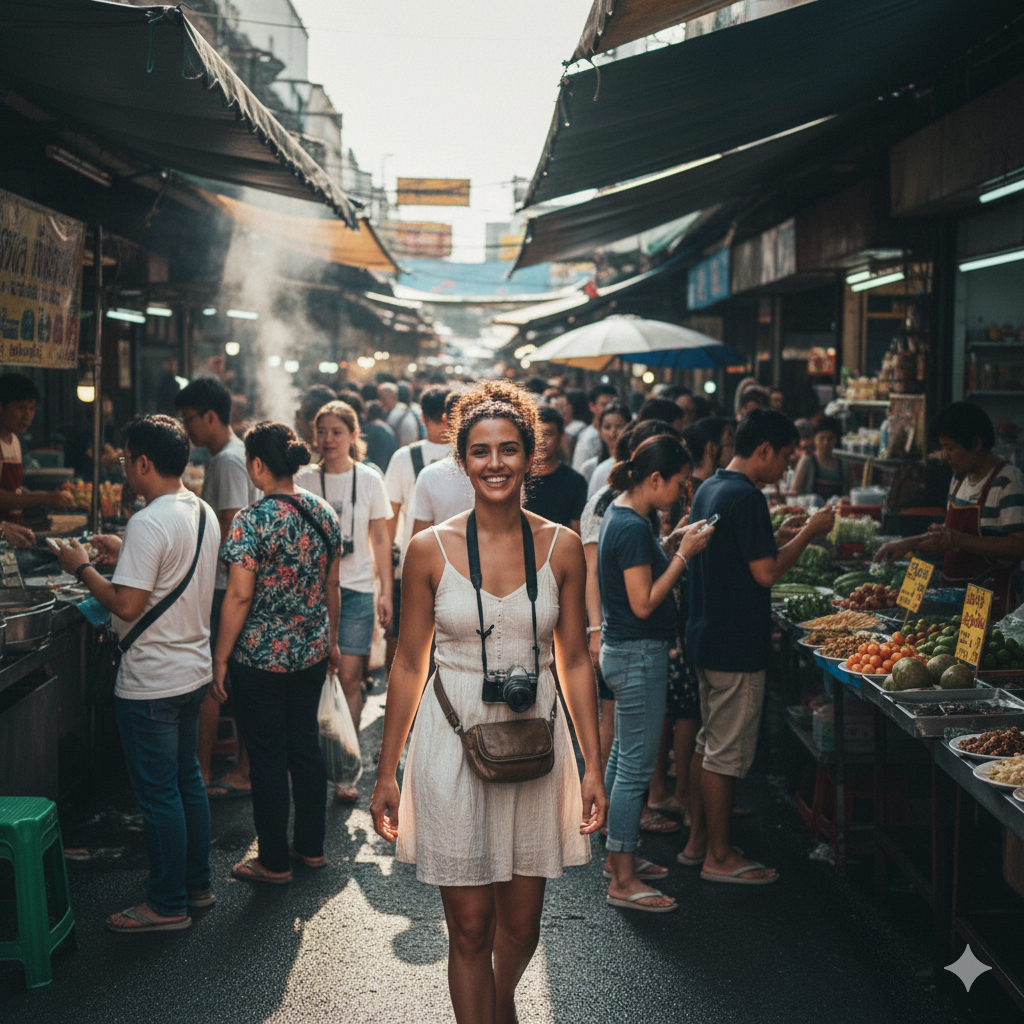
Walking confidently through a busy Thai street food market
Safety for Solo Female Travelers Eating in Thailand
According to the Global Peace Index, Thailand ranks among the top 30 safest countries for solo travel. Its food culture is particularly welcoming to women eating alone—unlike some cultures where solo female dining raises eyebrows.
Street food culture is casual, communal, and welcoming. Nobody stares when you eat alone. Vendors often treat solo diners with extra warmth.
When and Where to Eat Solo
Daytime eating is when you’ll feel most comfortable exploring new neighborhoods and unfamiliar stalls. Markets bustle with families, and the energy is open and bright.
Nighttime street food is equally safe in well-lit, busy areas:
- Night markets with crowds
- Popular tourist streets (Khao San, Yaowarat, Walking Street Chiang Mai)
- Stalls surrounded by locals
- Well-lit areas near your accommodation
Avoid:
- Empty side streets after dark
- Overly pushy vendors who follow you
- Deserted stalls in isolated areas
Safety Apps Every Solo Female Traveler Needs
Grab (Southeast Asia’s Uber): Essential for getting home safely after late-night food adventures. Rides are cheap (30-80 baht for most city trips) and tracked. Download it before you arrive.
Find My Friends/Location Sharing: Share your real-time location with a friend or family member when exploring night markets alone. Takes 30 seconds, brings peace of mind.
Google Maps: Save favorite safe stalls and create custom maps of your food finds. Works offline with downloaded maps.
GrabFood/Foodpanda: Food delivery when you’re too tired, sick, or jet-lagged to venture out.
Unwanted Attention
In over 300 street meals across Thailand, I encountered awkward interactions only a handful of times—far less than dining alone in Western cities.
If a vendor or fellow diner makes you uncomfortable: move to another stall without hesitation. You owe no one your time or politeness in exchange for safety.
Safety First: Trust your instincts. If something feels off, leave. There’s always another delicious stall around the corner.
Women-Led Food Tours
Book one on your first day to learn the ropes with other travelers in a structured, safe environment.
Recommended tour companies:
- Bangkok Food Tours – Women-led evening markets tour
- Chiang Mai Street Eats – Small group, max 6 people
- Taste of Thailand – Offers solo traveler discounts
Cost: Usually 800-1,500 baht ($25-45) for 3-4 hours including multiple food stops.
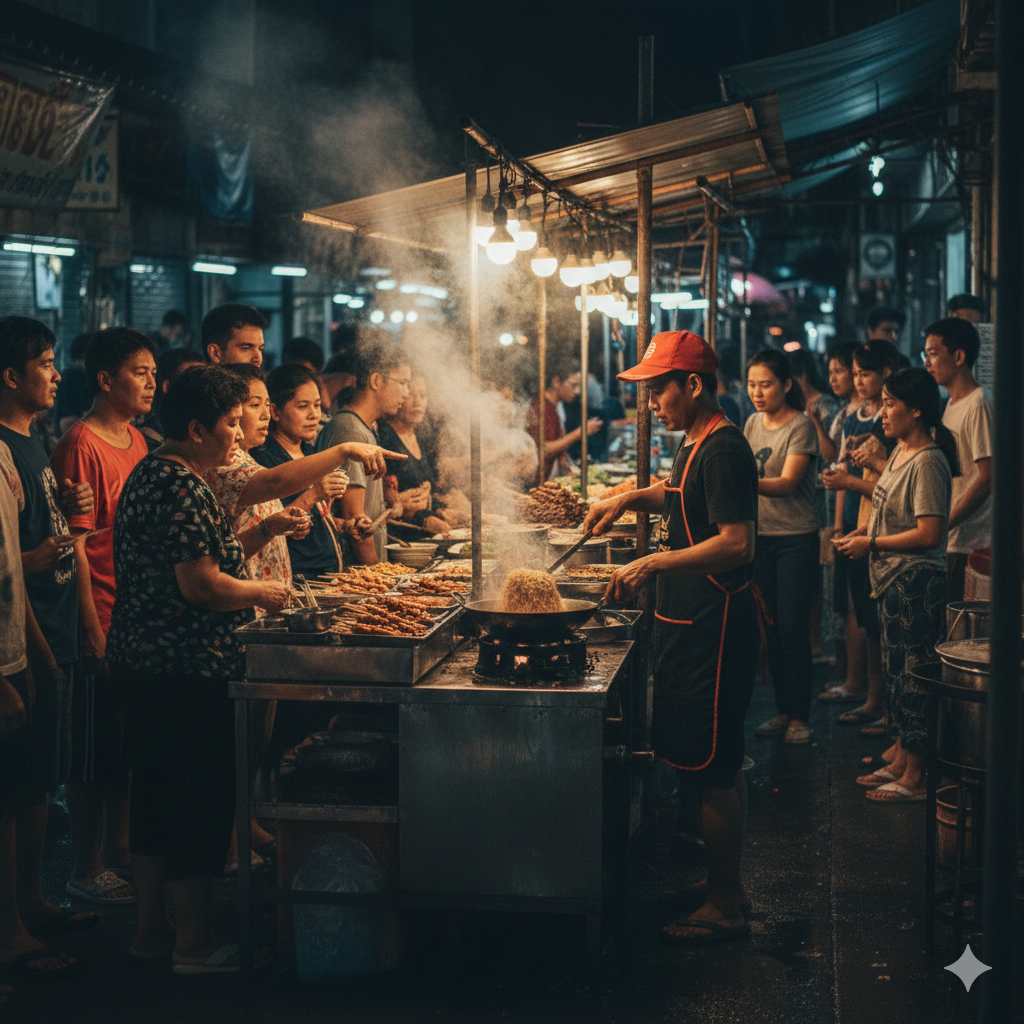
Busy Thai street food stall with fresh food being cooked in front of customers
How to Order Thai Street Food (Step-by-Step)
Street food is the soul of Thai dining, and also where solo travelers sometimes hesitate. Here’s your confidence-building playbook.
Step 1: Follow the Crowds
Pro Tip: Busy stalls mean fresh food, high turnover, and safety in numbers. If locals are queuing, join them.
Empty stalls at peak times (lunch 11 AM-1 PM, dinner 6-8 PM) are a red flag.
Step 2: Watch the Cooking Process
You can tell a lot by watching:
- Are ingredients covered?
- Does the cook use one set of utensils per dish?
- Is raw meat separated from cooked food?
- Do they make things fresh in front of you?
Thai cooking is fast—a good sign the food hasn’t been sitting out long.
Step 3: Use the Pointing Method
Don’t overthink it. Pointing at what others are eating works everywhere and isn’t considered rude in food contexts. Vendors expect it from tourists.
Pro move: Point to a dish, then show fingers for quantity (one finger = one plate). Hold up your phone with Google Translate if needed.
Step 4: Start Conservative, Then Experiment
Begin with recognizable dishes:
- Noodle soups (Pad Thai, boat noodles)
- Fried rice (Khao Pad)
- Grilled meats (Gai Yang, Moo Ping)
Once confident, branch out to:
- Som Tam (papaya salad)
- Massaman curry
- Pad See Ew (stir-fried noodles)
- Khao Soi (northern curry noodles)
Step 5: Master the Payment
Cash is king: Most street stalls only accept cash. Keep small bills (20, 50, 100 baht notes) for easy transactions.
Break large bills at: 7-Eleven, mall food courts, or sit-down restaurants before hitting street stalls.
Larger restaurants: Take cards and mobile payments like PromptPay.
Budget Guide for Solo Travelers
| Meal Type | Price Range | Example |
|---|---|---|
| Street food meal | 40-80 baht ($1.20-$2.40) | Pad Thai, Som Tam, fried rice |
| Casual restaurant | 150-300 baht ($4.50-$9) | Noodle shop, local restaurant |
| Mid-range dining | 400-800 baht ($12-$24) | Air-con restaurant, tourist area |
| Fine dining | 1,500+ baht ($45+) | Michelin-rated, rooftop bars |
Essential Thai Food Phrases to Learn
Learn these once, and they’ll get you smiles everywhere. Download Google Translate and save the Thai language pack offline before your trip.
| Phrase | Pronunciation | Meaning | When to Use |
|---|---|---|---|
| Mai phet | my pet | Not spicy | ALWAYS say this first as a beginner |
| Phet nit noy | pet nit noy | A little spicy | When you’re ready to level up |
| Phet mak | pet mahk | Very spicy | For experienced chili-lovers only |
| Aroy mak | ah-roy mahk | Very delicious | After your first bite—vendors love this |
| Khop khun ka | kop koon kah | Thank you (female) | Always, with a smile |
| Khai dao | kai dao | Fried egg | Add to anything for extra protein |
| Mai sai nam pla | my sai nahm plah | No fish sauce | For vegetarians/vegans |
| Mai sai khai | my sai kai | No egg | For vegans |
| Gin jay | gin jay | I eat vegetarian/vegan | Your magic phrase for plant-based eating |
| Mai ao phet | my ao pet | I don’t want spicy | Stronger than “mai phet” |
| Tao rai? | tao rai | How much? | Always ask before ordering at markets |
| Kin tee nee | kin tee nee | Eat here | Specify or they’ll bag it to go |
| Gup baan | gup baan | To go/takeaway | When you want to eat elsewhere |
Pro tip: Use Google Translate’s camera feature to scan menus. It works offline if you’ve downloaded the Thai language pack.
Thai Food Myths vs. Reality
| Myth | Reality |
|---|---|
| “Street food will make you sick” | Thai street stalls have high turnover and fresh cooking. I got sick once in 18 months—from a hotel buffet, not street food. |
| “Thai food is always spicy” | Many dishes are mild or customizable. Khao Soi, Massaman curry, and Pad See Ew are beginner-friendly. |
| “You can’t eat vegetarian in Thailand” | Thailand has Buddhist roots—vegetarian food (jay) is everywhere. Just learn “gin jay” and “mai sai nam pla.” |
| “Eating alone as a woman is awkward” | Thai food culture is built on quick, casual interactions. Solo diners are completely normal. |
| “Ice isn’t safe” | Factory-made ice (with a hole in the middle) is safe. It’s purified water. Avoid crushed ice from unknown sources. |
| “You need to tip at street stalls” | Tipping isn’t expected. Round up if you want, but locals don’t tip at street stalls. |
| “Thai food is cheap everywhere” | Street food, yes. Tourist-area restaurants charge Western prices. Know the difference. |
| “Pad Thai is the best Thai dish” | Pad Thai is good but often catered to tourists. Branch out to regional specialties for the real magic. |
Best Thai Dishes by Region: Where to Eat What
Different regions offer completely different flavors. If you eat the same dishes everywhere, you’ll miss half the magic.
| Region | Signature Dishes | Flavor Profile | Best For Solo Travelers | Must-Try Street Stall |
|---|---|---|---|---|
| Northern (Chiang Mai, Pai) | Khao soi, sai ua, nam prik ong, sticky rice | Comforting, herbaceous, mild heat | Walking streets perfect for solo grazing; café culture for lingering | Khao Soi at Samoe Jai (Chiang Mai) |
| Bangkok | Pad kra pao, boat noodles, tom yum, kanom jeen | Intense, fast, innovative, punchy | Night markets busy and safe; easy to blend in; endless variety | Boat noodles at Victory Monument |
| Southern (Krabi, Phuket, Islands) | Massaman curry, green curry, grilled seafood, roti | Spicy, zesty, bold, coconut-rich | Beach stalls welcoming; easy to strike up conversations with travelers | Grilled seafood at Ao Nang Night Market |
| Northeast (Isan) | Som tam, larb, gai yang, sticky rice | Sharp, sour, spicy, fermented | Market culture strong; locals extremely friendly to solo travelers | Som Tam stalls at Nong Khai Walking Street |
Northern Thailand: Chiang Mai and Pai
Northern cuisine is comforting, fragrant, and layered. Perfect for evenings after temple visits or long scooter rides.
Chiang Mai is the khao soi capital. This coconut curry noodle soup comes with crispy noodles on top and soft wheat noodles below. Each bowl tastes slightly different depending on the family recipe.
Where to eat:
- Samoe Jai Khao Soi – Local favorite, 40 baht per bowl, casual plastic chairs
- Khao Soi Lamduan Fa Ham – Richer version, popular with expats
- SP Chicken – Best rotisserie chicken with sticky rice
Other Northern must-eats:
- Sai ua: Northern herbal sausage with lemongrass and galangal
- Nam prik ong: Tomato and minced pork chili dip (not too spicy)
- Sticky rice with grilled meats: Eat with your hands
- Rotee: Crispy, buttery Thai-style crepe at night markets
Chiang Mai Café Culture
Chiang Mai is where you sit down for “just a coffee” and somehow end up journaling for two hours. Perfect for solo travelers who need quiet time.
Best cafés for solo work/lingering:
- Graph Café (near Nimman) – Minimalist design, excellent espresso, fast WiFi
- Ristr8to Lab (multiple locations) – Famous for latte art, Thai iced coffee
- The Hideout (Soi 1) – Incredible breakfast bowls, quiet garden atmosphere
- Rustic & Blue – Farmhouse vibe, all-day breakfast, homemade cakes
Pai is a slow, hippie, dreamy town. Walking Street offers smoky barbecue skewers, banana pancakes, and big bowls of noodles eaten on low stools. The town is social and relaxed—you’ll make friends while eating alone.
Bangkok: Culinary Chaos in the Best Way
Bangkok’s food scene is intense, fast-paced, and innovative. It’s where traditional street food meets Michelin stars.
Must-try dishes:
- Pad kra pao: Holy basil stir-fry with minced meat and runny fried egg
- Boat noodles: Small, flavor-packed bowls (order 3-4 at once)
- Tom yum goong: Shrimp soup with lemongrass, chili, and lime
- Kanom jeen: Fresh rice noodles with various curries
- Mango sticky rice: Sweet, creamy comfort (best March-June)
Where to eat solo in Bangkok:
- Yaowarat Road (Chinatown): Peak hours 6-10 PM; crowded but safest when busy; try T&K Seafood or Nai Ek Roll Noodles
- Victory Monument boat noodle alley: Daytime only; order multiple small bowls; locals will help you navigate
- Chatuchak Weekend Market: Saturday-Sunday 9 AM-6 PM; arrive early for best selection and smaller crowds
- Soi 38 Sukhumvit: Late-night (9 PM-2 AM); well-lit tourist street; perfect for jet lag meals; now relocated to Thonglor Soi 38
Solo dining tip: Bangkok’s night markets are perfect for “grazing”—walk around with a skewer here, a dumpling there. Movement keeps things dynamic and you never feel conspicuous eating alone.
Southern Thailand: Krabi, Phuket, and the Islands
The south is spicy, sour, bold, and doesn’t shy away from heat. Expect coconut-rich curries and fresh seafood everywhere.
Andaman Coast highlights:
- Massaman curry: Mild, comforting, with potatoes and peanuts
- Green curry: Fragrant coconut base with Thai basil (spicier than red)
- Grilled seafood: Fresh catches cooked over charcoal
- Roti: Sweet or savory flatbread (Muslim influence in the south)
In Krabi, my evening ritual was: fresh coconut (20 baht) + grilled seafood (200-300 baht) + waves in the background at Ao Nang beach stalls.
Island food culture:
- Smoothies and fruit shakes (40-80 baht)
- Beach barbecues
- Simple rice dishes
- Lots of fresh seafood
Koh Tao excels at brunch cafés. Koh Phangan has vegan options everywhere (yoga retreat culture). Koh Samui offers beachfront restaurants where you eat with your toes in the sand.
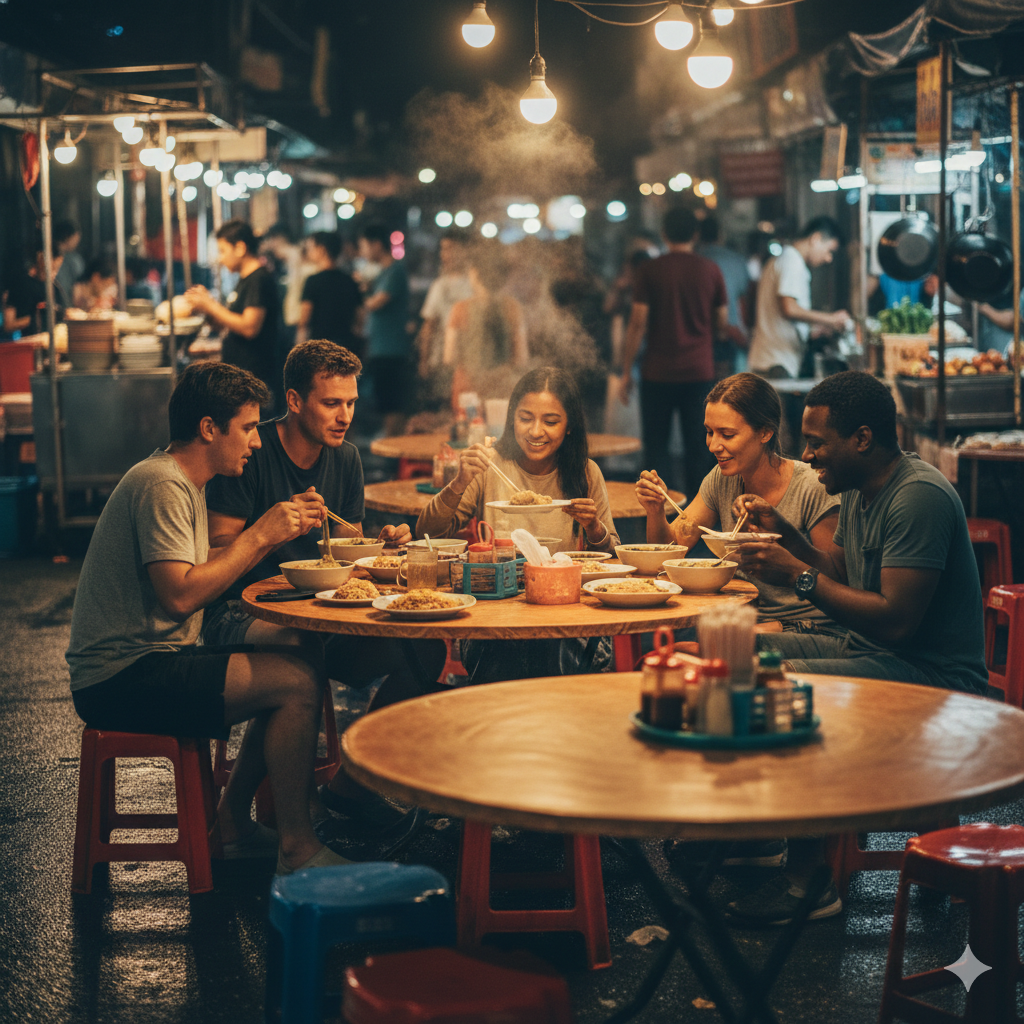
Communal street food seating in Thailand
Street Food Safety Without Paranoia
Let’s be practical: you can get sick anywhere in the world. But Thailand doesn’t deserve the fear it gets.
After 18 months and 300+ street meals, I got food poisoning once—from a hotel buffet, not street food.
How I Stay Safe
Eat at busy stalls: High turnover = fresh food. If locals are queuing, the food is good and safe.
Choose cooked, hot foods: Heat kills bacteria. Avoid lukewarm dishes that should be hot.
Ice is generally safe: Factory-made ice (with a hole in the middle) is purified. It’s the same ice used in hospitals.
Watch food being prepared: Fresh cooking in front of you is your best guarantee.
Stick to bottled or filtered water: For drinking and brushing teeth.
What I Avoid
- Empty stalls at peak hours (why is no one eating there?)
- Pre-cut fruit sitting out for hours in hot sun
- Lukewarm dishes that should be served hot
- Tap water for drinking (cooking with it is fine)
- Buffets that sit out for hours
If You Do Get Sick
Thai pharmacies are excellent and don’t require prescriptions for most medications. Pharmacists often speak basic English.
Common over-the-counter medications:
- Imodium (loperamide) for diarrhea
- Sponsor electrolyte powders – mix with water
- Activated charcoal for food poisoning
- Antihistamines for allergic reactions
Ask for: “Ya tawng sia” (diarrhea medicine)
Where to go: Boots, Fascino, or Watsons pharmacies in tourist areas
When to see a doctor: If symptoms last more than 48 hours, you have a high fever, or see blood. Bangkok Hospital and Bumrungrad have English-speaking doctors.
Must-Try Thai Dishes (The Essential 12)
| Dish | Description | Spice Level | Where to Find It | Order Tip | Price Range |
|---|---|---|---|---|---|
| Khao soi | Coconut curry noodles with crispy topping | Mild to medium | Northern Thailand | Ask for “khao soi gai” (chicken) for milder version | 40-60 baht |
| Pad kra pao moo | Holy basil stir-fry with pork and fried egg | Medium to spicy | Everywhere | Say “khai dao krueng” (runny fried egg) | 50-70 baht |
| Massaman curry | Mild peanut curry with potatoes | Mild | Southern Thailand | Perfect for spice-averse travelers | 80-120 baht |
| Som tam | Green papaya salad | Spicy | Everywhere | Say “mai sai kung haeng” (no dried shrimp) if you want milder | 40-60 baht |
| Gai yang | Grilled chicken with sticky rice | Mild | Northern/Northeast | Perfect safe starter dish, eaten with hands | 60-100 baht |
| Tom yum goong | Hot and sour shrimp soup | Medium to spicy | Everywhere | Can request “mai phet” for mild version | 80-150 baht |
| Boat noodles | Rich, flavorful small bowls | Mild to medium | Bangkok | Order 2-3 bowls minimum (they’re tiny) | 15-20 baht/bowl |
| Mango sticky rice | Sweet coconut rice with ripe mango | None | Everywhere | Best March-June (mango season) | 60-100 baht |
| Spring rolls | Fresh rice paper rolls with herbs | None | Everywhere | Ask for peanut sauce on the side | 40-80 baht |
| Kai jeow | Fluffy Thai omelette | Mild | Everywhere | Great with rice, any time of day | 40-60 baht |
| Moo ping | Sweet grilled pork skewers | Mild | Street stalls nationwide | Perfect breakfast with sticky rice | 10-15 baht/stick |
| Rotee | Crispy crepe with fillings | None | Night markets | Try banana-chocolate or egg-condensed milk | 30-50 baht |
Eating Vegan, Vegetarian & Halal in Thailand
Thailand accommodates dietary restrictions better than you’d expect once you know the right phrases.
For Vegetarians and Vegans
Your magic phrase: “Gin jay” (I eat vegetarian/vegan)
This gets you food without meat, fish sauce, eggs, or animal stock. Thailand has Buddhist roots—vegetarian food is everywhere, especially during vegetarian festivals.
Additional phrases:
- Mai sai nam pla – No fish sauce (critical—many “vegetarian” dishes contain fish sauce)
- Mai sai khai – No egg
- Mai sai nam man hoy – No oyster sauce
Naturally vegan dishes:
- Coconut milk curries (confirm no fish sauce or shrimp paste)
- Fresh spring rolls
- Mango sticky rice
- Pad pak (stir-fried vegetables)
- Fried rice without egg
- Papaya salad without fish sauce or dried shrimp
Best Cities for Vegan Food
- Chiang Mai – Highest concentration of veg restaurants; check out Goodsouls Kitchen, Khun Churn, May Kaidee
- Bangkok – Ari and Thonglor neighborhoods have modern vegan cafés; Veganerie, Broccoli Revolution
- Koh Phangan – Yoga retreat culture means vegan-friendly everywhere; especially around Haad Rin and Sri Thanu
Apps That Help
- HappyCow – Global database of vegan/vegetarian restaurants
- Abillion – Newer app with more Thailand listings and reviews
- Bangkok Vegan Guide – Blog with regularly updated listings
Hidden Pitfalls
Curry pastes often contain shrimp paste. Always ask “mai sai gapi” (no shrimp paste).
Noodle soups usually have animal-based broth. Specify “nam sup jay” (vegetarian broth).
Som tam traditionally includes fish sauce and dried shrimp. Order “som tam jay” or “mai sai kung haeng, mai sai nam pla.”
For Halal Eaters
Muslim communities thrive in southern Thailand (Phuket, Krabi, Pattani). Halal food is easy to find.
Look for:
- Signs saying “อาหารฮาลาล” (halal food)
- Halal certification symbol (crescent moon)
- Green signs or flags indicating Muslim-owned businesses
Where to find halal food:
- Southern Thailand (highest Muslim population)
- Bangkok’s Sukhumvit area (many Middle Eastern restaurants)
- Most 7-Elevens stock halal instant noodles and snacks
- Street stalls near mosques
Popular halal dishes:
- Roti (Muslim-style flatbread)
- Chicken or beef satay
- Biryani
- Grilled seafood (always halal)
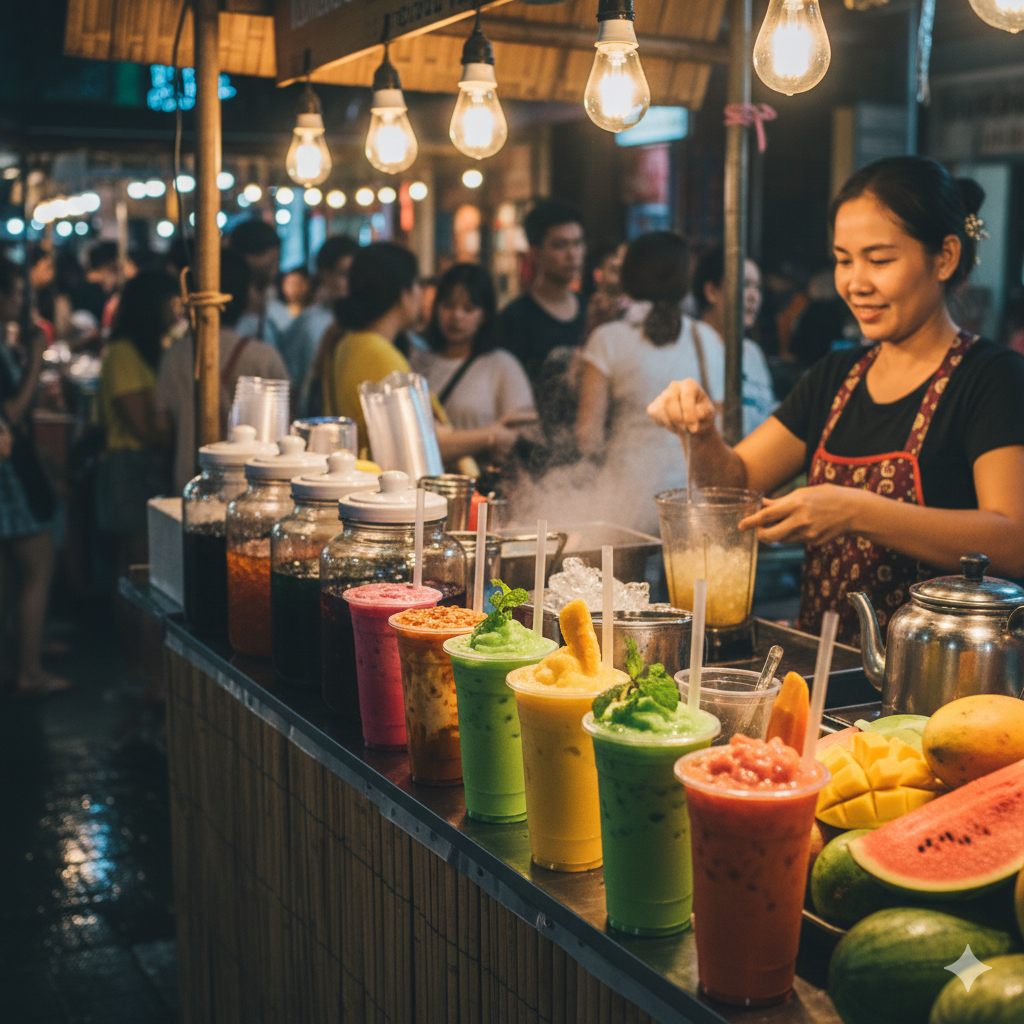
Best Thai Drinks to Stay Hydrated and Cool
Thailand’s heat and humidity mean you need 3-4 liters of water daily. Signs of dehydration: headache, dark urine, fatigue (easily mistaken for jet lag).
Hydration Essentials
Water safety: Stick to sealed bottles for drinking and brushing teeth. Most accommodations provide free drinking water. 7-Eleven sells 1.5L bottles for 10-15 baht.
Don’t panic about ice: Factory-made ice (with a hole in the middle) is purified water. It’s the same ice used in hospitals. Avoid crushed ice from unknown sources.
Must-Try Thai Beverages
Non-Alcoholic:
- Thai iced tea (cha yen): Sweet, creamy, orange, addictive – 20-30 baht
- Thai iced coffee (cha dum yen): Strong and sugary – 20-30 baht
- Fresh coconut water (nam maprow): Hydration straight from the source – 20-40 baht
- Sugarcane juice (nam oy): Refreshing and naturally sweet – 20 baht
- Watermelon shake (nam dtaeng mo pan): Blended fresh fruit perfection – 30-40 baht
- Lime soda (nam manao soda): Tangy and cooling, adjustable sweetness – 20 baht
- Chrysanthemum tea: Floral and soothing – 15-20 baht
Alcoholic Options
Local beers:
- Chang – Strong (6.4%), cheap, most popular
- Singha – Smoother, slightly more expensive
- Leo – Light, easy drinking
Price: 7-Eleven sells beer for 40-50 baht. Bars charge 80-150 baht.
AVOID BUCKET DRINKS
Bucket drinks (found on islands and Khao San Road) are often mixed with cheap, unregulated alcohol. There have been serious poisoning incidents, especially on Koh Phi Phi and Koh Tao.
Stick to:
- Bottled beer
- Cocktails from reputable bars
- Wine or spirits you can see being poured
Solo Female Drinking Safety
Safe drinking alone:
- Night markets during peak hours (crowded, well-lit)
- Rooftop bars in major hotels
- Beach bars in tourist areas (stay in populated zones)
Red flags:
- Overly friendly strangers offering free drinks
- Bars that are nearly empty
- Anyone pressuring you to drink more
- Drinks left unattended
Use Grab to get home safely. Rides are cheap (30-80 baht for most city trips) and tracked. Never accept motorcycle taxi rides after drinking.
How to Eat Alone in Thailand Without Feeling Awkward
Thailand is the easiest place in the world to eat alone. After 18 months of solo dining across the country, here’s what I learned.
Why Solo Dining Works in Thailand
No one stares. Thai culture doesn’t stigmatize eating alone. Locals do it all the time, especially at street stalls during work lunch breaks.
Quick, casual interactions: Street food culture is built on fast service. You order, eat, leave. No pressure to linger.
Communal seating is standard: Shared tables mean you’re surrounded by others but never obligated to interact.
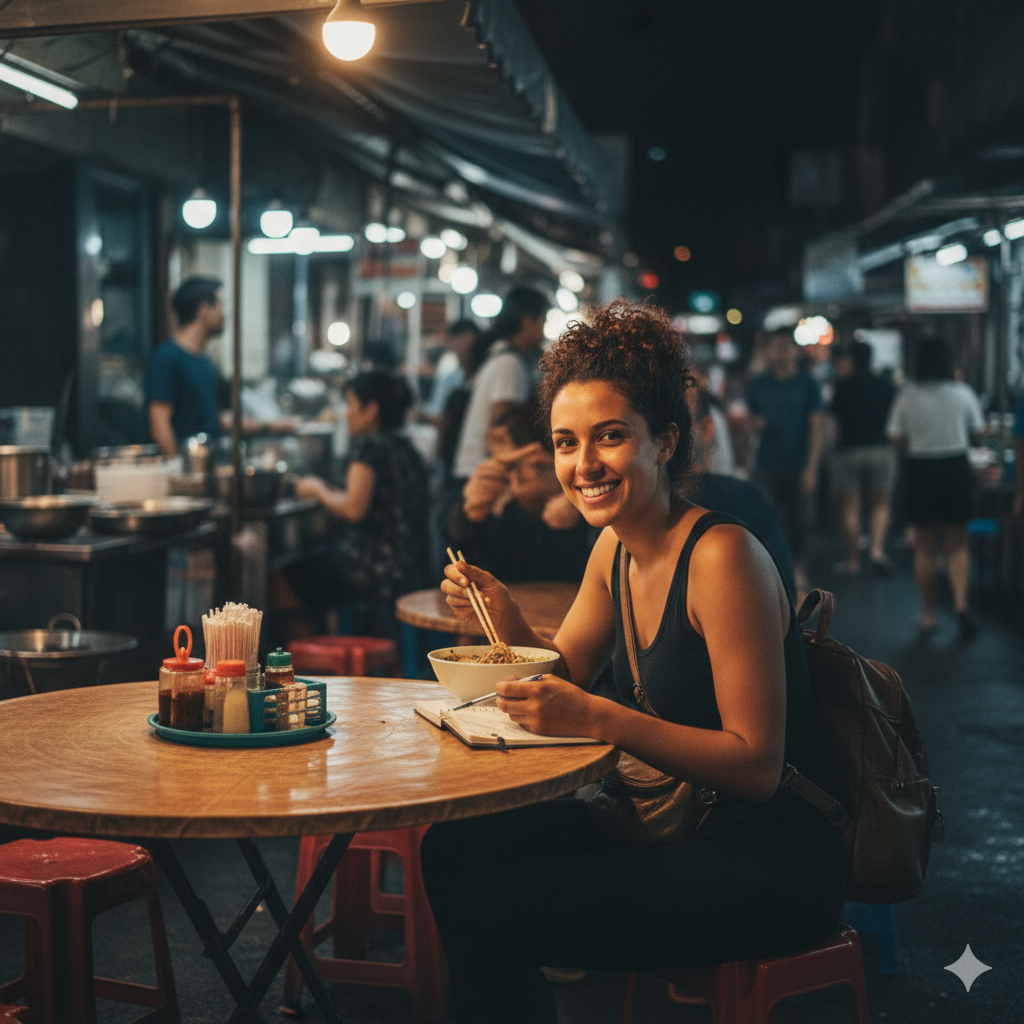
Eating alone at a Thai street food stall comfortably
My Solo Dining Strategies
1. Embrace Communal Tables
Shared seating at street stalls and food courts takes all pressure off solo dining. You’re surrounded by life and energy without the awkwardness of a table-for-one.
2. Make Night Markets Your Playground
Walk, nibble, try a skewer here, a dumpling there. Movement keeps things dynamic. You’re not “eating alone”—you’re exploring.
Best night markets for solo travelers:
- Chiang Mai Sunday Walking Street – Massive, safe, endless food
- Bangkok Rod Fai Night Market – Vintage vibes, great food, younger crowd
- Phuket Weekend Market – Local vibe, less touristy
3. Master the Art of People-Watching
Eating alone isn’t lonely—it’s an opportunity. Sit at a street stall with a clear view, order your food, and watch Thai life unfold. It’s meditative and fascinating.
4. Use Cafés as Your Office/Living Room
Chiang Mai cafés don’t rush you. Order one coffee and stay for three hours with a book or laptop. Nobody minds.
Best for solo lingering:
- Graph Café (Chiang Mai)
- Porcupine Café (Bangkok)
- The Larder (Phuket)
5. Bring Something to Do
Transform “eating alone” into intentional me-time:
- Journal about your day
- Edit photos
- Listen to podcasts
- Read a book
- Plan tomorrow’s adventures
6. Join Group Activities with Built-In Meals
- Hostel group dinners – Many hostels organize nightly outings
- Cooking classes – Learn to make Thai food, then eat it together
- Food tours – Meet other solo travelers while eating
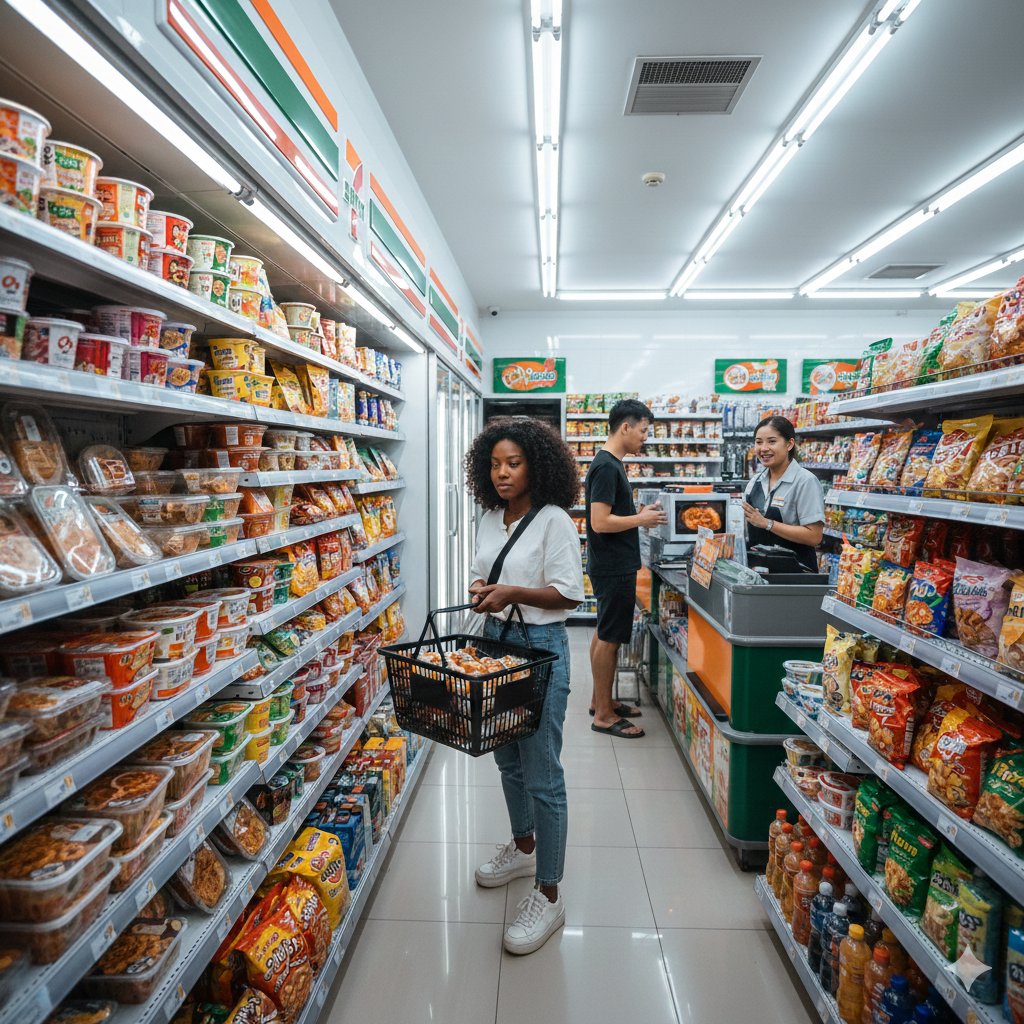
Inside a Thailand 7-Eleven showing food options for solo travelers
7-Eleven Survival for Solo Travelers
Thailand’s 7-Elevens deserve recognition. They’re clean, air-conditioned, open 24/7, and every 200 meters in cities. I relied on them constantly.
What 7-Eleven Is Good For
Hot food:
- Ham and cheese toasties – Toasted fresh, surprisingly good (25 baht)
- CP Brand dumplings – Microwaved but satisfying (35 baht)
- Steamed buns – Pork or red bean filling (15 baht)
- Instant noodles – Mama brand is Thailand’s favorite (10-15 baht)
Cold drinks:
- Cold brew coffee (20 baht)
- Thai milk tea (15 baht)
- Fresh coconut water (25 baht)
- Electrolyte drinks when sick (15 baht)
Solo traveler essentials:
- Bottled water (10-15 baht for 1.5L)
- Basic medications (pain relievers, antihistamines)
- Toiletries (forgot your toothbrush? They’ve got you)
- Snacks for long bus rides
- SIM card top-ups
- Small bills to break large notes
When to use 7-Eleven:
- First night jet lag – too tired for street food
- Recovering from food poisoning
- Late-night cravings (3 AM pad kra pao doesn’t exist, but 7-Eleven does)
- Breaking 1,000 baht notes before hitting street stalls
- Grabbing breakfast before an early bus
Pro tip: Download the 7-Eleven Thailand app. Promotions and deals for regular items
Thai Food Etiquette & Cultural Basics
How to Eat Properly
Spoon and fork method: Use your spoon as the primary utensil (held in right hand) and your fork to push food onto it (held in left hand). Fork rarely goes in your mouth.
Chopsticks: Only for noodle soups and Chinese-Thai dishes. Don’t use them for rice dishes.
Sticky rice: Eat with your hands in northern Thailand. Roll a small ball, dip in sauce, eat.
Sharing is normal: Thai meals are traditionally family-style with multiple dishes shared. Solo diners can order individual plates—totally acceptable.
Cultural Do’s and Don’ts
DO:
- Wait for the eldest to start eating (in formal settings)
- Try a bit of everything if dining family-style
- Compliment the food (“aroy mak!”)
- Eat at a relaxed pace
- Use serving spoons for shared dishes
DON’T:
- Stick chopsticks upright in rice (funeral symbolism)
- Point your feet at people or Buddha images
- Touch anyone’s head (even children)
- Raise your voice or show anger at vendors
- Take your shoes into someone’s home without being told it’s okay
Tipping Culture
Street stalls: No tipping expected. Locals don’t tip.
Casual restaurants: Round up the bill or leave 20-40 baht.
Mid-range/fine dining: 10% is appreciated but not mandatory.
Food delivery: Round up or add 20 baht.
When in doubt: If there’s no service charge on the bill, leaving a small tip is kind but not required.
Common Mistakes Solo Travelers Make
Ordering “medium spicy” as a beginner: Thai spice levels are no joke. Start with “mai phet” and work your way up over days, not at your first meal.
Skipping sticky rice in the north: It’s not a side dish—it’s the foundation. Northern cuisine revolves around sticky rice.
Assuming all curries taste the same: Green is spiciest, red is medium, Massaman is mildest, Panang is rich and mild. Know before you order.
Not bringing small bills: Vendors rarely have change for 1,000 baht. Break bills at 7-Eleven.
Forgetting to specify “eat here” or “to go”: If you don’t say “kin tee nee” (eat here), they’ll bag everything.
Being afraid to point: Pointing at food is normal. Vendors expect it.
Only eating at night markets: Morning markets offer incredible breakfast foods—jok (rice porridge), patongko (Thai donuts), sai krok Isan (fermented sausage).
Your Journey Starts with Food
You may forget temple names. You might blur one island into another. But you never forget the food.
Food in Thailand isn’t background—it is the experience.
It’s the crunchy sound of morning fried chicken in Chiang Mai. The steam from tom yum blowing into your face on a humid Bangkok night. Mango sticky rice eaten with strangers who become friends. Bargaining for fruit you can’t pronounce, and laughing with the vendor when you get it wrong.
Most importantly? Food is the easiest way to connect, even when you don’t speak Thai. Smile, point, say “aroy mak” when it’s good, and watch the magic happen.
Long after you’ve left Thailand, you’ll crave the feeling of sitting at a plastic table with steam rising from your bowl, surrounded by people who don’t speak your language—but somehow, you feel perfectly at home.
Now go eat fearlessly.
Before You Go: Download & Save
Print or screenshot these essentials:
- Thai food phrases table
- Emergency contact: Tourist Police 1155
- Grab app downloaded and set up
- Google Translate with Thai language pack (offline)
- Find My Friends location sharing activated
- Travel insurance details
- Nearest hospital to your accommodation
Join the conversation: What’s your biggest fear about eating alone in Thailand? Drop a comment—I respond to every question about specific cities, dishes, or dietary needs.
Pin this guide. You’ll want it at 2 AM when you’re jet-lagged, starving, standing in front of a noodle stall with your phone at 5%.
Safe travels, and may your bowl always be full.
FAQ Schema
Q: Is street food in Thailand safe for solo female travelers?
A: Yes. Thailand’s street food is generally very safe, with high turnover ensuring fresh food. Follow busy stalls, watch the cooking process, and trust your instincts. In 18 months and 300+ meals, I got sick once—from a hotel buffet, not street food.
Q: How much does food cost in Thailand?
A: Street food meals cost 40-80 baht ($1.20-$2.40). Casual restaurants are 150-300 baht ($4.50-$9). You can eat well for $10-15 per day.
Q: What Thai phrase should I learn first?
A: “Mai phet” (not spicy) and “Aroy mak” (very delicious). These two will get you through 90% of meals.
Q: Can I eat vegetarian/vegan in Thailand?
A: Absolutely. Say “gin jay” for vegetarian/vegan food. Thailand has Buddhist roots, so plant-based options are widespread, especially in Chiang Mai and Bangkok.
Q: Is it safe for solo women to eat at night markets?
A: Yes, especially in well-lit, busy markets. Stick to crowded areas, share your location with a friend, and use Grab to get home safely. Avoid empty side streets.
Q: What should I avoid eating in Thailand?
A: Avoid lukewarm dishes that should be hot, pre-cut fruit sitting in the sun for hours, and empty stalls during peak times. Tap water is for cooking only, not drinking.
Last Updated: January 26, 2026